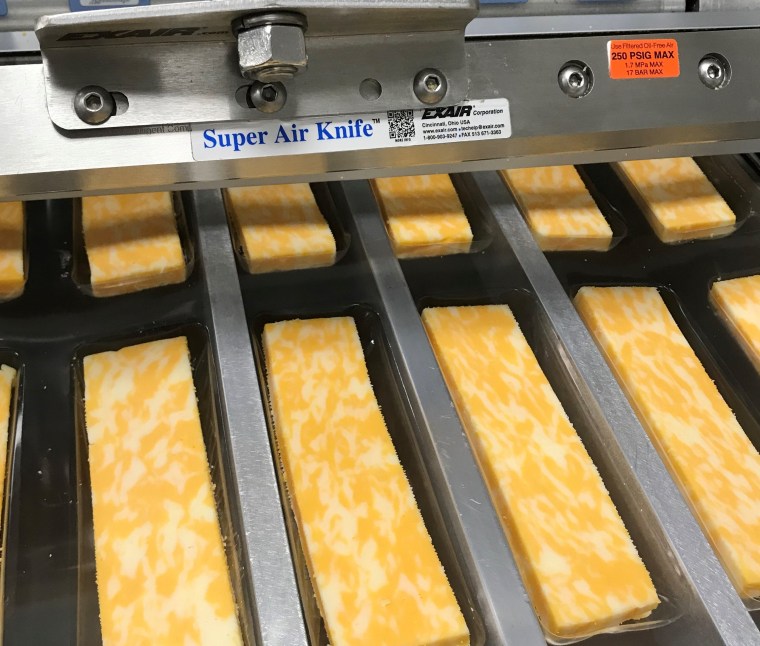
I was recently contacted by a manufacturer of specialty food products that was looking to increase productivity on one of their packaging lines. In order to do so, they needed a longer Super Air Knife.
Model 110012SS-316 Super Air Knife
They manufacture a variety of different products, but this application involved small snack-sized blocks of cheese. They’re placed into individual plastic containers, and before they seal the packaging any residual particles must be blown off, or affect the seal. Any residual particles of cheese around the container would allow air to come into contact with the product and affect shelf-life.
In the current setup, the customer is using EXAIR’s Model 110012SS-316 a 12” 316 grade Stainless Steel Super Air Knife, and the Model 9060 Universal Mounting System. They wanted to add in an additional two rows of cheese to help increase throughput. To do so, he needed an overall width of 18”. We do have an 18” available from stock, but rather than having a spare 12” model lying around, he wanted to try and utilize what he had without having to purchase an entirely new knife.
Model 9060 Universal Mounting System
Fortunately, EXAIR’s Super Air Knives can be coupled together to create a wide variety of different lengths. From stock, the Super Air Knife is available from 3”-108”. With the help of a Super Air Knife Coupling kit, we can achieve much longer lengths. In this case, although we did have an 18” knife available, we could also couple the existing 110012SS-316 (12”) with our Model 110006SS-316 (6”). This option was a bit cheaper than going with a new knife, and still allowed them to utilize the 12” that they already had.
Coupling Kit for Aluminum Super Air Knives
While this isn’t the typical application we’d recommend a coupling kit, it was an option that allowed the customer to save a bit of money but still get the same effect that they’d achieve with the 18”, single piece Air Knife. We also manufacture a wide variety of custom knives per customer specifications. If you’ve got an odd application that you don’t think is best served by a stock offering, give us a call. An Application Engineer will be happy to take a look at your application and help recommend the most suitable product.
EXAIR’sSuper Air Knife is THE best solution for compressed air blowoff operations that necessitate a wide sheet of compressed air. We’ve been manufacturing Air Knives for over 40 years, with the Super Air Knife making its first appearance back in 1997. Since then, the Super Air Knife has undergone a few enhancements over the years as we’re constantly trying to not only introduce new products but also improve on the ones we have. We’ve added new materials, longer single piece Super Air Knives, as well as additional accessories. But, by and large, the basic design has remained the same. As the saying goes: “If it ain’t broke, don’t fix it!”.
The Super Air Knife utilizes a source of compressed air to create a laminar sheet of high-velocity air. This supplied compressed air mixes with ambient air that is entrained into the primary airstream. The Super Air Knife entrains ambient air at a rate of 40:1, making it VERY effective in a variety of drying, cleaning, and cooling applications. Available in lengths ranging from 3”-108” and in a variety of different materials of construction, there’s a Super Air Knife available for just about any application. Any time you have product moving along a conveyor that needs to be cleaned, dried, or cooled off, a Super Air Knife is the ideal fit.
Not all applications involve blowing directly onto a product. In some cases, we use our Super Air Knives to perform what we often refer to as environmental separation. In an environmental separation application, we’re using high-velocity airflow to keep two areas separated from one another. That is, using the Super Air Knife to keep a protecting barrier in place so that harmful gases, vapors, or fumes don’t come back toward an operator. Or, it can be used in applications where we need to keep warm air from escaping (such as a large oven) or, on the other hand, cool air (from a refrigerator or freezer).
In many food processing plants, there are areas of the facility where products travel along conveyors that may enter/exit environmentally controlled spaces. In a recent application, I helped a customer that needed a solution for keeping the cold air from a freezer space contained. Inside the freezer it was -4°F. After the product has been baked, it goes through a network of conveyors at ambient temperatures to cool down. The product is then immediately frozen before final packaging.
At the entrance to the freezer is a conveyor with an 18” wide opening. To prevent the cold air from the freezer from exiting, a Model 110018SS Super Air Knife was installed across the top of the opening. The high-velocity, laminar airflow keeps the cold air inside the freezer while the warmer ambient air is unable to bypass the air from the knife.
While most applications will involve blowing off, drying, cooling, or cleaning, EXAIR’s Super Air Knives have a host of other potential possibilities. Feel free to take a look through the Application Database on the EXAIR website and get in contact with an Application Engineer today for assistance.
The compressed air coming directly from your air compressor will usually require further treatment & preparation before it can be used. It’ll contain particulate matter, moisture, and hydrocarbons that the intake filter won’t remove…remember, it’s there to protect the compressor itself against damage from larger particulate. Smaller particulate and other contaminants that can affect air operated products & tools will still need to be addressed, after compression. The degree to which this additional treatment is necessary is dictated by what you’re using your compressed air for.
ISO 8573-1:2010 – Compressed air – Part 1: Contaminants and Purity Classes quantifies the quality of the air according to three properties, into different classes:
Per the descriptions above, here are the criteria by which compressed air purity is classified in these three categories. Certain applications can call for different classes for these three categories (more on that in a minute).
Maximum particle size & concentration of solid contaminants. These can come from rust on the inside of the distribution piping, particulate generated by wear of air system components, and atmospheric contamination that the compressor’s intake filter doesn’t catch.
Maximum pressure dew point. No matter where your compressor is located, the air it pulls in contains some amount of water vapor. Dew point is the temperature at which it will condense at a given pressure. As long as the compressed air temperature is above that dew point, there won’t be any water (in liquid form) in it.
Maximum oil content. This most often is due to carryover from oil lubricated compressors, but can come from atmospheric oil (or other hydrocarbon) vapor drawn into the compressor’s intake.
So…what does this mean to you, relating to your use of compressed air? Well, it largely comes down to the nature of your application. Whatever is in your compressed air supply will be in contact with whatever the air comes in contact with. If a machinist is using a Safety Air Gun to blow chips & coolant from machined parts, they’re not going to be particularly concerned with this specification from a regulatory standpoint. If those parts are going straight from the machine shop to a paint booth, they’re certainly going to want to use air that’s free of particulate, moisture, and oil. All of those things will, quite noticeably, affect the quality of the painted finish. Filter Separators and Oil Removal Filters installed at the point of use will take care of that. A case could be made for a purity specification and regular testing of their compressed air, but this really just falls under the confines of good engineering practice.
Compressed air use in applications where it can come in contact with food or beverages intended for consumption (by people AND animals, according to the Federal Food, Drug, and Cosmetic Act) is considered a critical factor for cleanliness. They reference guidelines from the British Compressed Air Society (BCAS) to specify purity classes for both direct and indirect contact with food and beverage products:
Direct contact requires testing and compliance to Class 2:2:1 per the above table means:
Particulate Class 2 – particle concentration, by particle size, in concentrations no greater than:
400,000 particles sized 0.1-0.5 microns, per cubic meter
6,000 particles sized 0.5-1.0 microns, per cubic meter
100 particles sizes 1.0-5.0 microns, per cubic meter
Maximum pressure dew point Class 2 – vapor pressure dew point must be less than 40°F (40°C) at the maximum pressure of the compressed air system.
Oil content Class 1 – concentration must be less that 0.001 milligrams per cubic meter
Examples of direct contact applicable to the use of EXAIR Engineered Compressed Air Products include blowing air for cooling, moisture removal, coating layer distribution, etc., of unpackaged food product.
EXAIR Stainless Steel Super Air Knives are popular in food processing applications (left to right): removing excess moisture prior to flash freezing of fish filets, preventing clumping while packaging shredded cheese, and (my personal favorite) ensuring a consistent and even glazing of fresh, delicious doughnuts.
Line Vac Air Operated Conveyors and Vortex Tubes are also used in direct contact applications in the food industry:
Indirect contact is slightly (but JUST slightly) less restrictive: those are Class 2.4.2. Particulate and oil content classes remain the same, but dew point can be as high as 37°F (3°C). This is where the air the air is coming into contact not with the consumable product itself, but, for example, the packaging or container:
EXAIR Corporation is committed to helping you get the most out of our products – and your compressed air system. If you have questions, I can talk about compressed air all day – and oftentimes I do! Let’s talk.
Russ Bowman, CCASS
Application Engineer EXAIR Corporation Visit us on the Web Follow me on Twitter Like us on Facebook
Agriculture, it’s a word that invokes a lot of imagery. From the vast rolling fields, to animals roaming, to a simple life of tending to the land. For some it is the perfect life of hard work and simple living. Agriculture can make one think of tractors, heavy equipment, silos, fencing, and much more. But there is one thing that does not typically come to mind, and that is compressed air. Even though compressed air is not commonly thought of being used in agriculture does not mean that it cannot be used. In fact, it can be very useful.
In one application a manufacturer of corn meal needed to take a sample of the product to test the moisture content and quality before it was loaded into a rail car. The lab tech use to have to go out to the silo to scoop up about a pint and transport it back to the lab to be tested. To eliminate the manual retrieval and delivery of the corn meal EXAIR recommended a model #163300-316 3″ St. St. Sanitary Flange Line Vac Kit and was sold to the customer. A system of 100ft of pipe was installed from the silo to the lab so that the test sample could be conveyed by the Line Vac directly to the lab to be tested. This simple fix improved the reliability of the sample and decreased the time it takes to grab a sample. Along with the added benefit that now the lab tech does not need to walk over and scoop the sample out of the container or off the ground.
EXAIR’s Family of Sanitary Flange Line Vacs
Line Vacs are a great product for conveying bulk material from point A to point B and excel with “bucket and ladder” type scenarios where personnel is manually loading or unloading batches of material or scrap. EXAIR’s Air Operated Conveyors have always been well suited for applications involving food as the internal components are smooth and can be cleaned out easily and sanitized. With a 316 Stainless Steel body the unit provides superior corrosion resistance and can withstand most caustic cleaners and oxidants. The flange style connection also makes it easy to hook up and remove for cleaning purposes.
Model 161200-316 – 316 Stainless Steel Sanitary Flange Line Vac
Sanitary Flange Line Vacs are all made from 316 Stainless Steel and come in four sizes: 1-1/2”, 2”, 2-1/2”, and 3”.
If you are interested in more applications, check out our application database on our Website. Or if you have any questions on our Line Vacs give us a call, we have a team of application engineers ready to answer your questions and recommend a solution for your applications.
Cody Biehle Application Engineer EXAIR Corporation Visit us on the Web Follow me on Twitter Like us on Facebook