What’s So Super About Super Ion Air Wipes?

Static charge can cause a number of problems across a range of industries:

  • Dust clinging to a product, or product clinging to itself, rollers, etc.
  • Tearing, jamming, or curling
  • Feeding of sheets in printers, slitters, or cutters
  • Nuisance shocks to operators handling statically charged materials
  • Poor print quality (voids, misalignments, etc.) and even shorted printer/print head life

EXAIR Static Eliminators have been a popular, easy, and efficient solution for all of these and more, for decades. Really, the first thing we’re going to consider when specifying the right Static Eliminator is the size and shape of the ionized airflow that’s going to be needed. For pipe, hose, tube, wire, cable, extruded or molded continuous strands…anything that needs static elimination on all sides, really…EXAIR Super Ion Air Wipes are certainly worth a look.

360° blow off AND fast, efficient static dissipation: the EXAIR Super Ion Air Wipe.
Gen4 Super Ion Air Wipe

Super Ion Air Wipes generate a uniform 360° ionized airflow to eliminate static on the surface of the above-mentioned materials. They come in two sizes: one with a 2″ inside diameter, and one with a 4″ inside diameter. The split clamp design means you don’t have to ‘thread’ the material through…you simply undo the latch on one side and fit it back around the material or part. Some of the more popular and successful applications include:

  • Removing static charge from a 1.75″ diameter continuous feed of tubing on a pultrusion line that has axial slits cut in it. The slitting created an INCREDIBLE amount of static charge, continuously as the tubing moved through the process, causing shavings to statically cling to the surface. This caused false rejects in the inspection process, which were eliminated by the use of a 4″ Super Ion Air Wipe.
  • A PVC pipe manufacturer encountered issues with the quality of text being applied on the outside wall of the pipe by an ink jet printer. On larger pipes, where the printing was applied on one side of the pipe only, they used Ion Air Jets to remove static from the immediate area of the printing. For their smaller pipes (1-1/2″ and smaller), they use 2″ Super Ion Air Wipes to remove the static from the entire perimetry of the pipe. Print quality ceased to be a problem.
  • A wire manufacturer uses an encoder to measure & calculate wire lengths, so they’d know how much wire was going onto a spindle. The encoder wheel’s fabric coating and the wire’s nylon coating caused a static charge high enough to generate enough voltage to damage the encoder – they actually saw SPARKS coming off the wheel. A 2″ Super Ion Air Wipe removed the static from the entire area around the encoder.
  • A bottled water plant applied tamper-proof seals to the top of the bottles once they were filled & capped. In addition to putting consumers at ease that their drink had not been tampered with, it also kept the top of the bottle (which most people’s lips touch) clean & germ-free. Static charge on the seal material caused improper application, sometimes not even covering the whole cap.
By passing the seal material through a 4″ Super Ion Air Wipe, they went from a 30% rejection rate (due to the improperly applied seal) to ZERO defects.

They’re also incredibly quiet (77dBA for the 2″; 81dBA for the 4″) and provide low-cost operation, consuming just 29.5 SCFM (2″) & 50.2 SCFM (4″) @80psig, considering they can eliminate a 5kV charge in one fifth of a second. Oh…they’re also in stock, available for same day shipment, and if you order before March 31st, we’ll even throw in a FREE AC Sensor with any Static Eliminator Product purchase.

So – what’s “super” about our Super Ion Air Wipes? I think the better question is, what’s NOT? If you have problems with static charge, EXAIR has solutions. Give me a call.

Russ Bowman, CCASS

Application Engineer
Visit us on the Web
Follow me on Twitter
Like us on Facebook

EXAIR’s Varistat Benchtop Ionizer

EXAIR has a wide array of Static Elimination products. The vast majority combine compressed air blowoff with ionization technology to convey the ions to the surface, and eliminate static. This shouldn’t surprise you as EXAIR is a leader in manufacturing quiet and efficient compressed air products, and has been for over 40 years. What may be surprising, is that we have a non-compressed air option in our static elimination product line. Our Varistat Benchtop Ionizer is a blower-style static eliminator.

The Varistat is capable of reducing 1000 volts to 100 volts in 0.8 seconds. With the use of fans, as opposed to compressed air, the Varistat supplies a constant stream of ion-balancing airflow to keep products static-free and particulate-free with hands-free operation. It is engineered to fit various industrial applications and unique processes by offering customizable options such as an adjustable stand for mounting, selectable voltage, variable fan speed and adjustable polarity.

The adjustable polarity is a unique feature in our Static Eliminators product offering; the Varistat is our first and (currently) only product that can do this. You can manually adjust the polarity through the use of an intuitive selector with LED display. This enables you to achieve a result of less than 10V of charge.

As with all EXAIR products, the Varistat is OSHA compliant, meeting all pressure requirements, as well as being safe and quiet – producing only 67dBA!

The Varistat is great for eliminating static on workbenches, part assembly, web cleaning and more. If you would like to discuss your static application, don’t hesitate to give us a call!

Al Wooffitt
Application Engineer

Send me an Email
Find us on the Web
Like us on Facebook
Twitter: @EXAIR_AW

Static Elimination For Cleanrooms: The Intellistat Ion Air Nozzle

Cleanrooms (sometimes written as two words: “clean rooms”, and historically called “White Rooms” or “Dust-Free Rooms”) are engineered spaces where specialized equipment and procedures are used to maintain a very low concentration of contaminants. While certain levels of cleanliness are desirable for many processes, certain ones can be catastrophically affected by contamination. In the 1960’s, a physicist working for Sandia National Laboratories named Willis Whitfield pioneered the modern cleanroom. His designs focused on continuous filtration of the air inside. This was a real game changer for a number of industries like electronics, pharmaceuticals, semiconductors, and all kinds of scientific research facilities. They can be small – like a dedicated enclosure in a larger building or shop where one or two people perform benchtop testing, assembly, etc. They can also be enormous, like one of the earliest cleanrooms: a 70,000 square foot space at an RCA facility not far from here, in Cambridge, Ohio, where they made control equipment for some of the earliest intercontinental ballistic missiles in the U.S. military’s arsenal.

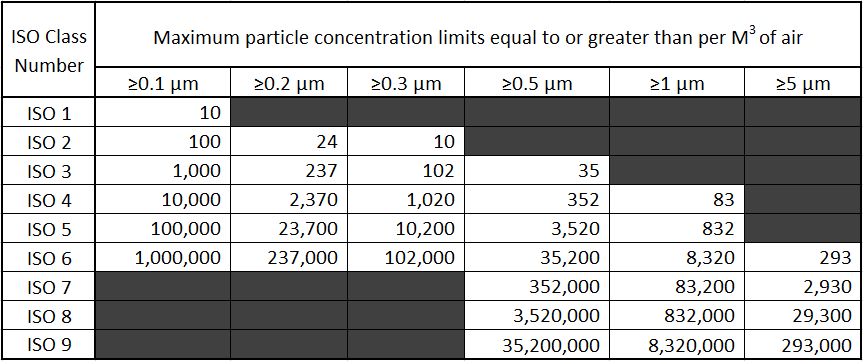
It should come as no surprise that equipment used in cleanrooms must comply to some demanding standards & specifications. To that end, ISO (The International Organization for Standardization) created ISO Standard 14644-1. It identifies nine Class Numbers, based on allowable particulate concentrations in a given volume of air. Here’s how it breaks those down:

Basically, the lower the Class Number, the cleaner the air. ISO 1 is often used in semiconductor manufacturing. Medical device manufacturers and pharmaceutical facilities typically specify ISO 5 & 7.

Equipment used inside a cleanroom must be designed, and operated, so as to not increase particulate concentration limits above these limits. You wouldn’t want to use steel tools that are prone to rust, or electric tools with carbon brushes in the motors, for example.

EXAIR’s Intellistat Ion Air Nozzle was designed with these considerations in mind. They were tested by a third part independent laboratory and are classified for use in ISO Class 5 (or below) cleanrooms. This has made them especially popular in pharmaceutical laboratory use, as well as:

  • A local eyeglass & camera lens manufacturer uses them to ensure precision measurement instruments’ readings aren’t affected by any residual static charge caused by the grinding process.
  • A company that makes overlays for medical devices (IV pump controllers, patient monitoring devices…pretty much anything with pushbuttons you might find in a hospital room or a doctor’s office exam room) uses them to maintain compliance with their customers’ standards.
  • A number of food production facilities around the country use them to remove static from processed foods, and packaging containers, during filling operations.
  • A manufacturer of packaging machinery includes them on filling machines servicing the food and pharmaceutical industries.
Order before March 31, 2025 and receive a FREE AC Sensor with any qualifying Static Eliminator purchase.

Whether they’re in a cleanroom or not, the compact design, ease of installation & operation, air use efficiency, and quiet operation make them ideal for a range of static elimination applications. If you’d like to find out more the Intellistat Ion Air Nozzle (or its handheld version, the Intellistat Ion Air Gun), give me a call.

Russ Bowman, CCASS

Application Engineer
Visit us on the Web
Follow me on Twitter
Like us on Facebook

Static and Variance

Okay, folks, it is time we seriously discuss how dry it is here in the MidWest right now and how much static there is anywhere we go. The dry air is the lack of moisture due to heat being used inside facilities, and thus, the static ramps up. If you didn’t understand much of those statements then it is okay, we have a whitepaper that covers the basics. The seriousness of the static in my home has reached critical mass. We are past the funny shocks and hair standing on the end humor side of static. We have reached a critical mass where it is no longer funny, my coffee is being affected by the ambient level of static charge.

That’s right, the coffee grinder I received for Christmas is riddled with static. Now, it is still functioning, thank goodness for that. The container that houses the fresh ground, the nectar of the gods making crushed beans, is made of polycarbonate material and is prime to hold a static charge. As the dry coffee beans are ground into obliteration there is a tremendous amount of friction which causes a very high charge on the ground bean discharge that goes into a very dry non-conductive container. This means the grinds all pile up and then also cling to every single surface on the interior of the small container. That’s fine, it still does not affect the performance of the grinder. Then, when I open the lid there is a detachment that happens and a small amount of that highly charged ground bean will start to dance all over the surfaces of the container, including outside of it and onto the counter. The end result is I have to constantly wipe up coffee grinds and I am wasting the grinds that give me the caffeine I intend to consume.

The dilemma here is that I don’t want to run compressed air into my kitchen, already have one project going on in the house. Secondly, my wife would not think it would be as entertaining as I would. So, I need a non-compressed air-assisted static eliminator that can plug straight into a voltage available here in the US, and let’s face it, coffee is a global consumption so 120 VAC and 230 VAC would be preferred. Enter, the VariStat Benchtop Ionizer.

The Varistat would easily mount to the wall over my coffee generation station and could be adjusted from a gentle breeze to where it doesn’t disturb the coffee grinds all the way up to a forceful blast in case the need would arise. I could also vary the balance of the unit to meet the atmospheric and surface conditions of the container.

Okay, so I’m probably not going to buy a Varistat Benchtop Ionizer and mount it to my kitchen wall. I would easily recommend it to any kind of hopper loader or regrind operation where the static is causing the materials to cling to the containers or causing nuisance shocks. This unit is easily sat on a bench top or mounted to a wall or ceiling over a hopper or workstation. Thanks to the operation of standard 120 VAC or 230 VAC it can function nearly anywhere in the world that has electricity.

If you would like to discuss coffee, what my favorite roasts are, or more importantly how can we make this work in our building, just let me know if you have some questions and we will get back to you quickly.

Brian Farno, MBA – CCASS Application Engineer

BrianFarno@EXAIR.com
@EXAIR_BF