
How One Customer Improved Safety and Reduced Noise with a Simple Retrofit

I recently had the opportunity to help a customer facing some serious concerns about their compressed air usage. They had just completed a safety audit conducted by a third-party firm, and one of the main issues identified was the use of handheld blow guns throughout their production floor.

“Thumb guns” are especially popular for blowoff because of their compact size, ergonomic design. and low price.

Even though the tools in question were commercially available and marketed as having “safety tips,” the auditors recorded noise levels exceeding 90 dBA—well above the acceptable threshold. The audit team explained that to maintain a safe work environment, noise levels needed to stay below 84 dBA, and the simplest way to get there was to address the blow guns being used.

That’s when the customer turned to us for help.

We discussed the application in detail, and it quickly became clear that EXAIR’s Model 1100 Super Air Nozzle would be a great fit. Not only does it significantly reduce noise levels—down to 74 dBA—but it also meets OSHA’s 30 PSI dead-end pressure requirement, ensuring operator safety in the event of a blocked nozzle.

This customer wasn’t focused on maximizing air output or performance—they simply wanted to make their environment safer for their team. What made this installation even better was the unexpected benefit: while addressing the safety concerns, it also reduced compressed air consumption. A win-win.

It’s always rewarding when we can help customers meet compliance goals and improve safety, but it’s even better when we can go beyond their expectations and help them uncover savings they weren’t even looking for.

Free testing. Verifiable data. EXAIR Efficiency Lab.

If you’re dealing with high noise levels or safety compliance issues around your compressed air applications, don’t hesitate to reach out. Our team is ready to help you find a solution that protects our people, meets regulations, and improves overall efficiency through the EXAIR Efficiency Lab.

Brian Farno, MBA – CCASS
National Business Development Manager

BrianFarno@EXAIR.com
@EXAIR_BF
One For The Gearheads

EXAIR Application Engineers are geeky about compressed air, but there’s a few gearheads at heart among us, too.  I’m one of them.  Read through my blog below for a dive into my most recent gear-driven fun!

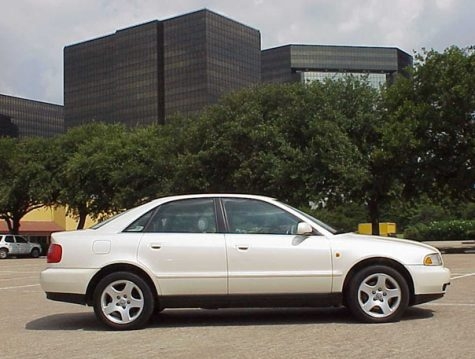
1998 A4

Recently I took on a new project at home.  One of my friends called me to tell me about an A4 with a potentially blown motor that might find a happy new home for the right (low) price.  Seeing as how I’ve procured many a vehicle in just the same way, I’m always optimistic about these kind of things.

So, I made the trip to look at the A4 and found a clean interior, 80k on the clock, and a no-start condition.  After sitting at the dealer for over a month without an accurate diagnosis, the owner had it towed to his house where he put it on the market as-is.  Unsure of the problem, but confident I could find and fix whatever is needed, I bought the car.

AHA DOHC

Cranking the engine (2.8 AHA code) over, I could hear a lack of compression, so I pulled the plugs and confirmed with a gauge.  Bank one (cylinders 1-3) had virtually zero compression on any cylinder, and bank two (cylinders 4-6) was perfect.  Interesting…  My first thought was that there was a timing belt failure and valves were bent when getting readings on bank one.  But the perfect readings on bank two made me second guess.  Nevertheless, I pulled the front carrier/core support and tore down to the timing belt.  Sure enough, the teeth of the belt were chewed off at the crank!  But, the story goes on…

The repair in a case like this is to pull the cylinder heads, check all the intake and exhaust valves for leakage, and replace those that are faulty (or all the valves depending on their condition).  Some people call this a rebuild of the top half of the engine, which is pretty accurate.

When I removed the cylinder heads and began to disassemble them, I could tell something wasn’t right.  There’s a camshaft adjustment unit used to advance or retard valve timing that has a special landing and thread for a service tool.  On the bank one cylinder head, this landing was missing (see the photo below).  Strange!  And, normally, the camshafts can be removed fairly easily once their bearing caps are removed.  But, on this cylinder head, no dice.

VVT Unit

Ultimately I found that the landing for the camshaft adjustment unit broke off and wedged on the exhaust cam of bank one.  See the photos below for the gouge mark on the casting.  This cam seized, locked everything on the head, and forced the crank to chew the teeth off the timing belt.  Miraculously, the valves on bank two avoided any damage and triple checked out when disassembled.

Head Gouge 1

Head Gouge 2

This failure led to the damage of (5) valves.  Some of them are visible to the naked eye as seen below.

Bent Valves

Now comes the fun part of getting the engine back together, knowing that there’s a “new” car at the end of all the work.

Lee Evans

Application Engineer

LeeEvans@EXAIR.com

@EXAIR_LE