Compressed Air Pressure Regulators Conserve And Protect

Imagine you’re enjoying a nice shower. A cascade of warm water is soothing your body – and spirit – then, someone starts the dishwasher. Or a load of laundry. Or flushes the toilet. Suddenly, the “soothe” turns to “scald” or “freeze,” depending on whether you’ve been robbed of hot, or cold water.  So, what happened?

What happened is, all of those “loads” on your house’s water supply that can ruin your shower experience are controlled by simple on/off valves…they open to permit a certain amount of water FLOW to pass.  When the dishwasher starts, or someone decides to wash a load of whites, the HOT water from your nice warm shower is diverted, leaving a stream of cold water.  When a toilet flushes, or it’s a load of colors, the COLD water is diverted…and that’s not just unpleasant, but downright painful.  Either way, (in my house anyway,) a teenager is getting read the riot act.

The same phenomenon can apply in a compressed air system, if simple flow control valves are used to throttle the appropriate supply of air to a pneumatic device.  If someone, for example, hooks up an air gun to blow off their tools or parts, the valves on EVERYTHING else will need to be opened up some to keep those devices working the same.  In the case of an air gun like this, it usually happens too quick to make the necessary adjustments (by hand) and you’re probably left with a machine tripped off-line, or a ruined part.

Pressure Regulators can prevent this by keeping (or regulating) their downstream pressure to a set value.  If a load elsewhere in the system is activated, the Pressure Regulator opens up, automatically, to keep its output constant.  When that load is secured, the Pressure Regulator closes back down accordingly.  Either way, no single load affects the operation of any others.

That’s only half the value of the use of Pressure Regulators, though.  The other half is, well…the value.  Just looking at a typical function of many EXAIR Intelligent Compressed Air Products – blow off – they’ll all pretty much accomplish the task if you run them, unrestricted, straight off your header.  That’ll give you a good, strong blast of air flow…and it may be more than what’s required, and a waste of good air.  Pressure Regulators will prevent this by allowing you to “dial in” the supply pressure to whatever it takes to get the job done, and no more.

EXAIR offers a range of Pressure Regulators capable of handling air flow of up to 700 SCFM.

Compressed air isn’t free.  Heck, it isn’t even cheap.  Don’t use any more than you have to, and get the most out of what you do use.  Pressure Regulators are one important step in doing this.  If you’d like to talk about optimizing your use of your compressed air system, give me a call.

Russ Bowman
Application Engineer
EXAIR Corporation
Visit us on the Web
Follow me on Twitter
Like us on Facebook

Business Benefits Of Compressed Air Efficiency

The primary business benefits of an efficient air compressor system are reduced operational costs, reduced maintenance and increased up-time.  With that being said, is your compressed air system costing you more than you think it should?  Are you having failures, pressure drops, inadequate volume and/or pressure?  You might think from these issues that your system has seen better days and is ready to be replaced.  However, it is possible that your existing tried and true compressor system has more life left in it than you think and with a few simple steps you could have it performing like a champ again!

It is estimated that typically plants can waste up to 30 percent of their generated compressed air and that cost is substantial.  Considering the average cost to generate compressed air is .25 cents per 1000 SCFM, that translates into .075 cents for every .25 cents spent!  Considering that energy costs have doubled in the last five years, it couldn’t be more timely to make your air compressor system more efficient.

So just where is all this waste occurring?  The largest source of compressed air energy waste is from unused or leaked compressed air and that is followed by line pressure drops, over pressurization and inadequate maintenance of the compressor.

So how can you identify this issues in your system?

1). Finding leaks can be accomplished by several methods such as soapy water applied to a suspected joint or connection or the EXAIR Ultrasonic Leak Detector.   It is a high quality instrument that can locate costly leaks in your compressed air system.  When a leak is present and audible tone can be heard in the supplied headphones and the LED display will light.  This testing can be done up to 20′ away so need to get on a ladder!

Leak Detector

2). Pressure drop is caused by is caused by the friction of the compressed air flowing against the inside of the pipe and through valves, tees, elbows and other components that make up a complete compressed air piping system.  If the piping system is to small, the flow (volume) will not be sufficient and the devices will not operate properly.  The volumetric demand would need to be added up to determine if the piping is of sufficient diameter to flow the required volume.  EXAIR’s Digital Flow Meter is an easy way to monitor compressed air consumption and waste.  The digital display shows the exact amount of compressed air being used, making it easy to identify piping that may be undersized.  Installing one on every major leg of your air distribution system to constantly monitor and benchmark compressed air usage is a fast and efficient way to see what your volume through that distribution leg is.

Flow Meter

3). Over pressurization is also an issue, as the pressure is raised to account for high demand periods, system leaks and pressure drops. Unfortunately operating at higher pressures can require as much as 25 percent more compressor capacity than needed, generating wasted air which is called artificial demand.

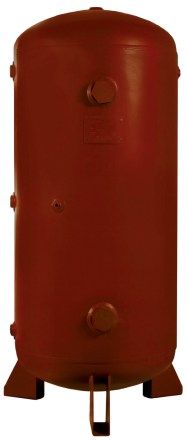
You can reduce the leakage rate by running the compressor at lower pressures. If you’re short on air, don’t turn up the pressure. Run your compressor at no higher pressure than what you process requires. To relieve peak demands on your system consider the EXAIR Receiver Tank.  It store’s compressed air during low usage times and releases it when the demand is increased without working your air compressor system harder.

receiver_tank

4). Finally, a preventative maintenance (PM) program will need to be implemented to keep the air compressor system running properly.  Two items that are often neglected are the drive belts and filters.  Loose belts can reduce compressor efficiency and dirty filters allow dirt to get through the system and cause pressure drops.  EXAIR has replacement elements for our line of filter separators to keep you air clean and line pressure down.

By increasing your awareness of the health of your air compressor system and implementing a PM program you can significantly reduce your costs from wasted energy and avoid costly down time from an out of service air compressor.

If you would like to discuss improving your compressed air efficiency or any of EXAIR’s engineered solutions, I would enjoy hearing from you…give me a call.

Steve Harrison
Application Engineer
Send me an email
Find us on the Web 
Follow me on Twitter
Like us on Facebook


Intelligent Compressed Air: Things to Consider when Designing the Compressor Room

37719673802_6f5c603fa6_o

One common thing that can be easily overlooked is the importance of designing an efficient compressor room. After you’ve determined your overall requirements and selected the appropriate compressor, you can begin designing the layout of your compressor room. For starters, the compressor room should be located in a central location when possible, close to the point of use. This will help to minimize pressure drop as well as reduce installation costs as less piping will be required. If this isn’t possible, try to keep the compressor room close to the larger volume applications in your facility. Otherwise you will have to use larger diameter piping in order to ensure an adequate volume of air is available.

The diameter of the distribution piping should NOT be based on the connection size of the compressors, aftercoolers, or filters. According to the Compressed Air Challenge Best Practices for Compressed Air Systems handbook, piping should be sized so that the maximum velocity in the pipe is 30 ft/sec. When the distance between the compressor room and the point of use is lengthy, consider increasing the pipe diameter to minimize the pressure drop across the system.

Inside of your compressor room you’ll have a variety of different equipment, all dependent on the demand, quality, supply, storage, and distribution of your compressed air. Keeping all of the equipment in its own room will also provide some insulation from the noise associated with compressed air generation. It is crucial that the space selected as your compressor room is sufficiently large enough to accommodate everything without becoming cramped. As a general rule of thumb, keep about 3′ of space between equipment such as the compressor, receiver tanks, aftercooler, and dryer. This helps to prevent equipment from overheating as well as offers maintenance personnel adequate space with which to perform any regularly scheduled maintenance or repairs.

Once you’ve selected your equipment, piping, and determined the location, another thing to consider is ventilation. As compressed air is generated, the compressor gives off a good amount of heat. It is important that the exhaust air is not permitted to re-circulate throughout the compressor room. The exhaust needs to be ducted so that it the warm air is not drawn in at the air intake on the compressor. Some equipment, such as refrigerated dryers, requires a substantial amount of cooling air. In these situations, an exhaust fan can be used to provide that additional airflow.

To further enhance the efficiency of your facility, the heat generated from compression can be re-purposed instead of simply exhausting into the ambient environment. This process is commonly referred to as compressed air energy recovery. Some industries require a source of heat for many of their manufacturing processes. In these scenarios, the heat energy that is produced during compression can be reused rather than having to generate another source of heated air. If the heated air can’t be used for any of your manufacturing processes, the heat can be used as a means to heat your water supply or even to heat the facility itself. This can drastically reduce your electricity or gas requirements during cooler periods.

To reduce the amount of required maintenance and ensure that your compressor is operating as efficiently as possible, the compressed air intake must also be free from particulate and harmful gases. When dust and dirt is drawn into the compressor, it can cause wear on the internal components. If the ambient environment contains a lot of dust and particulate, a pre-filter can be used to prevent any future problems. In these instances, it is important to consider the pressure drop that will be caused when designing the system.

Keeping these tips in mind will serve to make your life much easier in the long run. Once you have everything installed and set up, visit the EXAIR website or give us a call to speak with an Application Engineer. EXAIR’s Intelligent Compressed Air Products  can help you reduce compressed air consumption and increase worker safety by adhering to both OSHA 1910.242(b) and 1910.95.

Tyler Daniel
Application Engineer
E-mail: TylerDaniel@exair.com
Twitter: @EXAIR_TD

Image Courtesy of  thomasjackson1345 Creative Commons.