Why Use EXAIR Super Air Knives: Return on Investment

Return on Investment, or ROI, is the ratio of profit over total investment.  Many people use it to check stocks, financial markets, capital equipment, etc.  It is a quantitative way in determining the validity for an investment or project.   You can use the ROI value to give a measurable rate in looking at your investment.  For a positive ROI value, the project will pay for itself in less than one year.  Any negative values would represent a high-risk investment.  In this blog, I will compare the ROI between an EXAIR Super Air Knife to a common drilled pipe.  Let’s start by looking at Equation 1 to calculate the Return on Investment:

Equation 1:  ROI = (Total annual savings – Total Project Cost) / Total Project Cost * 100

The Total Project Cost is the cost of the product with the labor to install.  In our example, we will use a 24” (610mm) wide blow-off device.  One device will be an inexpensive drilled pipe and the other will be a high-efficiency EXAIR Super Air Knife.  The drilled pipe had (48) 1/16” (1.6mm) diameter holes spaced ½” (13mm) apart.  EXAIR manufactures the model 110024 Super Air Knife with a .002” (.05mm) slot along the entire length.  Both have a blowing width of 24” to cover the conveyor.  The model 110024 has a retail price of $491.00 each.  The cost of the drilled pipe was around $50.00.  What a difference in price!  But, how could EXAIR remain a leader in this industry for over 35 years?

Let’s continue on with the Return on Investment.  The amount of time required to install the Super Air Knife across the conveyor only took a maintenance staff about one hour to mount.  The labor rate that I will use in this example is $75.00 per hour (you can change this to your current labor rate).  The labor cost to install the knife is $75.00.   The Total Project Cost can be calculated as follows: ($491 – $50) + $75.00 = $516.00.  The next part of the equation, Total annual savings, is a bit more in-depth, but the calculation is shown below.

Super Air Knife

EXAIR manufactures engineered products to be efficient and safe.  The Super Air Knife has a 40:1 amplification ratio which means that 40 parts of “free” ambient air is entrained for every 1 part of compressed air.  For comparison, the Super Air Knives are to compressed air systems as LED lightbulbs are to electricity.  In that same way, the drilled pipe would represent an incandescent lightbulb.  The reason for this analogy is because of the amount of energy that the EXAIR Super Air Knives can save.  While LED lightbulbs are a bit more expensive than the incandescent lightbulbs, the value for the Return on Investment is at a higher percentage, or in other words, a short payback period.  On the other hand, the drilled pipe is less expensive to make, but the overall cost for using it in your compressed air system is much higher.  I will explain how below.

To calculate the Total Annual Savings, we will use the same blow-off scenario as above.  The amount of compressed air used by the drilled pipe is around 174 SCFM (4,924 SLPM) at 60 PSIG (4.1 Bar).  The model 110024 Super Air Knife has an air consumption of 55.2 SCFM (1,563 SLPM) at 60 PSIG (4.1 Bar).  At an electrical rate of $0.08 per Kilowatt-hour, we can figure the cost to make compressed air.   Based on 4 SCFM per horsepower of air compressor, the electrical cost is $0.25 per 1000 standard cubic feet, or $0.25/1000SCF.  To calculate an annual savings, let’s use a blow-off operation of 8 hours/day for 250 days a year.   Replacing the drilled pipe with the model 110024 Super Air Knife, it will save you (174 SCFM – 55.2 SCFM) = 121.8 SCFM of compressed air.  To put this into a monetary value, the annual savings will be 121.8 SCFM *$0.25/1000SCF * 60 Min/hr * 8hr/day * 250 day/yr = $3,654 per year.

With the Total Annual Cost and the Project Cost known, we can insert these values into Equation 1 to calculate the ROI:

ROI = (Total annual savings – Total Project Cost) / Project Cost * 100

ROI = ($3,654 – $516.00) / $516.00 * 100

ROI = 608%

With a percentage value that high, we are looking at a payback period of only 52 days.  You may look at the initial cost and be discouraged; but in a little over a month, the model 110024 will have paid for itself.  And after using it for one year, it will save your company $3,654.00.  Some things that may be overlooked are safety issues.  With some inexpensive blow-off devices, the noise levels are over the OSHA limits.  The drilled pipe had a noise level of 91 dBA while the Super Air Knife only had a noise level of 65 dBA.

In my experience, a loud blowing noise from your equipment is generally coming from an inefficient and safety-concerned product.  With these “cheap” ways to blow compressed air, it will cost your company a lot of money to use as shown in the example above.  If you would like to team up with EXAIR to set up ways to increase savings, improve productivity, and promote safety, an Application Engineer can help you to get started.

John Ball
Application Engineer
Email: johnball@exair.com
Twitter: @EXAIR_jb

People of Interest: Daniel Bernoulli

Daniel Bernoulli

Whenever there is a discussion about fluid dynamics, Bernoulli’s equation generally comes up. This equation is unique as it relates flow energy with kinetic energy and potential energy. The formula was mainly linked to non-compressible fluids, but under certain conditions, it can be significant for gas flows as well. My colleague, Tyler Daniel, wrote a blog about the life of Daniel Bernoulli (you can read it HERE). I would like to discuss how he developed the Bernoulli’s equation and how EXAIR uses it to maximize efficiency within your compressed air system.

In 1723, at the age of 23, Daniel moved to Venice, Italy to learn medicine. But, in his heart, he was devoted to mathematics. He started to do some experiments with fluid mechanics where he would measure water flow out of a tank. In his trials, he noticed that when the height of the water in the tank was higher, the water would flow out faster. This relationship between pressure as compared to flow and velocity came to be known as Bernoulli’s principle. “In fluid dynamics, Bernoulli’s principle states that an increase in the speed of fluid occurs simultaneously with a decrease in static pressure or a decrease in the fluids potential energy”1. Thus, the beginning of Bernoulli’s equation.

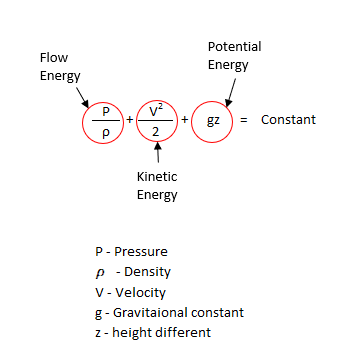
Bernoulli realized that the sum of kinetic energy, potential energy, and flow energy is a constant during steady flow. He wrote the equation like this:

Equation 1:

Bernoulli’s Equation

Not to get too technical, but you can see the relationship between the velocity squared and the pressure from the equation above. Being that this relationship is a constant along the streamline; when the velocity increases; the pressure has to come down. An example of this is an airplane wing. When the air velocity increases over the top of the wing, the pressure becomes less. Thus, lift is created and the airplane flies.

With equations, there may be limitations. For Bernoulli’s equation, we have to keep in mind that it was initially developed for liquids. And in fluid dynamics, gas like air is also considered to be a fluid. So, if compressed air is within these guidelines, we can relate to the Bernoulli’s principle.

  1. Steady Flow: Since the values are measured along a streamline, we have to make sure that the flow is steady. Reynold’s number is a value to decide laminar and turbulent flow. Laminar flows give smooth velocity lines to make measurements.
  2. Negligible viscous effects: As fluid moves through tubes and pipes, the walls will have friction or a resistance to flow. The surface finish has to be smooth enough; so that, the viscous effects is very small.
  3. No Shafts or blades: Things like fan blades, pumps, and turbines will add energy to the fluid. This will cause turbulent flows and disruptions along the velocity streamline. In order to measure energy points for Bernoulli’s equation, it has to be distant from the machine.
  4. Compressible Flows: With non-compressible fluids, the density is constant. With compressed air, the density changes with pressure and temperature. But, as long as the velocity is below Mach 0.3, the density difference is relatively low and can be used.
  5. Heat Transfer: The ideal gas law shows that temperature will affect the gas density. Since the temperature is measured in absolute conditions, a significant temperature change in heat or cold will be needed to affect the density.
  6. Flow along a streamline: Things like rotational flows or vortices as seen inside Vortex Tubes create an issue in finding an area of measurement within a particle stream of fluid.
Super Air Knife has 40:1 Amplification Ratio

Since we know the criteria to apply Bernoulli’s equation with compressed air, let’s look at an EXAIR Super Air Knife. Blowing compressed air to cool, clean, and dry, EXAIR can do it very efficiently as we use the Bernoulli’s principle to entrain the surrounding air. Following the guidelines above, the Super Air Knife has laminar flow, no viscous effects, no blades or shafts, velocities below Mach 0.3, and linear flow streams. Remember from the equation above, as the velocity increases, the pressure has to decrease. Since high-velocity air exits the opening of a Super Air Knife, a low-pressure area will be created at the exit. We engineer the Super Air Knife to maximize this phenomenon to give an amplification ratio of 40:1. So, for every 1 part of compressed air, the Super Air Knife will bring into the air streamline 40 parts of ambient “free” air. This makes the Super Air Knife one of the most efficient blowing devices on the market. What does that mean for you? It will save you much money by using less compressed air in your pneumatic application.

We use this same principle for other products like the Air Amplifiers, Air Nozzles, and Gen4 Static Eliminators. Daniel Bernoulli was able to find a relationship between velocities and pressures, and EXAIR was able to utilize this to create efficient, safe, and effective compressed air products. To find out how you can use this advantage to save compressed air in your processes, you can contact an Application Engineer at EXAIR. We will be happy to help you.

John Ball
Application Engineer
Email: johnball@exair.com
Twitter: @EXAIR_jb

  1. Wikipedia https://en.wikipedia.org/wiki/Bernoulli%27s_principle

Super Air Knives Are Ideal For Super Aggressive Environments

Hydrochloric Acid. Sodium Hydroxide. Nitric Acid. Hydrogen Peroxide. Whether you know it or not, these are all commonly used around the house as tile/grout cleaners, drain openers, lawn fertilizers, and disinfectant for cut & scrapes, respectively.

They’re also used in a variety of industrial applications, such as the making of plastics, glass, pharmaceuticals, and wastewater treatment, respectively…all of which also have applications for which EXAIR Corporation’s Intelligent Compressed Air Products provide safe, efficient, and quiet solutions for.

Stainless Steel Super Air Knife Kits include the Air Knife itself, a Shim Set, an Automatic Drain Filter Separator, and a Pressure Regulator. The Air Knife & Shim Set are all Stainless Steel (grade 303 or 316, depending on which is specified) construction.

Consider the Super Air Knife: If you need one that’ll stand up to contact with hydrochloric acid, you’re looking for PVDF construction. Nitric acid is a different story – our 303SS, 316SS construction Super Air Knives are well suited for those applications.

On the other end of the (pH) spectrum, any of those materials are suitable for exposure to Sodium Hydroxide. PVDF is still the best choice, as the Stainless Steels will be subject to discoloration or slight corrosion, depending on the concentration.

PVDF Super Air Knife Kits include the Air Knife itself (PVDF body, Hastelloy C-276 hardware, and PTFE Shims,) a PTFE Shim Set, an Automatic Drain Filter Separator, and Pressure Regulator.

Acids and bases aside, oxidizers are also very corrosive, especially in higher concentrations.  Hydrogen peroxide is a commonly used oxidizer in industries as diverse as pulp & paper, soap & detergent, and water sterilization.  Like other chemicals, compatibility depends on the concentration, but like nitric acid & sodium hydroxide, our PVDF Super Air Knives are still the best, but the Stainless Steel models are still acceptable.

These are just a few, very basic, examples of chemical compatibility.  If you have an application that calls for installing one of our compressed air products in an area where you’re concerned about corrosion, give me a call.

Russ Bowman
Application Engineer
EXAIR Corporation
Visit us on the Web
Follow me on Twitter
Like us on Facebook

EXAIR’s Long Super Air Knives Dry Auto Bodies

I was recently contacted by an automobile manufacturer that was looking for a quote for a system of Super Air Knives for a current process they were replicating at a new facility. The customer had an existing application where they’re using the Super Air Knife to dry the body of the car after a washing operation and before it enters into an oven. Any large water droplets remaining when the body enters the oven cause water spots that must then be cleaned off, adding an additional step in their process.

SAK car blowoff2

The solution was working well to dry the bodies, they just needed a quote so that they could implement the very same process in the new plant. As this was an installation that had been in place for many years, they had an older style of Long Super Air Knife that consisted of two shorter knives coupled together. In 2014, EXAIR began manufacturing our Long Super Air Knives in one single piece (available from stock up to 108”!!).

So, now, rather than having two individually coupled knives they could order (1) single 84” knife with a consistent flow all the way across and no dead spots. They ordered one for the top, one for each side and replicated the already successful application.

EXAIR’s industry leading Super Air Knife dramatically reduces compressed air usage and noise when compared to other blowoff methods. The Super Air Knife is available in lengths ranging from 3”-108” and in Aluminum, 303 Stainless Steel, 316 Stainless Steel, and PVDF for corrosive applications. Even at high pressures of 80 psig, the Super Air Knife is able to maintain a sound level of just 69 dBA for most applications! Air is entrained from the ambient environment at a rate of 40:1, maximizing the force and flow from the Super Air Knife. In addition, these knives meet or exceed OSHA maximum dead-end pressure and noise requirements.

Adjustability of both the force and flow from the Super Air Knife is infinitely adjustable. Right out of the box from the factory the Super Air Knife comes stock with a .002” thick shim installed. This sets the gap between the body and cap of the knife and determines how much compressed air can flow through the precise, slotted orifice.

An accessory that EXAIR has available for the Super Air Knife is the shim set. For the aluminum knives, a .001”, .003”, and .004” plastic shims come in the shim set. To reduce the flow and force, a .001” can be used. If more force is required, a thicker shim can be installed. For the stainless steel and PVDF knives, (3) .002” shims are included in the set. Stainless steel shims for the stainless knives and a PTFE shim for the PVDF. These, as well as the plastic shims, can be stacked on top of one another to create an even larger gap. One thing that is important to keep in mind however, the larger the air gap the greater the air consumption. Installing a .004” shim in a Super Air Knife will double the force, flow, and consumption of the knife when compared to the stock .002” shim.

If you have a new application (or need to replicate an existing one) for the Super Air Knife, don’t hesitate to reach out to an EXAIR Application Engineer for assistance. With a highly-trained team coming from multiple different industry backgrounds, we’re ready to help.

Tyler Daniel
Application Engineer
E-mail: TylerDaniel@EXAIR.com
Twitter: @EXAIR_TD