How Do You Mount An EXAIR Super Air Knife?

This is a fairly common question for the Application Engineering team. The quick (and fairly accurate) answer is: “Any way you want.”

Let’s unpack that a little, though. We’re obviously constrained by the laws of physics, so the method of mounting it has to be structurally sound enough to support the Super Air Knife’s weight, and the reaction force of the compressed air discharge. 3″ Super Air Knives can actually be mounted (and supplied with compressed air) using Stay Set Hoses, if you have an air line ‘drop’ nearby. If not, you can use a Magnetic Base to hold the Stay Set Hose and the Super Air Knife:

Compact, efficient and quiet, the EXAIR 3″ Super Air Knife is an ideal blow-off solution for a variety of applications. Installation is quick & easy with a Stay Set Hose and a Magnetic Base.

Longer Super Air Knives can be installed just about as easily with Universal Air Knife Mounting Systems. Air Knives up to 18″ long use one Model 9060 Mounting System. Longer Air Knives need multiple Mounting Systems for proper support.

The 72″ Super Air Knife w/ Plumbing Kit Installed shown here will use four Model 9060 Universal Air Knife Mounting Systems for proper support.

Because of their design, though, there are a number of other ways to mount a Super Air Knife. If you’re using hard pipe to supply compressed air, a shorter-length Super Air Knife will essentially be as well-supported as the pipe itself. I’ve talked to users who have successfully installed 6″ and 9″ Aluminum Super Air Knives in this manner. We wouldn’t recommend doing that with anything longer than that, due to concerns about overhung loading. The exception to that would be a Super Air Knife installed vertically…and even then, I’m unaware of anyone doing that with any Super Air Knife longer than 12″.

Curiously, though, you can use the supply piping for longer models. A Super Air Knife over 18″ in length will need to be supplied with compressed air to both ends. A properly supported pipe holding up either side offers a great deal of stability.

This Model 110054 54″ Aluminum Super Air Knife is well supported by its black iron supply pipe.

Super Air Knives also have 1/4-20 threaded holes along the bottom of the body. These are the ‘leftover’ threads below the cap screw ends that hold the cap to the body. Those cap screws can also be replaced with longer 1/4-20 hardware. That allows you to use a bracket of your choosing to mount it. We have customers who have gotten downright creative with those:

Yes, that’s a door hinge. No, it wasn’t my idea, but I kind of wish it was.

No matter which Super Air Knife you’re using, and what you’re using it for, there are always options for mounting. If you’d like help in determining which one(s) is best for you, give me a call.

Russ Bowman, CCASS

Application Engineer
Visit us on the Web
Follow me on Twitter
Like us on Facebook

Static Season is Here

Here in Cincinnati we have officially hit static season. Highs in the low 30ies and lows in the teens mean the AC has been turned off and the furnaces are operating at full power. You can tell the air has a bit of a dryness to it. In fact, at home I just switched on the whole home humidifier as my RH was dropping and I was even shocked by a potato I was peeling for Thanksgiving Day mashed potatoes.

Just like our lips and hands can become dry and cracked, the moisture level in the air is also linked to static electricity. Cold air lacks the moisture that warm air contains. As winter temperatures drop, the air becomes drier, leading to a sensation of increased dryness. This moisture in the air is referred to as water vapor. Water vapor helps to dissipate electrical charges. When there’s less of it, your body retains a higher electrical charge. A higher charge results in more significant discharges. Therefore, it’s no surprise that during the winter months, you may experience more frequent static shocks, which can be a bit jarring when you touch a doorknob, your pet, or even, in my case, some potatoes.

Now, of course, you see this in your home life, but it also carries over to every manufacturing facility, as many processes tend to create static, so the dry air will only worsen the issues.

Static tends to propagate.  The more contact, detachment, and friction that occurs, the higher the static charges.  Even when the static is removed from the surface, static charges can still regenerate by the mechanisms above.  So, controlling the static can be determined by the treatment process as well as the location.

Regardless of the nature of the application, if you’ve got a static problem, EXAIR has a solution!

To combat static electricity in your processes, EXAIR manufactures a complete line of Static Eliminators. Any of them are available to ship on the same day from stock to customers in the U.S. with an order placed by 2:00 ET (1:00 ET for same day shipments to Canada). We’re all tired now of receiving extremely long lead times for seemingly everything we try to order. That’s not the case here at EXAIR, if you need a solution and FAST give us a call!

Jordan Shouse
Application Engineer

Send me an email
Find us on the Web 
Like us on Facebook
Twitter: @EXAIR_JS

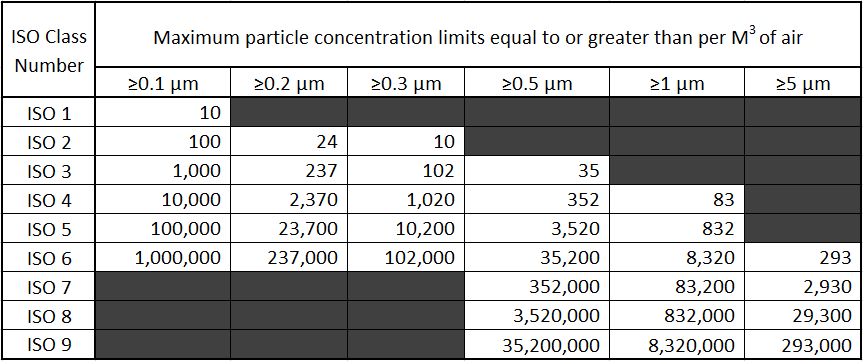
ISO 14644-1 Cleanroom Designations

The number of clean room certificates is vast.  So, ISO narrowed this range to make a common standard, called ISO 14644.  This standard shows the maximum allowable particles per unit volume by micron size that can be permitted for certain industries.  This would include pharmaceuticals, semiconductors, quality control, laboratories, cosmetics, etc.  The chart for maximum particle concentrations is located in the sub-category, ISO 14644-1.  The classification is by number for easy reference.

A clean room recirculates the air inside the room and uses filters to remove the particles.  The filters can be made from either High Efficiency Particulate Air filter media, HEPA, or Ultra Low Penetration Air filter media, ULPA, depending on the quality required.  The lower the ISO number, the more cost involved in achieving such a status.  This will include entrance and exit requirements, clean room garments, and materials of construction.  Each class is divided into ISO numbers, ranging from 1 to 9. The class identifies the maximum limit for particulate size and quantity per cubic meter of air. The chart below showcases the size and the quantity breakdown.

The EXAIR IntelliStat® Air Guns and IntelliStat® Nozzles can be used in rooms that are ISO 5 and larger.  The IntelliStat product is designed for manual or hands-free operations to remove static and to clean surfaces.  It is a great product for quality checks, PCB manufacturing, cleaning glass lenses and medical devices without sacrificing the clean room requirements. 

EXAIR does have the capability to design and create specialized products as well to suit specific clean rooms. If you would like to discuss your production environment or blow-off application within a clean room, please contact an Application Engineer.    

John Ball
Application Engineer
Email: johnball@exair.com
Twitter: @EXAIR_jb

Clerk Maxwell: The Man, the Myth, the Demon

Thermodynamics is a branch of physics that focuses on heat and energy. It studies how these forms of energy move and change within a system. An isolated system is a key concept in thermodynamics; it is a space that does not interact with anything outside of it. This means that no heat or energy can enter or leave a system. Understanding these principles helps scientists and engineers design better machines and improve energy efficiency.

The unique physical phenomenon of the Vortex Tube principle generates cold air instantly, and for as long – or short – a time as needed.

Maxwell’s demon is a thought experiment created by the mathematician James Clerk Maxwell. This imaginary being has the ability to see fast and slow-moving molecules in a gas. By sorting these molecules, the demon could supposedly create a situation where one side of the container is hot, and the other side is cold, without using energy. This idea challenges the second law of thermodynamics, which states that systems tend to move towards disorder. Maxwell’s demon shows that there are limits to our understanding of energy and order in the universe.

How a Vortex Tube Works

Maxwell’s demon is a molecule-sized trapdoor that separates a box of gas into two sides. The demon observes molecules and only allows fast-moving molecules to pass through to one side, and only slow-moving molecules to pass through to the other side. This would cause the temperature inside the container to increase without any work being applied, which would violate the second law of thermodynamics.

The cold air from the Vortex Tube (dark blue arrow) is aimed directly at the inlet plenum of the Air Amplifier. As it draws in environmental air (at ambient temperature, pale curved arrows), the Air Amplifier discharges cool air (light blue arrow) at the desired temperature.

The Vortex Tube by EXAIR is a product that demonstrates this theory to its fullest extent. Using an ordinary supply of compressed air as a power source, Vortex Tubes create two streams of air, one hot and one cold, with no moving parts. Vortex Tubes offer a temperature range between -50F to +260F, with flow rates ranging from 1 to 150 SCFM. EXIAR Vortex Tubes are constructed of stainless steel, which offers resistance to corrosion and oxidation, and will provide years of reliable, maintenance-free operation.

If you would like to discuss the Vortex Tube, please do not hesitate to contact an Application Engineer. We are always happy to help!

Jason Kirby
Application Engineer
Email: jasonkirby@exair.com
Twitter: @EXAIR_jk