3 Common Mistakes in Your Compressed Air System

Every day I speak with engineers who are having trouble using compressed air products. A common problem they have is not providing an adequate air supply to their unit. I go through a basic troubleshooting technique to ensure that their pressure and flow rate is adequate. I ask them to install tee on the inlet to the compressed air product in order to install a pressure gauge right at the inlet to the pipe. This allows us to know exactly what pressure we are supplying to the product. Customers are always surprised how the gauge on the compressor or the regulator may read 120 PSIG, but the gage on the inlet to the compressed air product is significantly less.

Last year, my colleague, Russell Bowman, made an excellent video showing how the inlet pressure at the knife will have a significant impact on the performance of the Super Air Knife.  In the video, he changes the length and ID of the compressed air supply to illustrate the difference a proper supply line will have on the performance of a compressed air products.

Not providing adequate air supply is commonly caused by these three mistakes, when plumbing compressed air systems.

1. Incorrectly Sized Piping – This can be the single biggest problem. A lack of planning before installing a compressed air product. Not all compressed air systems are created equal. Though a 1/4″ shop air hose may work for a number our products, some of our products require a larger air line because they require more volume of air to be effective. We often speak with customers an illustrate this problem by stating small air lines are like trying to feed a fire hose with a garden hose – there simply is not enough volume to create the pressure necessary to reach the fire, or solve the application in our scenarios. We publish the flow rates for all of our products and make inlet pipe size recommendation in the installation and maintenance guide furnish with the products so you may avoid this common problem. We also have air data tables in our Knowledge Base or  you may consult an application engineer who will be happy to make the proper recommendation.

2. Quick Disconnects – These handy connectors are great when operating a brad nailer, or a small blow gun, but the small through diameter can severely limit the flow rate into a long air knife, large diameter air operated conveyor, or big vortex tubes.  Due to this fact it is strongly advised to use threaded fittings or over-sized quick disconnects.

3. Adding extra hose or pipe – Extra hose is never a bad thing, right? No, an extra 30 feet of air hose can significantly drop the pressure of a compressed air system. 20 feet of ½ Pipe can flow 70 CFM with a 5 PSI pressure drop.  50 feet of ½” pipe will only flow 42 SCFM with the same 5 PSIG pressure drop. Keep your hose or pipe lengths to a minimum to improve the volume of air you can deliver to a compressed air product.

Dave Woerner
Application Engineer
DaveWoerner@EXAIR.com
@EXAIR_DW

When Is A Half Inch Not A Half Inch? When It’s Half Inch Pipe, Of Course!

People have been using pipe to transport fluids for thousands of years. Archeologists have discovered evidence that the Chinese were using pipes made of reeds for irrigation as early as 2,000 B.C. Lead pipe began to supplement, and eventually replace, the Roman aqueducts in the first century A.D. In the early 1800’s, someone got the idea to use gas burning lamps to light city streets, and, over the next few years, men like James Russell and Cornelius Whitehouse came up with better and better methods of mass producing metal tubing and pipes.

Over the course of the 19th Century and the Industrial Revolution, iron pipe came to be manufactured in standard sizes, which were called out by the inside diameter of the pipe. ¼” pipe had a ¼” ID, ½” pipe had a ½” ID, ¾” pipe had a ¾” ID, etc. Iron pipe could be found in any facility that needed to move a gas or a liquid: factories, power generating stations, chemical plants…you name it.

As engineers and metallurgists came up with new ways to produce pipe, technological advances led to the ability to decrease the wall thickness and still maintain high structural integrity. This was a HUGE improvement: not only could piping manufacturers make more pipe with less material, bringing down the cost, it was also lighter in weight, making it easier to transport, handle, and install. Because of the massive amount of existing piping already in place, it made sense to keep the outside diameter the same, so that all the fittings would match when these facilities went to replace worn out or damaged pipe. So, the inside diameter was increased. That’s why, today, ¼” pipe has a 0.36” ID, ½” pipe has a 0.62” ID, ¾” pipe has a 0.82” ID, etc. Lower cost, lighter weight, more flow capacity…it’s all good, right?

Well, yes, but sometimes, it can lead to confusion, especially when we’re talking about properly sized compressed air lines. See, we know how much compressed air will flow through certain sized pipes of specific lengths. The Installation & Operation Instructions for all of our products contain recommended infeed pipe sizes to ensure sufficient air flow. Keep in mind, these are Schedule 40 pipe sizes, and should not be confused with hose or tubing sizes, which usually report the outside diameter but could also report the inside diameter, depending on the source.

Consider this example: you want to install an 6” Super Air Knife in a location 10 feet from the compressed air header. Following the “Infeed Pipe Size Length of Run” column (10’) down, we see that this will require a ¼” SCH40 pipe, which has an ID of 0.36”. If you want to use hose or tubing to supply it, that’s fine – it’ll have to have a 3/8” ID, though, or you’re going to risk “starving” the Air Knife for air. If you choose a 3/8″ tube remember that dimension is usually referring to the outside diameter of the tube and automatically means your inside diameter is smaller than we would recommend.

SuperAirKnifeInfeedPipe

If you’d like to learn more, it’s actually been a pretty popular blog topic as well:

The Importance of Proper Compressed Air Supply Lines

Video Blog: Proper Supply Plumbing For Compressed Air Products

Top 6 Compressed Air Plumbing Mistakes and How to Avoid Them

…and that’s just to name a few.  If you have specific questions about how to properly supply your EXAIR product(s), you can give us a call – we’re eager to help!

Russ Bowman
Application Engineer
EXAIR Corporation
(513)671-3322 local
(800)923-9247 toll free
(513)671-3363 fax
Web: www.exair.com
Twitter: twitter.com/exair_rb
Facebook: http://www.facebook.com/exair

Have You Ever Had a Bad Hookup?

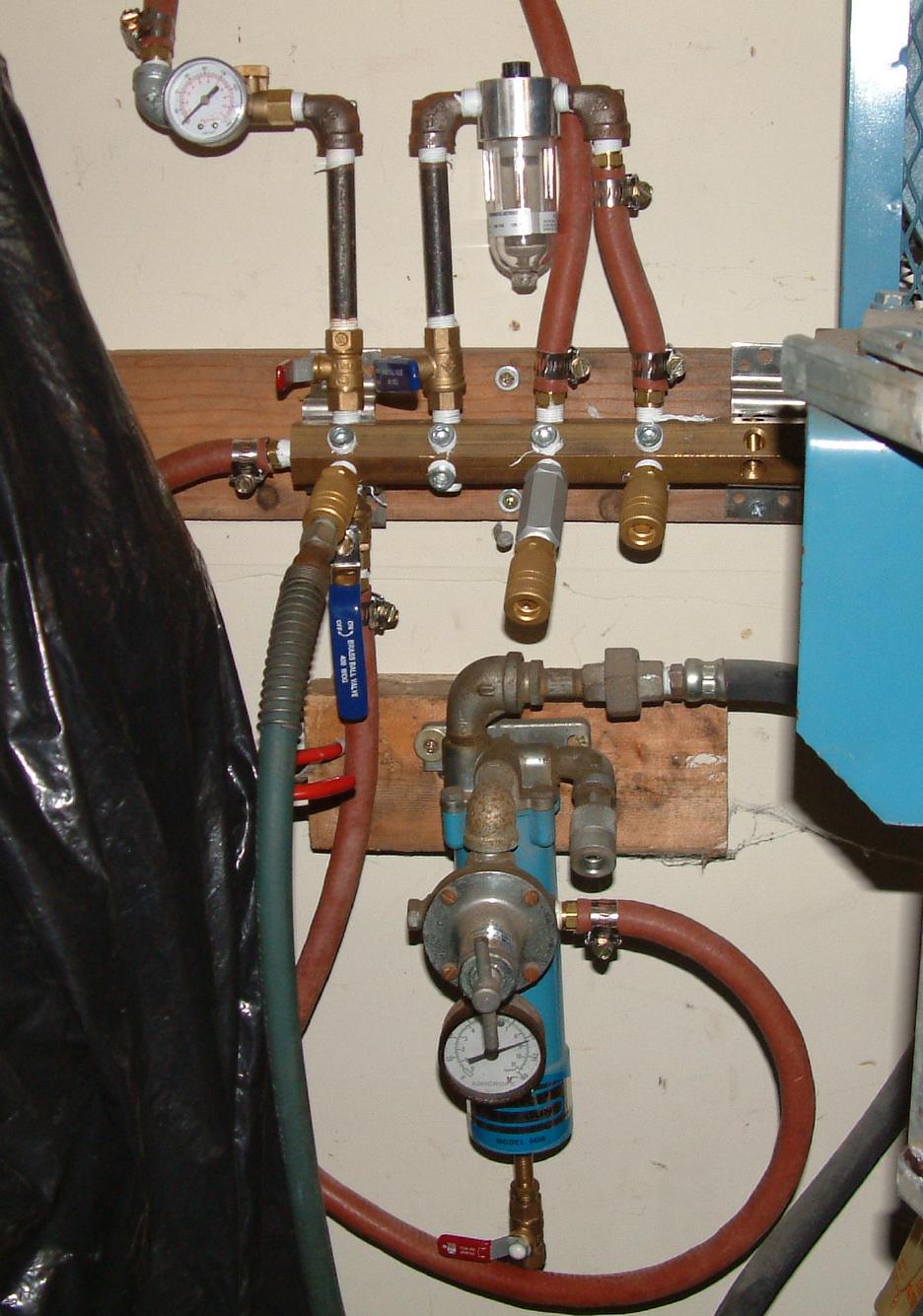
Now that I have your attention I can assure you I am only going to talk about compressed air.  At a compressed air seminar I attended yesterday, I saw many images of poorly connected air lines and fittings. The majority of the cases I saw all boiled down to one common denominator.  See if you can find anything wrong with the pictures below and then we’ll get into it.

The first picture shows the easy way to hook up a regulator and make it easy to take apart.   The issue is the quick disconnects may make it easy to hook something up or take the regulator out for maintenance but you are also restricting your flow considerably.  If you were to hook a Soft Grip Safety Air Gun up at the end of the line you would be limiting the amount of air you can flow to the gun before it even gets to the regulator.   The correct way to plumb this system would be to have a larger supply line and then have the regulator as close to the point of use as possible.  Also if you are setting all the regulators throughout your facility to the same point, i.e. 80 PSIG, then why pay to generate more at the source.  Reduce your compressor output to 80-90 PSIG.

The second picture has a lot going on and again the main problem here is all the leech hoses from the manifold are the same size, if not bigger than the supply line.  Not to mention the line that goes from one port on the manifold back to another port on it.  This means as soon as you turn on one leg of that manifold you might be at the capacity for that line and starving other processes.

The answer isn’t installing more compressors, the answer is to utilize the compressed air wisely making sure your system is plumbed properly.   We preach it every day here and can’t stress it enough.  If you have questions about your compressed air application or how to approach it, don’t hesitate to contact us.

Enjoy the weekend everybody!

Brian Farno
Application Engineer
BrianFarno@EXAIR.com
@EXAIR_BF