What is Sound and Interesting Facts About Sound

In physics, sound is a wave of pressure. It occurs in a medium, which can be a solid, liquid or gas. Sound cannot travel through a vacuum, such as in space. The wave of pressure reaches our ears and causes the ear drum to vibrate, which then goes through a complex process to ultimately be perceived as audible sound.

There are several characteristics of sound waves that can be measured and help define the sound. A sound wave can be visualized as a repeating sinusoidal wave (see below), and can be described by these properties – frequency and wavelength, amplitude, and speed.

Sound Wave
Sound Wave
  • Frequency is the number of cycles in 1 second, and is measured in Hertz (Hz)
  • Wavelength is the distance over which 1 cycle occurs, and for audible sound is  between 17 m and 17 mm long
  • Amplitude is the measure of its change over a single period, and normally a measure of sound loudness
  • Speed is the distance traveled per unit time

The speed of sound in air can be found using the equation:  a = Sqrt (γ•R•T)

where for air:
γ = ratio of specific heats = 1.4,
R = gas constant = 286 m²/s²/K
T = absolute temperature in °K (273.15 + °C)

At room temperature, 22°C (71.6°F), the speed of sound is 343.8 m/s (760 mph)

Some interesting facts about sound:

  • Sounds generally travels faster in solids and liquids than in gases.
  • You can estimate the distance from a lightning strike by counting the seconds that pass between seeing the lightning flash and hearing the thunder.  Take this duration an divide by 5 to get the distance away, in miles.
  • Humans normally hear sound frequencies between 20 Hz and 20,000 Hz.
  • Sound waves above 20,000 Hz are known as ultrasound, and sound waves below 20 Hz are known as infrasound.
  • Sound travel through water close to 4 times faster then through air.
  • The sound of a cracking whip occurs because the speed of the tip has exceeded the speed of sound.

Sound that is too loud can be a problem. The Occupational Safety and Health Administration (OSHA) has set limits on the noise exposure that an employee can be subjected. Exceeding these values can cause permanent damage to your ears and cause noise induced hearing loss. So, knowing and reducing the sound levels within a manufacturing operation is important.

OSHA Chart

EXAIR has many products that can help reduce the sound levels in your processes.  With products such Air Knives, Air Wipes, Air Amplifiers, Air Nozzles and Jets, and Safety Air Guns, strong, quiet and efficient blowoff, drying, and cooling can be performed.

Quiet Products

If you have questions about sound and keeping your sound levels in check or any of the 15 different EXAIR Intelligent Compressed Air® Product lines, feel free to contact EXAIR and myself or any of our Application Engineers can help you determine the best solution.

Brian Bergmann
Application Engineer
Send me an email
Find us on the Web 
Like us on Facebook
Twitter: @EXAIR_BB

OSHA 29 CFR 1910.15(a) – Occupational Noise Exposure Limits

Hearing loss due to high noise levels is a common problem in many industrial facilities. Without the use of proper PPE, hearing loss can occur quickly. This is a serious concern as hearing loss is permanent and once the damage is done there’s no way to reverse it. Due to this risk, OSHA strictly enforces standard 29 CFR-1910.95(a).

This directive discusses the effects of noise and limits exposure based on the dBA. The table below indicates the maximum allowable exposure time to different noise levels. Sound levels that exceed these levels should first be addressed by proper engineering controls such as isolating the source of the sound from personnel or replacing the cause of the sound with something like an engineered compressed air nozzle. When such controls aren’t feasible, proper PPE must be worn to protect the operator.

OSHA Chart

Hearing loss can occur in as little as 30 minutes when exposed to sound levels 110 dBA or greater. Operators have a tendency not to use PPE as directed, if an OSHA inspector comes to your facility and notices that the sound levels exceed the maximum allowable level without protection hefty fines will be soon to follow. In this example from the United States Department of Labor, a company was fined a total of $143,000 for failing to protect their employees.

SoundMeter_new_nist225
Model 9104 Digital Sound Level Meter

In order to identify the places or processes in your facility that are causing the problems, you’ll need a tool to measure the sound level. EXAIR’s easy to use Digital Sound Level Meter allows you to measure and monitor the sound level pressure in a wide variety of industrial environments. The source of the loud noise can then be identified and isolated so that corrective action can be taken. For compressed air related noise, EXAIR manufactures a wide variety of engineered compressed air products that can reduce the sound level dramatically. In many cases, EXAIR products are capable of reducing noise levels by as much as 10 dBA. Since the dBA scale is logarithmic, this equates to cutting the sound level in half!

sound-level-comparison
Drilled pipes and open ended tubes are the common culprit for excessive noise levels. Replacing them with an engineered solution often eliminates the need for hearing protection.

If there’s processes within your facility that are above these limits and you’d like to eliminate relying on proper PPE, give an Application Engineer a call. We’ll help walk you through the selection process and make sure that when the OSHA inspector comes knocking you’re prepared!

Tyler Daniel
Application Engineer
E-mail: TylerDaniel@exair.com
Twitter: @EXAIR_TD

Sound – It Adds Up! How to Calculate Decibel Levels

Keeping noise levels in check and at safe levels is very important to ensure employee safety and well being.  OSHA (the Occupational Safety and Health Administration) through standard 29 CFR-1910.95(a) has studied the situation and set Maximum Allowable Noise Exposure limits in Hours per Day based on the Sound Level, in dBA, of exposure.

For existing processes, a Digital Sound Meter is a valuable tool to measure the sound level to ensure that the source of loud noises can be quickly identified and isolated for immediate corrective action.

For new processes, or changes to an existing process, it is important to estimate the sound level prior to installation and start-up, so that precautions can be taken as needed.

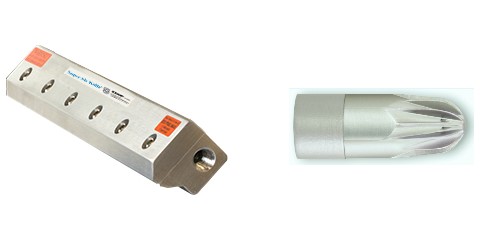
For example, let’s say we are going to add a blow off station to clean off a part on a conveyor to improve the process and increase the throughput.  A typical set-up might be a 12″ Super Air Knife (model 110012) blowing off the top and a pair of Super Air Nozzles (model 1100) to blow off the sides.

SAK and ASAN
12″ Super Air Knife and Super Air Nozzle

If we look at the performance data for the (2) different blow off devices, we find that the Super Air Knife is rated at 69 dBA and the nozzles at 74 dBA, when operated at 80 PSIG of compressed air supply.

SAK and ASAN

When asked, “what is the sound level for (1) of the knives, and (2) of the nozzles” a little Acoustic Engineering is in order. The decibel scale is logarithmic, and determining the total sound level when all (3) devices are in operation is not as easy as adding up the three sound level values (which would equal 218 dBA, way off the charts!).  Thankfully, both the actual sound level and the numerical value are determined another way.  I’ll spare you a lot of the math but the equation is as below.

Capture

… where SL1, SL2, SL3, … are the sound levels in dBA of the each sound makers, for as many that are being combined (in our example SL1 = 69, SL2 = 74 and SL3 = 74)

Plugging in the numbers into the equation, the combined sound level works out to be a quiet 77.65 dBA — well within the OSHA limit for exposure for a full 8 hour period.

To discuss your application and how an EXAIR Intelligent Compressed Air Product can make your process better and quieter, feel free to contact EXAIR and myself or one of our other Application Engineers can help you determine the best solution.

Brian Bergmann
Application Engineer

Send me an email
Find us on the Web 
Like us on Facebook
Twitter: @EXAIR_BB

Digital Sound Level Meter Identifies Harmful Noise in the Workplace

slm-newlabel EXAIR offers the model 9104 Digital Sound Level Meter.  It is an easy to use instrument for measuring and monitoring the sound level pressures in and around equipment and other manufacturing processes.

Sound meters convert the movement of a thin membrane due to the pressure waves of sound into an electric signal that is processed and turned into a readable output, typically in dBA.  The dBA scale is the weighted scale that most closely matches the human ear in terms of the sounds and frequencies that can be detected.


To protect workers in the workplace from suffering hearing loss OSHA has set limits to the time of exposure based on the sound level.  The information in the OSHA Standard 29 CFR – 1910.95(a) is summarized below.

OSHA Noise Level

The Digital Sound Meter can be used to monitor and measure sound levels of manufacturing processed such as blowoffs for cooling or drying.  Many blowoffs, especially open or drilled pipes are very inefficient and can be identified as a source of excessive noise, outside the OSHA exposure ranges.  Once the noise violators are identified, a review can be done and the implementation of engineered solutions such as Super air Nozzles or Super Air Knives can be investigated. Keeping harmful noise levels in check benefits everyone involved.

The EXAIR Digital Sound Level Meter is an accurate and responsive instrument that measures the decibel level of the sound and displays the result on the large optionally back-lit LCD display. There is an “F/S” option to provide measurement in either ‘slow’ or ‘fast’ modes for stable or quickly varying noises. The ‘Max Hold’ function will capture and hold the maximum sound level, and update if a louder sound occurs.

Certification of accuracy and calibration traceable to NIST (National Institute of Standards and Technology) is included.

There is an informative Video Blog, presented by @EXAIR_LE that can be found here.

If you have questions about the Digital Sound Level Meter, or would like to talk about any of the quiet EXAIR Intelligent Compressed Air® Products, feel free to contact EXAIR and myself or one of our Application Engineers can help you determine the best solution.

Brian Bergmann
Application Engineer

Send me an email
Find us on the Web 
Like us on Facebook
Twitter: @EXAIR_BB