The Importance Of Preventative Maintenance

The first new car I ever bought was a 1995 Ford Escort Wagon. It got GREAT gas mileage (which was important for my 25 mile one-way commute to the day job), and had ample room to haul my keyboards & amplifier rig (which was just as important to my side hustle as a potential rock star). Since it only had four miles on the odometer – and, it was the first purchase I ever financed over a period of YEARS, I decided to follow the owner’s manual’s maintenance schedule religiously. And it paid off: I got eleven years and just shy of 200,000 miles out of one of the least expensive cars ever made. It was actually still running like a top when I sold it to “upgrade” to a minivan, which suited my needs at the time for a vehicle that fitted the car seats for our little boys (who are now a U.S. Marine and a hippie college student, respectively). I actually followed the maintenance schedule for that minivan too, and got 14 years & almost 180,000 miles out of it, without a major breakdown.

Whether you call it “preventive”, “preventative”, “scheduled”, or “planned” maintenance, there’s an old adage that applies in any case:

“If you don’t plan maintenance, it’ll plan itself without regard to your schedule.”

While following the proverbial “owner’s manual’s maintenance schedule” doesn’t guarantee against catastrophic failures, it’s awfully good insurance against them. For your privately owned vehicles, I encourage you to follow the owner’s guide as best you can. For your compressed air system – from the compressor to the devices it provided compressed to (and everything in between) – there’s likely similar documentation to follow, and for good reason. Consider:

  • Air compressor maintenance. Failure to properly maintain a compressor can increase energy consumption by not keeping it operating as efficiently as possible. For example, just like not periodically replacing your car engine’s air filter will impact your gas mileage, failure to do the same for your compressor’s intake air filter will impact its production of compressed air.
  • Air leaks are costly. Not only do they waste the money you spent on running the compressor (a leak that’s equivalent to a 1/16″ diameter hole costs you over $700.00 annually – let me know if you want to do the math on that), your system pressure takes a hit too. Pressure drop caused by those leaks (plural because there’s rarely just one) can create what’s known as “false demand”, which costs you money as well: every 2psi increase in compressor discharge pressure makes for a 1% increase in power consumption. So, it’s really important to stay on top of them. Regularly scheduled surveys with an instrument like EXAIR’s Model 9207 Ultrasonic Leak Detector allows you to quickly find – and then fix – those leaks.
EXAIR Model 9207 Ultrasonic Leak Detector comes with everything you need to find out if you have a leak (with the parabolic disc, lower right) and then zero in on its exact location (with the tubular extension, bottom).
  • Filters, part 1: I already mentioned the compressor intake filter above, but the rest of the filters in the system need attention from time to time as well. Filter manufacturers typically call for replacing the element in a filter when pressure drop reaches a certain point. I’ve seen published values of 2-5psi for that. Of course, that may not occur at a convenient time to shut down everything downstream of that filter, so lots of folks replace those elements as part of planned maintenance evolutions that require depressurization of that particular part of the system anyway. Dirty filters mean you have to increase their inlet pressure to maintain the same outlet pressure you had when they were clean – and the same 1% increase in power consumption for a 2psi pressure increase applies here too.
  • Filters, part 2: most compressed air operated products have small passages that the air has to flow through, and without filtration, those can get clogged with dirt that the intake filter doesn’t catch, solid particulate from compressor ‘wear & tear’, and rust from header pipe corrosion, just to name the “usual suspects”. An argument could be made that installation & upkeep of properly rated Filter Separators at the point of use of these devices is part of those devices’ planned maintenance. In any case, it’s akin to the awfully good insurance against catastrophic failures I mentioned earlier.
Good engineering practice calls for point of use filtration and moisture removal, such as that provided by EXAIR Filter Separators.

Again, many of the components that make up a typical industrial compressed air system will have a manufacturer’s recommended maintenance schedule, but if they don’t, how can you properly plan for it? Monitoring of certain system parameters can be a valuable tool for determining how often some planned maintenance should be performed:

  • Power consumption of the compressor. The benefit of measuring & logging this on a regular basis is, if you see sudden changes, you can start looking for what’s causing them. Maybe a bearing or belt is wearing out, some leaks have popped up, or a filter’s clogged. In any case, it’s an indication that SOMETHING needs attention. Large industrial compressors might even have power monitoring in their control scheme. If not, there ARE other parameters you can measure…like:
  • Pressure and flow. EXAIR’s Pressure Sensing Digital Flowmeters make monitoring these parameters quick and easy. Managing the readings can be done with our USB Data Logger, or you can get it on your computer, via a Zigbee Mesh Gateway, with our Wireless Models.
EXAIR Digital Flowmeters are made for iron, copper, or aluminum compressed air pipe in sizes from 1/2″ to 8″ diameters. Options include Pressure Sensing, Wireless Output, USB Data Logger, Hot Tap, and Metric display.

At EXAIR, we’re committed to helping you get the most out of your compressed air system. If you’d like our help with that, give me a call.

Russ Bowman, CCASS

Application Engineer
Visit us on the Web
Follow me on Twitter
Like us on Facebook

Featured image courtesy of Compressor1creative commons license

Compressed Air Digital Flow Meters Monitor Your System Demand

In the times we live in, efficiency is key. To offset the rising costs of goods, services, and energy we must be purposeful in lowering costs wherever we can. Every company has large utility expenses such as electricity, water, gas, sewer, waste, and recycling. Many companies have policies and systems in place to help control these expenses. One major utility that gets overlooked is your compressed air. Many companies just loop this expense into the gas and or electricity funnel and move on. But that can be a costly mistake. Assuming you utilize compressed air in your facility, it is most likely your 3rd-4th highest utility expense. The good news is there are many ways to make this utility much more efficient.

We have several EXAIR blogs on how to improve your compressed air efficiency from mitigating leaks, sizing pipe properly, flow control, pressure regulators, engineered nozzles and tools, and even receiver tanks. These are all very effective ways to reduce this expense. There is another tool that I would like to share with you; our Digital Flow Meters. What they are, how they work, and how they can save you money…

With a rough cost of $0.25 per 1000 SCFM, wouldn’t it be nice to know how many SCFM you are using? (Please click here for a great blog on how to calculate your SCFM cost) More importantly how much air are you wasting… Your compressor information already tells you how much air it is producing and with EXAIR’s Digital Flowmeter, you will know the exact amount of compressed air that is being used, making it very easy to identify loss. These losses are primarily found in leaks or inefficient air products. A best practice is to install one of these on each leg of the air distribution system and monitor and and benchmark the compressed air usage.

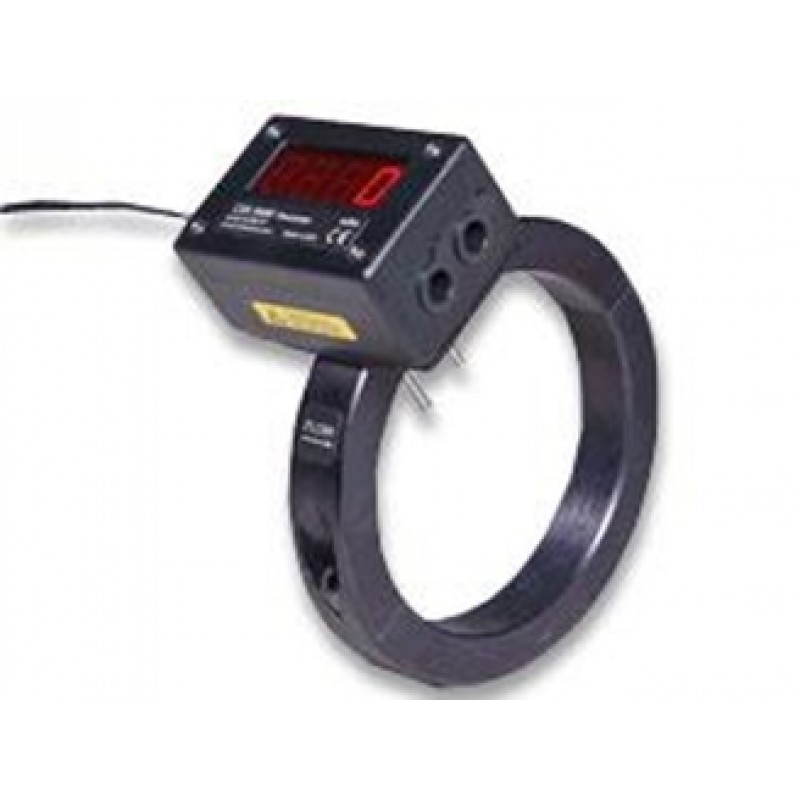
EXAIR Digital Flowmeter

The EXAIR Flowmeters work by measuring the temperature differential between two probes that are inserted into the compressed air pipes. One probe is kept warmer than the other, and the mass flow rate is determined by the amount of heat required to maintain the temperature differential. The flow rate, or SCFM is displayed on the large digital display

To install the Flowmeters, you will drill 2 holes into your pipe for the probes. Included with the meter is the drill bit and the Drill Guide to quickly install the meter. We have these available in many sizes from 1/2″ to 4″ iron pipe, We also offer these for Copper Pipes, and can make / calibrate them for many others, we will just need the information.

In addition to our standard version we offer several upgrades. One is a Data Logging version. You can download our software and then set the data logging to record from once a second for about 9 hours of data to twice a day for over 2 years worth of data. You simply plug the Data Log Stick this into your computer, download and repeat.

We also offer a wireless option that will run through a ZigBee mesh Network. A radio module within each meter transmits data to an ethernet connected gateway. You can also piggyback meter to meter to extend the range for this wireless solution. Each meter has a range of about 100 feet.

Many people ask if they have to shut down their system to install the Flowmeters. Understanding that this could cause systemic issues, we have a Hot Tap option that will allow you to install while the pipe is still under pressure. It incorporates 2 valves that the probes pass through as well as a muffler that collects the chips from the drilling process. This is only available on the 2″ or larger units.

Speaking of pressure, we also offer a Pressure Sensing Digital flow meter. On this, there is a pressure sensor that is mounted between the two flow sensor probes. The pressure is sent via a second milliamp output. The display can be configured to show either pressure or flow. You can set this to send alarms if the pressure falls under 50 psi. Also only available on 2″ pipes and above.

Finally, we also offer Block Off Rings. These are simply rings to block off holes where the flowmeter was, in case you need to use the same one in a different location.

Please fee free to reach out with any questions, or for more information. Let us help you save air and money…

Thank you for stopping by,

Brian Wages

Application Engineer

EXAIR Corporation
Visit us on the Web
Follow me on Twitter

Why use EXAIR’s Digital Flow Meters

Since air compressors use a lot of electricity to make compressed air, it is important to use the compressed air as efficiently as possible. EXAIR has six simple steps to optimize your compressed air system. Following these steps will help you to cut electrical costs, reduce overhead, and improve your bottom line. In this blog, I will cover the first step – Measure the air consumption to find sources that use a lot of compressed air.

Six Steps to Optimizing Your Compressed Air System

Information is important to diagnose wasteful and problematic areas within your compressed air system. To measure air consumption, flow meters are used to find the volume or mass of compressed air per unit of time. Flow rates are very useful data points to find problems like leaks, over-use in blow-offs, waste calculations, and comparison analysis.

There are many different types of flow meters. Many of them entail a breakdown of your current compressed air lines by cutting, welding, or dismantling for installation. This will add cost in downtime and maintenance staff. But, not with the EXAIR Digital Flowmeters. In this blog, I will share the features and benefits of the Digital Flowmeters including options for you to start measuring and optimizing your compressed air system in Step 1.

Digital Flowmeter

Overall, it only takes a few minutes to install and start measuring. The installation kit comes with a drill bit and a drill guide to properly locate the two holes on the pipe. The Digital Flowmeter uses a clamp to mount to the pipe and to seal the area around the probes. Once it is powered, the unit is ready to measure the air flow inside the pipe with a large LED display. The display can be customized to show flow readings in three different units; SCFM, M3/hr or M3/min; and, it can display the Daily Usage and Cumulative Usage.

To get started, the EXAIR Digital Flowmeter is a thermal dispersion device that can accurately measure compressed air flows. They use two sensing probes for comparative analysis. One probe is a temperature sensing probe, and the other is a flow-sensing probe. By comparing these, the Digital Flowmeter can measure precisely the mass air flow without needing to be recalibrated. They are a cost-effective, accurate, and simple way to measure compressed air flows.

EXAIR stocks a large volume of Digital Flowmeters to ship same day for U.S. and Canadian customers. We also offer a 30-day unconditional guarantee to try them out. We stock meters for pipe diameters from ½” NPT to 4″ NPT Schedule 40 black pipe. EXAIR can also offers flow meters up to 8″ NPT black pipe; copper pipes with diameters from 3/4″ to 4″, and aluminum pipes with diameters ranging from 40mm to 101mm. If you have another type of piping for your compressed air system, you can give us the material, O.D. or I.D., and wall thickness. We may still be able to get a Digital Flowmeter for you.

For measuring, all the units come standard with a 4 – 20mA analog output. Per your request, we can change this signal to a serial output for RS-485 or Ethernet connections. What more can we offer with the EXAIR Digital Flowmeter? Options. Options upgrade the flow meters to better suit your application. Here is a list below:

EXAIR’s Digital Flowmeter w/ USB Data Logger

USB Data Logger: This option allows for a recording of the flow information. With a software download, you can setup the USB Data Logger to record the flows from once a second (roughly 9 hours of storage) to every 12 hours. After the data points are recorded, you can then download the information into the software to review. Then the information can be uploaded into an Excel program to do further analysis.

Summing Remote: With compressed air pipes running along the ceiling and walls, reading the Digital Flowmeter may be difficult. The Summing Remote has a 50-foot (15 meter) cable to bring the LED display into viewing. The Summing Remote is powered by the Digital Flowmeter, and it can be positioned at eye level, inside managers’ rooms, or around large equipment for monitoring.

Digital Flowmeter w/ Wireless Capability, Gateway, and Drill Guide Kit

Wireless Capability: Our latest Digital Flowmeter now has wireless capabilities. They use a Zigbee® communications to pick up flow readings from other flow meters and the Gateway. The Gateway can detect over 100 Digital Flowmeters in your facility. From the Gateway, the information is transferred through a LAN. You can record and analyze the flow information from each meter on the network with our EXAIR® Logger Software. You can set limits to send warnings when your compressed air system is using too much or too little of compressed air. This technology makes it very easy for measuring your compressed air system in the entire facility without having to be there.

Hot Tap DFM

Hot Tap Digital Flowmeter: This option is a great way to install a Digital Flowmeter to the pipe without shutting down the compressed air line. We offer this option for 2″ and larger flow meters for steel and copper pipes. It gives a quick and easy way to attach if you have a 24-hour operation or a critical process that needs to continue to run.

Pressure Sensing Port

Pressure Sensing Digital Flowmeter: If you would like to know the compressed air flow and the air pressure, this option will be able to do this. They are available with the Digital Flowmeters for steel and copper pipes that are 2″ and larger, and for the aluminum piping that is 50mm and larger. This option can display pressure units in either PSI or Bar right on the same LED display that shows the flow readings.

When you need to analyze your pneumatic components, flow is an important point in diagnosing the overall “health” of your compressed air system. The EXAIR Digital Flowmeter can give you that important data point. With optimization, you can cut your energy consumption, improve pneumatic efficiencies, and save yourself money. This blog is an overview of Step 1 of six steps. You may have more questions; and, that is great! You can find them in other EXAIR blogs, or you can contact an Application Engineer at EXAIR.

Jordan Shouse
Application Engineer

Send me an Email
Find us on the Web 
Like us on Facebook
Twitter: @EXAIR_JS

EXAIR Digital Flow Meters

A topic that we’ve talked about here on the EXAIR blog discusses the costs of compressed air and how to use it more efficiently. How can you determine the costs of your compressed air? The first step you’ll need to take is to put a number to how much compressed air you are currently using. In order to do that you’ll need a measurement tool such as the EXAIR Digital Flowmeter.

EXAIR Digital Flow Meters

The Digital Flowmeter is available from stock for use on Schedule 40 pipe with sizes ranging from ½”-4” I.D. Sizes up to 8” for Schedule 40 and ¾”-4” for copper pipe are also available. Metric sizes are also available for 25mm, 40mm, 50mm, 63mm, 76mm, and 101mm. With a digital readout display, it’s easy to accurately monitor your compressed air usage throughout the facility. Creating a baseline of your usage will allow you to understand your compressed air demand, identify costly leaks, and replace inefficient air products.

The Digital Flowmeter installs in minutes with help from a drill guide and locating fixture to assist in mounting the Digital Flowmeter to the pipe. Two flow sensing probes are inserted into the drilled holes in the pipe. The meter then seals to the pipe once tightened. There is no need to cut, weld, or do any calibration once it is installed. With blocking rings also available, installation can be permanent or temporary. Below is a easy to follow video on how to install EXAIR’s Digital Flow Meter!

The newest addition to this product line is the Digital Flowmeter with wireless capability. Using a ZigBee® mesh network protocol, data is transmitted to an Ethernet connected gateway. This allows you to mount the Digital Flowmeter in areas that you may not be able to easily access and wirelessly monitor and graph the usage with the EXAIR Logger software. Take a peek at this video blog for a demonstration of the use of a wireless Digital Flowmeter software to compare an open pipe to an engineered Air Nozzle.

wirelessdfmpr2_1670x574
Wireless output gives you the freedom to track air usage data from any computer!

In addition to communicating wirelessly with the gateway, the Digital Flowmeters can “piggyback” off of each other to extend their range. Each meter has a range of 100’. Using multiple Digital Flowmeters within the same ZigBee® mesh network, data can be passed from meter to meter to extend the distance over which the meters can operate. These can be installed on each major leg of your compressed air system to continuously monitor usage throughout the facility.

If you’d rather go with a hard-wired data collection method, the Digital Flowmeter is also available with a USB Data Logger. Simply remove the Data Logger from the Digital Flowmeter and connect it to the USB port of your computer. The data can then be viewed directly in the accompanying software or exported into Microsoft Excel.

dataloggerPRce_559wide
Add a Data Logger for easy Value Tracking

Two special flow meter options we now offer are the Pressure Sensing Digital Flowmeters, and the Hot Tap Digital Flowmeters!

Pressure Sensing Digital Flowmeters help by generating a pressure and consumption profile of a system can help to pinpoint energy wasters such as timer-based drains that are dumping every hour versus level based drains that only open when needed. Hot Tap Digital Flowmeters offer a way to install a flow meter on a pipe that is currently under pressure. It uses a series of valves and mufflers to maintain a safe working environment for the installer.

If you’d like to get a clear view of your compressed air usage, give us a call. An Application Engineer will be happy to work with you and get the proper Digital Flowmeters installed in your facility!

Jordan Shouse
Application Engineer

Send me an Email
Find us on the Web 
Like us on Facebook
Twitter: @EXAIR_JS