
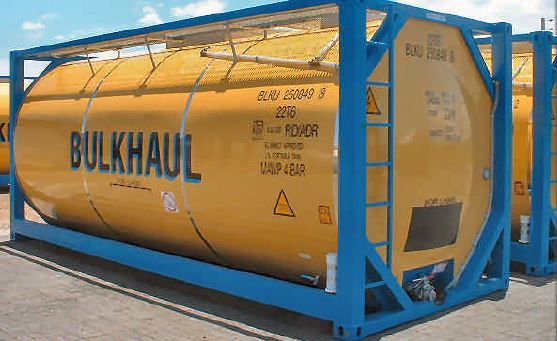
Vortex Tube Thaws Steam Connections on Bulk Liquid Sea Containers

Bulk container

Vortex Tube applications for cooling are many and a wide variety. Heating applications though, do tend to be a bit more elusive. That being said, I thought I would highlight a recent application where vortex tubes were used to thaw out steam lines that are used to heat up fluids in bulk sea containers.

We have all seen them running up and down the expressways, the large, bulk liquid containers that have the multi-modal capability to be on a ship, a train or a truck going down the road. I personally never thought about what the users of these tanks must do in order to get the liquid inside up to certain temperatures to allow the material inside to flow easily. I live in the Midwest area of the US, so we get really cold weather for only a few weeks during the year. In the Northern climates though, these bulk container users must have ways to thaw out the product before it can be used. To do this, these bulk containers are equipped with steam lines. Steam is used to heat the liquid inside to get it up to temperature. Once the steam is connected to the lines and circulating, all is well. But before they can get to that point, the steam connections on the tank are usually plugged with ice from condensate from previous use. The previous method was to simply snake a steam line up inside the heater lines to warm them up, but that presented a further problem. That same condensate ends up rolling out the pipe and dripping on the ground, re-freezing and creating a huge slip hazard.

 Steam connections

Above are the typical 1” BSP steam connections found on the bulk tanks.

In order to eliminate the slip hazard, the customer began looking for another method to supply a hot gas to these steam lines to thaw them out. In comes EXAIR with our Vortex Tube selection. The idea is to replace the mini steam line with the hot air output flow from a vortex tube to thaw out the connections. Since the customer has compressed air utility in plentiful supply on site, this makes for a very convenient way to warm up the pipes with a relatively “dry gas”. That being the dry compressed air supplied in the facility. The customer ended up using (2) model 3225 Vortex tubes with Cold Flow Mufflers, to provide the hot air for the steam connections. In fact, the diameter of the hot tube for the vortex tubes was the perfect size to simply slide up inside the steam pipes and hang there until the pipes were free of the problematic ice. There was still some small amount of liquid that re-froze from within the steam pipes, but it was certainly much more manageable than the mess the customer was dealing with previously.

Neal Raker, Application Engineer
nealraker@exair.com

Shared Details Equal Better Solutions

Fortunately for us, and our customers, we manufacture custom parts to meet their application if our cataloged products do not meet their requirements. Just look at these blogs. Customers often come to us to know if our products can be used in a corrosive environment, or if they are suitable within a high temperature, or within a small envelope.  Shortly after I started working in the Application Engineering department, I have found that the answers to these questions are generally “Yes, but why?”

Our marketing department does a great job of displaying our capabilities.  Just look at the special pages: Air Knives, Line Vacs, Air Amplifiers, or Cabinet Coolers. We can make a great variety of products and materials, but we always will ask the next question. Why?

Some customers are surprised at how emphatic we can be about knowing why you need a special part or process. We are only asking to best serve you. For instance, I had a customer come to me today after seeing our Special Air Knife page and seeing our flat Super Air Knife that is only 11/16″ thick.  This is a great product for its application, but when compared to our stock Super Air Knife, it is more expensive and carries and cannot be shipped until 2-3 weeks after it is ordered since we would build it from scratch.  Customers first look at the Super Air Knife and see that the overall height of the product is 1.44″, which is too large to fit in their machine.  When they see that the Super Air Knife is too big they assume they need something special.  This is generally, when I get a call like this.

“I need your Flat Super Air Knife. What is the part number and price?”

Flat Super

“We don’t have a standing part number for that unit. It was a special part that we created for a specific customer. Why do you need that model?” I reply.

“It is thinner than the Super Air Knife.” – customer

“Have you looked at the Full Flow Air Knife?” – my reply

“No, What is that?” – customer

This is where the reasoning behind the request is so important. Purchasing one piece of a custom made thin Super Air Knife pictured above is significantly more expensive than the production run and in stock Full Flow Air Knife.  The Special thin Super Air Knife is 0.688″ thick. The Full Flow Super Air Knife is 1.03″ thick. And in this case case, the Full Flow Air Knife worked for this customer.  This is just one example of finding out why a customer needs a special product is so important.  If the machine envelope is 1.25″ the Full Flow Air Knife will fit just fine. If the machining envelope is 0.75″, a Special thin Super Air Knife will be the solution. When we share the details together, it is easier to produce the best solution for our customers.

Dave Woerner
Application Engineer
DaveWoerner@EXAIR.com
@EXAIR_DW

EXAIR Air Wipes

Super Air Wipe

Whenever I come across an extrusion application, I am reminded of an on-site visit I made with our Costa Rican distributor, Dansar Industries.  During our visit we reviewed a previously solved application problem in which an extrusion line was experiencing poor coolant removal and high noise levels.  The EXAIR Super Air Wipe installed in the application corrected the poor coolant removal problem, brought the noise level down, and lowered compressed air use.

The secret to offering such a solution was the ability of the distributor to spot the application and make a model number recommendation accordingly.  When walking through the shop floor of your facility, remember the following tenets when considering an EXAIR Air Wipe:

  1. The Standard Air Wipe and Super Air Wipe have the same performance. The choice of which to use is based on the material of construction for various components.
  2. A difference of ~0.5” (13mm) is ideal between the OD of the part and the ID of the Air Wipe.
  3. A difference that is larger than ~0.5” (13mm) can be acceptable in many applications, depending on speed of travel of the material, shape of the material, inlet air pressure, etc.
  4. For applications exceeding our largest Air Wipe diameters we recommend an arrangement of Super Air Knives and/or nozzles to provide a solution.
  5. Maximum line speed when using an Air Wipe must be determined through testing.

As with any EXAIR products, our Air Wipes are OSHA compliant and maximize force per volume of compressed air consumed.  If you have any specific questions regarding the use of an Air Wipe in your application, contact an EXAIR Application Engineer.

Lee Evans
Application Engineer
LeeEvans@EXAIR.com
@EXAIR_LE

The (Not So) Dreaded Warranty Claim Call, Resolved

A couple of weeks ago, I wrote about warranty claims…one, specifically, that I had recently received (it’s still worth a look even if you remember it well, just for another chance to see the old luggage commercial with the gorilla again.) I also advised my readers to stay tuned, which reminds me of another blast from my past as a kid who watched way too much TV in the early 1970’s…

same_bat-time_same_bat-channel

We did, in fact, receive and evaluate the failed Stay Set Hose. This is a formal process by which our Quality Control team analyzes all the information that I can give them as to the application, installation, and use of the product. They then perform a detailed inspection, evaluation, and test (if needed) of the product in question. I won’t say we never find manufacturing or assembly problems, but our records indicate we’ve never found the same one twice…we’re keenly aware that the first time may be a mistake, but the second time is a choice.

More often than not, we find the problem is due to easily correctable installation, operation, or air supply problems. In this case, when we inspected the bendable element, we could see that it had been subjected to an unsupported, twisting motion, which had fatigued it at the point where it was bent, and sheared it away from its internal connection.  The customer and I had already gone over the common best practices for their use (which included properly supporting the hose while bending…see pictures below,) so they got a replacement Stay Set Hose, and are back in operation.

Hose is being bent with one hand, with no support at the bending point.  DON'T DO THIS.
Hose is being bent with one hand, with no support at the bending point. DON’T DO THIS.
Hose is being held firmly at connection end, providing support for the element's connection inside the fitting.  DO THIS INSTEAD.
Hose is being held firmly at connection end, providing support for the element’s connection inside the fitting. DO THIS INSTEAD.

If you’ve got questions about how EXAIR’s Intelligent Compressed Air Products…and accessories…can make better use of your compressed air, give me a call.

Russ Bowman
Application Engineer
(513)671-3322 local
(800)923-9247 toll free
(513)671-3363 fax
Visit us on the Web
Follow me on Twitter
Like us on Facebook