Critical Factors to Consider When Designing Your Compressor Room

One common thing that can be easily overlooked is the importance of designing an efficient compressor room. After you’ve determined your overall requirements and selected the appropriate compressor, you can begin designing the layout of your compressor room. For starters, the compressor room should be located in a central location when possible, close to the point of use. This will help to minimize pressure drop as well as reduce installation costs as less piping will be required. If this isn’t possible, try to keep the compressor room close to the larger volume applications in your facility. Otherwise you will have to use larger diameter piping in order to ensure an adequate volume of air is available.

The diameter of the distribution piping should NOT be based on the connection size of the compressors, aftercoolers, or filters. According to the Compressed Air Challenge Best Practices for Compressed Air Systems handbook, piping should be sized so that the maximum velocity in the pipe is 30 ft/sec. When the distance between the compressor room and the point of use is lengthy, consider increasing the pipe diameter to minimize the pressure drop across the system.

Inside of your compressor room you’ll have a variety of different equipment, all dependent on the demand, quality, supply, storage, and distribution of your compressed air. Keeping all of the equipment in its own room will also provide some insulation from the noise associated with compressed air generation. It is crucial that the space selected as your compressor room is sufficiently large enough to accommodate everything without becoming cramped. As a general rule of thumb, keep about 3′ of space between equipment such as the compressor, receiver tanks, aftercooler, and dryer. This helps to prevent equipment from overheating as well as offers maintenance personnel adequate space with which to perform any regularly scheduled maintenance or repairs.

Once you’ve selected your equipment, piping, and determined the location, another thing to consider is ventilation. As compressed air is generated, the compressor gives off a good amount of heat. It is important that the exhaust air is not permitted to re-circulate throughout the compressor room. The exhaust needs to be ducted so that it the warm air is not drawn in at the air intake on the compressor. Some equipment, such as refrigerated dryers, require a substantial amount of cooling air. In these situations, an exhaust fan can be used to provide that additional airflow.

To further enhance the efficiency of your facility, the heat generated from compression can be re-purposed instead of simply exhausting into the ambient environment. This process is commonly referred to as compressed air energy recovery. Some industries require a source of heat for many of their manufacturing processes. In these scenarios, the heat energy that is produced during compression can be reused rather than having to generate another source of heated air. If the heated air can’t be used for any of your manufacturing processes, the heat can be used as a means to heat your water supply or even to heat the facility itself. This can drastically reduce your electricity or gas requirements during cooler periods.

To reduce the amount of required maintenance and ensure that your compressor is operating as efficiently as possible, the compressed air intake must also be free from particulate and harmful gases. When dust and dirt is drawn into the compressor, it can cause wear on the internal components. If the ambient environment contains a lot of dust and particulate, a pre-filter can be used to prevent any future problems. In these instances, it is important to consider the pressure drop that will be caused when designing the system.

Keeping these tips in mind will serve to make your life much easier in the long run. Once you have everything installed and set up, visit the EXAIR website or give us a call to speak with an Application Engineer. EXAIR’s Intelligent Compressed Air Products  can help you reduce compressed air consumption and increase worker safety by adhering to both OSHA 1910.242(b) and 1910.95.

Tyler Daniel
Application Engineer
E-mail: TylerDaniel@exair.com
Twitter: @EXAIR_TD

Image Courtesy of  thomasjackson1345 Creative Commons Attribution-NoDerivs 2.0 Generic (CC BY-ND 2.0)

Compressed Air System Drawing Symbols

When any product / system is designed drawings are made to assist in the production of the designed product. For example if a mechanical part is being machined you may see symbols like these to verify the part is made correctly:

GD&T
GD&T Symbol Examples

Same with an electrical panel, they use symbols like the ones below to note the type of equipment used in a location.

electronic.JPG
Electrical Symbol Examples

Then there’s the Piping & Instrumentation Diagram (P&ID)…it depicts an overall view of a system, showing the flow (usually fluid or electricity) through that system’s components, giving the viewer an understanding of the operation, and expected results from said operation.

Some examples of symbols you might find in a compressed air system are:

Compressors:

all-compressor
The one on the left can be used for any air compressor. The others denote specific types of air compressor (from left:) Centrifugal, Diaphragm, Piston, Rotary, and Screw.

Air preparation & handling:

filters-and-regulator-symbols-and-pic.jpg
The symbols on the left denote the EXAIR products on the right: Automatic Drain Filter Separator, Oil Removal Filter, and Pressure Regulator

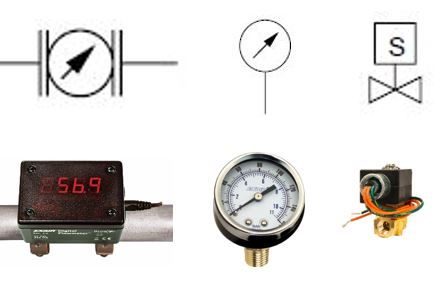
Instrumentation and control:

instrumentation-and-controls1.jpg
The symbols on top denote the EXAIR products below (left to right): Flowmeter, Pressure Gauge, and Solenoid Valve

Occasionally, we’re asked if there are standard ANSI or ISO symbols for any of our  engineered Intelligent Compressed Air Products…and there aren’t.  Perhaps one day they might make the cut, but for now, their standard convention is to choose a shape and call it out by name.  It might look something like this:

sak-pid1
From top left, and then down: Automatic Drain Filter Separator, Oil Removal Filter, Pressure Regulator, and Super Air Knife

If you have questions about any of the quiet EXAIR Intelligent Compressed Air® Products, feel free to contact EXAIR and myself or one of our Application Engineers can help you determine the best solution.

Jordan Shouse
Application Engineer
Send me an email
Find us on the Web 
Like us on Facebook
Twitter: @EXAIR_JS

About Rotary Screw Air Compressors

What is an air compressor? In simple terms it is a machine that increases fluid pressure, it works by changing the volume of air and storing it in a storage tank. Many industries use compressors to increase production and thus has led to the development of many new industries. There are a couple types of air compressors but today I will focus on the Rotary Compressor.

The Rotary Screw Compressor is a very common type of air compressor. This compressor uses dual rotors with meshing lobes that trap air while rotating. The rotation continues to push air toward a discharge port while decreasing the space the air take sup, thus increasing pressure. The rotary compressor has a simple structure with few components and has some clear advantages over other compressors:

  • Longevity
  • When operating, they are quiet
  • Low vibration
  • Continuous operation, or they can match demand

Some disadvantages include:

  • Skilled maintenance required compared to other compressors.
  • They are more expensive than other compressors

There are two types of rotary air compressors. They are oil-injected and oil-free rotary air compressors. Oil-injected rotary screw compressors as the name suggests has oil injected in the compressor element during the air compression. An insignificant amount of oil will escape into the compressed air system also known as “oil carryover”. The use of EXAIRs oil removing filters and filter separators will help remove the oil, moisture and other particulates from the compressed air lines resulting in clean compressed air.

Oil-free rotary screw compressors are similar to the oil-injected compressor but without the use of oil. The oil-free compressors use a two stage system with a cooling process between stages as the compressed air will become extremely hot if not for a cooling process between stages of compression. The oil-free compressors are commonly used in food and medical industries.

EXAIR is here to help with your “Intelligent Compressed Air Products” so please contact us with your compressed air tooling needs.

Eric Kuhnash
Application Engineer
E-mail: EricKuhnash@EXAIR.com
Twitter: @EXAIR_EK

File:IngersollRand R-series-R110.jpg image is licensed under the Creative Commons Attribution 3.0 License.

Vortex Tubes Video – How Fast Can They Produce Cold Air?

Today’s video is going to showcase for you just how fast an EXAIR Vortex Tube or spot cooling product produces cold air to published values. The answer may surprise you. Take a couple minutes and watch, then if you have any questions or want to discuss it further, please contact an Application Engineer.

A Vortex Tube produces cold air instantly, cools down the temperature probe in seconds!

Brian Farno
Application Engineer
BrianFarno@EXAIR.com
@EXAIR_BF