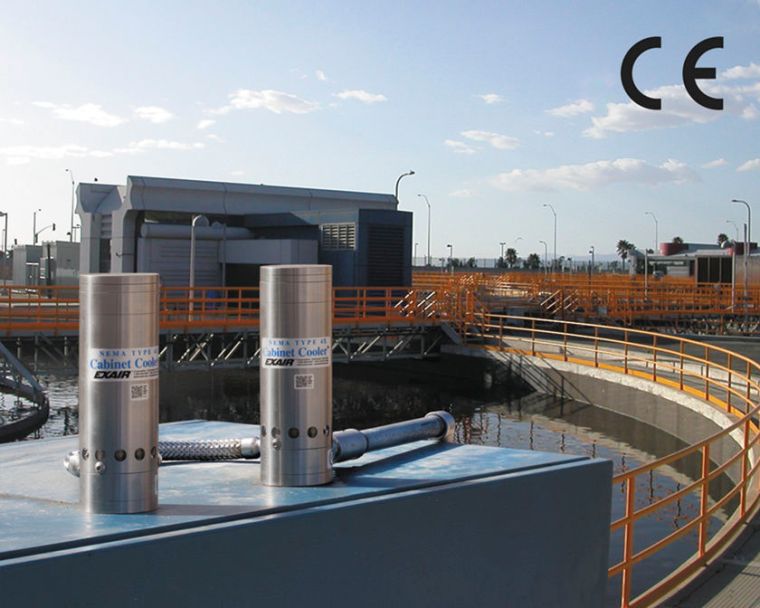
Customized Cooling

Have you ever walked through a production facility and actually looked at and in electrical cabinets? If you did, you would find very few that are identical and even ones that are similar sizes; the internals can be drastically different. When I was in the metal cutting industry customizing, installing, and servicing CNC machines, the same model machine may have different drives for an extra option and can easily add additional heat load to the panel. Bring this up because it’s time we talk about how the dimensions of a panel are not enough to select the level of cooling needed.

Some manufacturers of air movers and “traditional” enclosure cooling method devices will use merely the dimensions of a panel to estimate a heat load and then treat the panel for the worst case scenario. Sometimes it may even be a worst-case scenario for that size of panel. I’m here to tell you from experience that’s not always the best option. This is why we like to have additional information, an “inside man” on the panel, if you will. We want to know exactly what kind of air temperatures we are seeing so that we can use that information combined with some math to determine an acceptable heat load that needs to be dissipated.

The information permits us to size the Cabinet Cooler system for your exact panel; even if you have two that are the same size but one of them has some additional drives or circuits running through it, we can account for that. The reason it is essential to size each panel that has anything different in it is that all devices have some level of efficiency. So the power they consume isn’t 100% converted into their intended function. This results in some level of heat generation. That means different internal components, and different heat loads, easy as that.

This is one of the reasons we took so much care when designing and refining our Cabinet Cooler Calculator. Each variable will impact the heat load and model selection for the Cabinet Cooler System. Some major factors, such as solar heat load and cabinet color, are even accounted for when panels are located outside. We even account for existing fans that will need to be removed to seal the panel. This is because all of these factors directly affect the amount of cooling needed.

Suppose you are looking to cool down some electrical cabinets throughout your facility and want to fully understand what heat load you may need to dissipate and maintain a safe operating environment; check out our Cabinet Cooler Calculator, or contact an Application Engineer today. In that case, we can size the system while we are talking on the phone with you.

Brian Farno
Application Engineer
BrianFarno@EXAIR.com
@EXAIR_BF

Which to Choose: Cabinet Coolers Vs. Coolant Driven A/C Units

From ancient times humans have sought ways to cool themselves down, from the invention of the manual fan in ancient times to the modern A/C systems that are used to cool down entire buildings. Anymore these days there is a cooling system for just about anything; gaming PC’s have there own cooling system, personal fans that mist water for cooling down people, climate-controlled boxes for artifacts in museums, etc. But what about your electrical cabinets in your facility? Electrical cabinets that overheat can cause expensive shut downs and lead to unsafe operations where the doors are left open with fans blowing in. When it comes to electrical cabinets there are two well-known ways that are used to cool down electrical cabinets which are fans and A/C units. But there is a third option you can go with which is EXAIR’s Cabinet Coolers.

EXAIR’s High Temp Cabinet Coolers

Cabinet Coolers are compressed air powered cooling units that utilize a source of compressed air and vortex tubes to cool down enclosed areas. But why would you choose a Cabinet Cooler over an A/C coolant driven system? Each system has pros and cons that can be weighed against each other.

A/C Coolant Driven Systems:
Pros:
Can produce higher cooling loads effectively

Cons:
Expensive up front
Constant maintenance

Cabinet Coolers:
Pros:

Inexpensive upfront cost, lower lifetime cost
No moving Parts / No actual maintenance

Cons:
Smaller range for effective cooling

Even in extremely aggressive environments, EXAIR Cabinet Cooler Systems provide reliable heat protection for your sensitive electronics and controls.

A/C Units operate in most cases using a chemical known as Dichlorodifluoromethane more commonly referred to as Freon (Freon is a registered trademark of Chemours Co.). By compressing and decompressing the liquid you can cause significant temperature drops in the surrounding air that can be blown into an area. This process requires a lot of moving parts that will eventually wear out and need to be replaced at a cost. Cabinet Coolers don’t have that issue, since they use vortex tubes there are no moving parts to wear out. As long as you provide clean dry air to a Cabinet Cooler the system will run indefinitely. Another thing to keep in mind is that although Dichlorodifluoromethane is a safer version of the older CFC’s , the chemical is not completely safe. Freon can be harmful to the environment as it can breakdown ozone, and due to its its density it will displace oxygen and can cause rapid suffocation.

Cabinet Coolers use compressed air, air which we breath and is all around us. So, no hazards with its energy source.

How the EXAIR Cabinet Cooler System Works

Lastly, although A/C units are cheaper to run they are much more expensive upfront cost and upkeep cost. This means in the long run it is actually cheaper to use a Cabinet Cooler because it does not have any upkeep cost for maintenance and repairs, along with being much cheaper to begin with.

EXAIR’s Cabinet Coolers are currently on promotion – receive a free AC Sensor with the purchase of any Cabinet Cooler.

Take advantage of our promo today!

If you have any questions or want more information on EXAIR’s Cabinet Coolers or like products. Give us a call, we have a team of application engineers ready to answer your questions and recommend a solution for your applications.

Cody Biehle
Application Engineer
EXAIR Corporation
Visit us on the Web
Follow me on Twitter
Like us on Facebook

Cooling Electronics Down With Cabinet Coolers

As the summer days have reached maximum temperatures, I find myself busting out my kayak and heading down to the wild whitewater rivers for a weekend full of adventure in the cool water. I personally am not a fan of the heat and as most people enjoy the water and swimming, I partake in the high adventure sport of whitewater kayaking. I’ve been around the sport of whitewater most of my life and have kayaked some of the hardest rivers east of the Mississippi including the well-known rivers of the Upper Gauley, the New River, and the Tallulah.

When the temperature rises and I start to overheat and kayaking is the best way that I enjoy to cool off and enjoy the weekend; splashing around in the wild waves. With plenty of summer heat ahead of us it’s a perfect chance for all to get outside and jump in a lake, swimming pool, or even a river to cool down and take a chance to enjoy a little fun.

Baby Falls on the Tellico River

But what about your electrical cabinets; they deserve to stay nice and cool on the inside as well. All electrical components are not 100% efficient meaning that when an electrical current is flowing through them a certain amount of heat is generated. This phenomenon is commonly referred to as heat loss and VFD’s and other drives are typical offenders. Heat loss is not the only thing that can attribute to electrical cabinets overheating, sun light is another big factor for outside electrical cabinets. Based on the color of a cabinet sitting out in the sun a specific percentage of heat is absorbed into the cabinet; black absorbs the most heat and white absorbs the least. In most cases solar heat can be negated by installing a cover over top of the cabinet to provide shade.

From right to left: Small NEMA 12, Large NEMA 12, Large NEMA 4X

At EXAIR we have designed a cost-effective way to cool down these overheated cabinets during these summer months. EXAIR’s Cabinet Coolers are designed to provide cooling using just a source of compressed air; they utilize our vortex tube to provide a constant source of cold air as long as they are connected to a source of compressed air. Our Cabinet Coolers have also been designed to be used in a large variety of environments ranging from standard production to Classified environments.

NEMA 4 Dual Cabinet Cooler System with ETC

EXAIR also can provide our Electronic Thermostat Control system or ETC for short which can give a user much better control over the temperature inside the cabinet as well as visual feedback of the internal temperature. The ETC allows for easy and constant changing of what internal temperature is desired. The ETC will also provide live temperature readings on the internal temperature of the cabinet.

If you have any questions about compressed air systems or want more information on any of EXAIR’s products, give us a call, we have a team of Application Engineers ready to answer your questions and recommend a solution for your applications.

Cody Biehle
Application Engineer
EXAIR Corporation
Visit us on the Web
Follow me on Twitter
Like us on Facebook

What Are NEMA Types And Why Do They Matter for Your Enclosure?

NEMA Type 4X Dual Cabinet Cooler System in 316 Stainless Steel

Electrical enclosures and control cabinets come in all shapes, sizes and colors. They all have the same job, to protect and house critical electronics in order to ensure a machine or piece of equipment can safely operate.  These electronics and enclosures are also located in a variety of environments that differ just as much as the panels themselves.  With that, different requirements and needs to protect the internal components of the cabinet are needed.  A systematic approach to designate the requirements for these panels to meet the needs of different environments was designated by the National Electrical Manufacturers Association.  Thus, the NEMA rating was created.

Currently, there are nearly 20 different NEMA classifications that enclosures can be designed for and operate within. EXAIR offers three main NEMA types which are the most commonly found within industrial facilities as well as an additional two that are designated strictly for Hazardous Locations and are separately certified by UL to meet those standards.

NEMA Type 12 Cabinet Cooler System protects an HMI on a machine tool.

NEMA Type 12 enclosures are constructed mainly to be used indoors and to protect personnel in the area from any hazardous equipment such as electrical contacts or transformers. This also helps to protect those electronics from things like foreign matter in the air around the panel and keep any kind of drips of moisture from getting into the electronics. These are found in most general light assembly or industrial environments.

EXAIR NEMA Type 4 Cabinet Cooler System protects against direct water.

NEMA Type 4 enclosures are a few steps up from NEMA Type 12 in the level of protection they give the internal electronics. These are suitable for indoor or outdoor use to protect both personnel and the internal cabinet components from the environment.  They are dust and airtight as well as protect from the ingress of water and ice. These can be found in washdown environments, hot environments, or extremely dirty environments throughout industry.

EXAIR NEMA 4X Cabinet Cooler Systems are made of corrosion-resistant stainless steel for corrosive environments and are also available with Side Mount Kits.

NEMA Type 4X enclosures are similar to NEMA Type 4 as far as that they protect for and the environments they are suited for, the standard also adds a level of corrosion resistance to the panels which permit them for use around certain chemicals and/or outdoors in certain facility environments.

Hazardous Location Cabinet Cooler Systems

The last type to be discussed is the Hazardous Locations that are offered in both NEMA Type 4 and NEMA Type 4X ratings.  These environments are under strict classifications and EXAIR follows the UL Classified certifications for these restricted areas.

If the panel or environment within a given facility is in a different NEMA type than the ones mentioned above it can often be remedied by going to the next highest level.  For instance, NEMA Type 5 rated enclosures could be protected by a NEMA Type 4 and still maintain their integrity.

If you would like to discuss NEMA ratings or what type of panel may be within your facility, please contact us.

Brian Farno
Application Engineer
BrianFarno@EXAIR.com
@EXAIR_BF