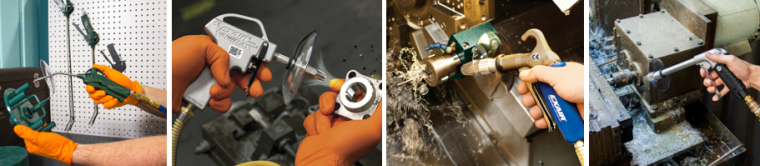
Compressed Air Safety Dos and Don’ts

In the Navy, it was a universally accepted fact that NOTHING onboard the ship was “sailorproof.” Regardless of how it was designed, what it was made of, how many interlocks, mechanical stops, automatic shutoffs, etc., something had, any & all of those features could be overridden (by accident or on purpose) and cause a wide range of chaos, and/or damage, and/or injury. That’s why training and procedures are so important.

It’s the same in any civilian/corporate industry too – any device, tool, instrument, machinery, etc., can be inherently dangerous if it’s not used properly. And “used properly” for a LOT of those includes personal protective equipment, commonly known as PPE.

In the United States, the Occupational Safety & Health Administration (OSHA) publishes a couple of standards relevant to the safe use of compressed air:

Standard 1910.242(b) applies to the use of compressed air for cleaning. It states “Compressed air shall not be used for cleaning purposes except where reduced to less than 30 p.s.i. and then only with effective chip guarding and personal protective equipment.”

  • Do wear eye protection, at a bare minimum, in regard to the personal protective equipment, no matter what. If the debris you’re blowing off is sharp or jagged, a full face shield & long sleeves are likely called for as well.
  • Don’t operate a blowoff device in a manner where the static pressure at the outlet of the nozzle will reach or exceed 30 p.s.i. If you’re using an engineered product like an EXAIR Super Air Nozzle, it’s perfectly fine to use a higher air supply pressure than that. They’re designed so that the outlet pressure won’t exceed 30 p.s.i. no matter what the supply pressure is.
EXAIR engineered Air Nozzles, like the Model 1100 Zinc Aluminum Super Air Nozzle shown here, discharge the compressed air flow through a series of holes, recessed between an array of fins. This means that there’s always a relief path for the airflow, so the outlet pressure cannot reach a dangerous level.

Standard 1910.95(a) isn’t exclusive to the use of compressed air, but since the discharge of a high pressure gas to atmospheric pressure can create quite a racket, noise levels associated with the use of compressed air often exceed exposure limits published in this standard.

  • Do protect your ears, same as you do your eyes. This one is near & dear to me, because my Dad lost a significant amount of his hearing in his early 40’s as a result of occupational noise exposure, and I saw first-hand what an impact that has on quality of life…for him, and frankly, for us too. There are a number of ways to do this, and the National Institute of Safety & Health (NIOSH) ranks them in order of effectiveness in their Hierarchy of Controls.
  • Don’t make earplugs, earmuffs, headphones, etc., the first and only line of defense. Don’t get me wrong; they work GREAT when the right ones are used properly…”right” and “properly” being the key words there.
  • So, DO make selection, training, and enforcement of their usage a high priority if the source of the noise cannot be:
    • Eliminated – this can be a toughie, because whatever’s making the noise is very likely there for a reason.
    • Substituted – this is a much more common, and still highly effective method, as engineered products like EXAIR manufactures can dramatically lower noise levels while maintaining the effectiveness of compressed air usage.
Examples of some sound levels we’re all familiar with, and how some EXAIR products compare favorably.

In closing, my last dos & don’ts are: Do heed OSHA’s safety standards, so you don’t get a hefty fine for endangering yourself or the folks you work with. Frankly, if they catch you before anyone gets hurt, you got off light. If you’d like to find out more about how EXAIR Intelligent Compressed Air Products can improve safety with your compressed air usage, give me a call.

Russ Bowman, CCASS

Application Engineer
Visit us on the Web
Follow me on Twitter
Like us on Facebook

Accessories to Get the Most Out of Your Safety Air Gun.

EXAIR Has a useful selection of Safety Air Guns. Including the VariBlast Precision,  CompactSoft GripHeavy Duty and Super Blast Safety Air Guns, along with the newest addition, the TurboBlast. These blow guns are available with a variety of air nozzles, chip shields and pipe extensions. (Click on the product link above to see a blog about any of the eight types of Safety Air Guns) They are durable, comfortable and ergonomic to use. These Safety Air Guns are designed with durability and comfort in mind while also being ergonomically safe to use. Safe operation is assured along with low air consumption and noise levels. EXAIR Engineered air nozzles are available in Type 316 stainless steel for superior corrosion resistance and mechanical wear, Type 303 stainless steel for corrosion resistance, PEEK thermoplastic for non-marring and chemical resistance or zinc/aluminum alloy for general purpose applications.

Flying Debris? – Chip Shields are durable polycarbonate shields that protect the operator from the risk of flying debris often seen when blowing off chips from machined parts. They are also useful to prevent coolant from splashing back, creating a mess during drying processes.

The Chip Shields are available for EXAIR’s VariBlastSoft Grip and Heavy Duty Safety Air Guns. The Chip Shield can be used on Safety Air Guns with or without an aluminum extension. They may be purchased as part of a new air gun system, or retrofitted as a Chip Shield Kit.  Consult an Application Engineer for selection assistance.

If you have a blow-off process where the air is to be directed at a distance away from the operator, or into a hard-to-reach location, an extension is the solution. Available in lengths from 6″ (152mm) to 72″ (1829mm), with sizes to meet most requirements can be found. To add an extension to an air gun, simply add -xx to the current part number. EXAIR’s Stay Set Hoses are available from 6”-36” in lengths with ¼ NPT male threads on each end, or a ¼ NPT male on one end and 1/8 NPT female on the other.

Model 1310-12 Heavy Duty Safety Air Gun, With 12″ Extension & 1100 Super Air Nozzle

The Stay Set Hoses are rigid and allow you to maintain precise positioning of the blow off nozzle. The hoses have “memory” and will not creep or bend.

Options from 6″ to 36″

 If you need a 12′ coiled air hose, to use with your Safety Air Gun, we have them available and in stock. Available with 1/8 NPT, 1/4 NPT or 3/8 NPT male end swivel connections. Avoid tangled and messy air lines and keep things neat!

If you have an application and need help deciding which EXAIR Safety Air Gun and/Nozzle you need. Please contact us and ask for an Application Engineer. We are always happy and eager to help.

Jordan Shouse
Application Engineer

Email me: email
Find us on the Web 
Like us on Facebook
Twitter: @EXAIR_JS

Safety Air Gun Accessories!

EXAIR Has a nice selection of Safety Air Guns. The VariBlast Precision and Compact, Soft Grip, Heavy Duty and Super Blast Safety Air Guns, and the newest addition, the TurboBlast are available with a variety of air nozzles, chip shields and pipe extensions. (Click on the product link above to see a blog about any of the eight types of Safety Air Guns) They are durable and comfortable and ergonomic to use.These Safety Air Guns are designed with durability and comfort in mind while also ergonomically safe to use. Safe operation is assured along with low air consumption and noise levels. EXAIR Engineered air nozzles are available in Type 316 stainless steel for superior corrosion resistance and mechanical wear, Type 303 stainless steel for corrosion resistance, PEEK thermoplastic for non-marring and chemical resistance or zinc/aluminum alloy for general purpose applications.

Flying Debris? – Chip Shields are durable polycarbonate shields that protect the operator from risk of flying debris often seen when blowing off chips from machined parts. They are also useful to prevent coolant from splashing back, creating a mess during drying processes.

The Chip Shields are available for EXAIR’s VariBlast, Soft Grip and Heavy Duty Safety Air Guns. The Chip Shield can be used on Safety Air Guns with or without an aluminum extension. They may be purchased as part of a new air gun system, or retrofitted as a Chip Shield Kit.  Consult an Application Engineer for selection assistance.

If you have a blow-off process where the air is to be directed at a distance away from the operator, or into a hard-to-reach location, an extension is the solution. Available in lengths from 6″ (152mm) to 72″ (1829mm), with sizes as to meet most requirement can be found. To add an extension to an air gun, simply add -xx to the current part number. EXAIR’s Stay Set Hoses are available from 6”-36” in lengths with ¼ NPT male threads on each end, or a ¼ NPT male on one end and 1/8 NPT female on the other.

Model 1310-12 Heavy Duty Safety Air Gun, With 12″ Extension & 1100 Super Air Nozzle

The Stay Set Hoses are rigid and allow you to maintain precise positioning of the blow off nozzle. The hoses have “memory” and will not creep or bend.

Options from 6″ to 36″

 If you need a 12′ coiled air hose, to use with your Safety Air Gun, we have them available and in stock. Available with 1/8 NPT, 1/4 NPT or 3/8 NPT male end swivel connections. Avoid tangled and messy air lines and keep things neat!

If you have an application and need help deciding which EXAIR Safety Air Gun and/Nozzle you need. Please contact us and ask for any Application Engineer. We are always happy and eager to help.

Jordan Shouse
Application EngineerSend me an email
Find us on the Web 
Like us on Facebook
Twitter: @EXAIR_JS

EXAIR Corporation Puts The “Safety” In Safety Air Guns

One of the most dangerous things you can do is depressurize a line full of a pressurized gas. If the charge pressure is high enough, it’s going to come roaring out, with tremendous force and velocity. Anything in its path is subject to that force & velocity. Objects small enough to become entrained in its flow can become hazardous projectiles. The noise it creates can be literally deafening. If the point of discharge is accidentally jammed against your body, the pressure can get through your skin. As if that wasn’t scary enough, the gas then has a free path inside your body…they call that an embolism, and it can kill you.

Why on earth would anyone want to do that on purpose? Well, it happens every day, in factories, businesses, and homes all over the world, when people operate compressed air operated blow off devices. Of course, there are numerous factors that can drastically reduce the risk of injury associated with compressed air blow off devices.

One of these is mandated by the government. The Occupational Safety and Health Administration (OSHA) regulates the outlet pressure of any compressed air device used in industry for cleaning purposes. Keeping the outlet pressure low mitigates the risk of puncturing the skin. There are various methods of compliance with this regulation:

  • Regulate the supply pressure to less than 30psig. This absolutely complies, but it severely hampers your ability to get much done, as the air flow will be too weak to blow off anything but lightweight debris, from a smooth, dry surface, with the device pretty much right up on top of it.
  • Use a device that provides a relief path for the air flow if it was to become blocked or obstructed. EXAIR engineered Air Nozzles are designed to do this…you can supply them with higher pressures but they provide a relief path for the air, meaning they can’t be blocked or dead-ended.
Regardless of the compressed air supply pressure, the design of EXAIR Super Air Nozzles prevents a dangerous pressure from developing at the outlet.

The same regulation – OSHA 1910.242(b) – also addresses the airborne projectile problem by mandating the use of appropriate chip guarding. There are a number of ways to do this as well…chief among these is personnel protective equipment (PPE). At a minimum, you absolutely, positively should be wearing safety glasses with side shields whenever you have a blow off device in your hand (and so should anyone working near you, for that matter). If an operator is blowing off small, sharp shards, an OSHA inspector is probably going to get grumpy if they’re not wearing a full face shield, long sleeves, and maybe even a durable apron. Alternately, the blow off device could also be fitted with guarding as well…something like the Chip Shields that are available for most EXAIR Safety Air Guns. These polycarbonate dish-shaped shields fit on a rigid extension between the Safety Air Gun and the Super Air Nozzle, and can be positioned at an optimal distance to keep solid debris and liquid being blown off away from the operator.

Chip Shields are available for most EXAIR Safety Air Guns (left to right): VariBlast Precision & Compact, Soft Grip, and Heavy Duty Safety Air Guns…
…and others. These are just a few examples of blow off devices that can be successfully fitted with an EXAIR Chip Shield.

Another OSHA Standard – 1910.95(a) is there to protect operators against that literally deafening roar associated with unregulated discharge of compressed air. While cross-drilled nozzles (most easily seen in the lower left hand image above) provide a relief path to keep the outlet pressure at a safe level if they’re dead-ended, they’re still for all intents & purposes, an open-ended blow off…and quite loud. EXAIR Super Air Nozzles reduce the sound level of their air flow by design…the entrained air (which makes them so efficient) also forms a lower velocity barrier layer in the flow, which makes them extraordinarily quiet. In fact, all EXAIR Super Air Nozzles except our largest High Force models comply with OSHA limits for 8 hour noise exposure limits. Most callers that we talk to about applications for those are in areas where hearing protection is mandated anyway…if you need more than 4 pounds of blowing force, you’re probably wearing ear plugs already.

If you use compressed air for cleaning, drying, blow off, etc., you really need to do it safely, and in compliance with published & established safety standards. OSHA WILL fine you otherwise, and, even worse, someone could get hurt. EXAIR Corporation is devoted to helping you get the most out of your compressed air usage, and safe use is key to that. If you have any questions about it, give me a call.

Russ Bowman, CCASS

Application Engineer
EXAIR Corporation
Visit us on the Web
Follow me on Twitter
Like us on Facebook