Sound – It Adds Up! How to Calculate Decibel Levels

Keeping noise levels in check and at safe levels is very important to ensure employee safety and well being.  OSHA (the Occupational Safety and Health Administration) through standard 29 CFR-1910.95(a) has studied the situation and set Maximum Allowable Noise Exposure limits in Hours per Day based on the Sound Level, in dBA, of exposure.

For existing processes, a Digital Sound Meter is a valuable tool to measure the sound level to ensure that the source of loud noises can be quickly identified and isolated for immediate corrective action.

For new processes, or changes to an existing process, it is important to estimate the sound level prior to installation and start-up, so that precautions can be taken as needed.

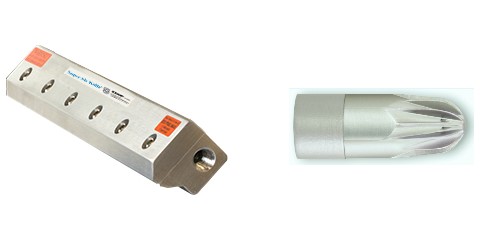
For example, let’s say we are going to add a blow off station to clean off a part on a conveyor to improve the process and increase the throughput.  A typical set-up might be a 12″ Super Air Knife (model 110012) blowing off the top and a pair of Super Air Nozzles (model 1100) to blow off the sides.
SAK and ASAN
12″ Super Air Knife and Super Air Nozzle

If we look at the performance data for the (2) different blow off devices, we find that the Super Air Knife is rated at 69 dBA and the nozzles at 74 dBA, when operated at 80 PSIG of compressed air supply.

SAK and ASAN

When asked, “what is the sound level for (1) of the knives, and (2) of the nozzles” a little Acoustic Engineering is in order. The decibel scale is logarithmic, and determining the total sound level when all (3) devices are in operation is not as easy as adding up the three sound level values (which would equal 218 dBA, way off the charts!).  Thankfully, both the actual sound level and the numerical value are determined another way.  I’ll spare you a lot of the math but the equation is as below.

Capture

… where SL1, SL2, SL3, … are the sound levels in dBA of the each sound makers, for as many that are being combined (in our example SL1 = 69, SL2 = 74 and SL3 = 74)

Plugging in the numbers into the equation, the combined sound level works out to be a quiet 77.65 dBA — well within the OSHA limit for exposure for a full 8 hour period.

To discuss your application and how an EXAIR Intelligent Compressed Air Product can make your process better and quieter, feel free to contact EXAIR and myself or one of our other Application Engineers can help you determine the best solution.

Brian Bergmann
Application Engineer

Send me an email
Find us on the Web 
Like us on Facebook
Twitter: @EXAIR_BB

Protect Personnel from Noise with Engineered Products

Sound can be defined as vibrations that typically travel as an audible wave through mediums that can be a gas, liquid or solid. For this blog we will concern ourselves with sound travelling through a gas (atmosphere) in an industrial setting.

Sound is energy that travels in waves and is measured by its frequency (cycles per second) and amplitude (intensity). A common unit of measurement for sound energy is the decibel. The decibel (abbreviated with dBA) is a unit-less number that is based on the logarithm of a known measured quantity to a reference quantity. Without reciting the equation for every increase of 3 dBA is a doubling of sound energy or twice as loud.

Since our focus is on industrial sound one might question why be concerned at all, after all sound emanates from most machines and devices. The reason for concern is that there are OSHA regulations regarding the amount of time workers can be exposed to different levels of sound in their workday as illustrated below. These limits are in place to protect personnel from Noise Induced Hearing Loss or NIHL. When the damage to anyones hearing is caused by their profession, it is also referred to as Occupational Hearing Loss or OHL.

After monitoring for noise, NIOSH and the CDC next recommend administrative controls to minimize or eliminate the noise hazard (click for their helpful PDF). This would include the use of noise reducing EXAIR products like Super Air Nozzles, Air Knives and Air Amplifiers.

dBA Chart.JPG
OSHA Maximum Allowable Noise Exposure

When considering the many items in an industrial setting that produce loud sounds the list would be exhaustive. Many of them simply produce loud sounds that can’t be eliminated or reduced while on the other hand there are some that can. Some of the noisiest offenders that plants have control over are air powered tools and open tube blow-offs.  Eliminating inefficient methods of part blow off & part cleaning with an engineered solution allows a company to significantly reduce the level of sound in their plant, improve worker safety and save money on compressed air consumption.

Employers are required to provide hearing protection to employees whom are exposed to sounds above 90 dBA on a Time Weighted Average (TWA). Without digressing into the formulas TWA calculates a workers daily exposure to occupational sounds by taking into account the average levels (in dBA) and the time exposed to different levels.  This is the how OSHA assesses workers exposure and what steps should be taken to protect the workers.

To conclude, plants need to be mindful of the OSHA regulations for sound levels, time of exposure and that hearing protectors wear out. Earmuff seals can lose their elasticity and reduce their effectiveness and the soft pre-molded earplugs can wear out in a day and need replaced.  Keep a good supply on hand and OSHA suggests letting workers with noisy hobbies take them home for protection off the clock!

If you would like to discuss reducing noise or any EXAIR product, I would enjoy hearing from you…give me a call.

Steve Harrison
Application Engineer

Send me an email
Find us on the Web 
Follow me on Twitter
Like us on Facebook

The Decibel

The decibel is a unit of measurement that relates the ratio of a physical value to another value and is expressed on a logarithmic scale.  The common symbol for decibel is dB.  The decibel is used as a measure for many parameters in science and engineering such as acoustics (sound), electronics (power levels) and control theory.

The decibel originates from methods used to express performance and loss in telegraph and telephone circuits.  The term ‘bel’ was coined in honor of Alexander Graham Bell, and the decibel, being 1/10th of a bel was established.

For most of us, the decibel is the familiar term relating to how loud a sound is.

With sound, the sound pressure is typically what is measured and is the local pressure deviation from the base or equilibrium atmospheric pressure, caused by a sound wave. In air, the sound pressure can be measured by a standard microphone, and is measured in pascals (Pa.)

To get to the common decibel reading we are familiar with, a little mathematics comes into play.

Capture

  • where Lp is the Sound Level in dB, prms is the measured sound pressure, and pref is the standard sound reference pressure of 20 micropascals.
  • The prms is what is measured by a microphone

Below are some representative sounds and the decibel rating – Note that sounds that are above 85 dB can cause hearing issues, and proper protection should be taken.Decibel Scale Still Photo

Some other interesting blogs about sound for you take a look at-

Measuring and Adding Sounds

Sound Power Level and Sound Pressure

Super Air Knife Math – When 72  + 72 = 75

If you would like to talk about sound or any of the EXAIR Intelligent Compressed Air® Products, feel free to contact EXAIR and myself or one of our Application Engineers can help you determine the best solution.

Brian Bergmann
Application Engineer

Send me an email
Find us on the Web 
Like us on Facebook
Twitter: @EXAIR_BB

EXAIR Products: Silencing Mufflers Overview

OSHA Standard 29 CFR 1910.95(a), relating to permissible noise exposure levels, states that when employees are subjected to sounds in excess of 90 dBA, some type of control should be used to reduce the sound level. In an industrial setting, it’s very common to find the exhausting air from air operated devices such as actuators, diaphragm pumps or cylinders for example, to produce sound levels well above the allowable limits set forth in the Standard. EXAIR offers a variety of different Silencing Mufflers that help to reduce this  noise level, while also increasing operator safety.


Reclassifying Mufflers are available in 1/8″, 1/4″, 3/8″, 1/2″, 3/4″ and 1″ NPT sizes

EXAIR’s Reclassifying Mufflers offer noise reduction up to 35 dB and are available in sizes ranging from 1/8″ to 1″ NPT. These types of mufflers are often considered”dual-purpose” as they not only reduce the noise level but also remove oil from the exhaust airflow by incorporating a removable filter element.  The exhausting oil mist is reduced from 50 PPM (parts per million) to only 0.015 PPM, when the device is operated at 100 PSIG. In addition, there is a bowl on the bottom to capture any residual oil and a 1/4″ tube adaptor to allow for easy draining.

Sintered Bronze Mufflers are available in #10-32, 1/8″, 1/4″, 3/8″, 1/2″, 3/4″, 1″, 1-1/4″ and 1-1/2″ NPT sizes, as well as 1/2-20 UNF female for use with solenoid valves
Straight Through Mufflers are available in 1/4″, 3/8″ and 3/4″ MNPT x FNPT

Sintered Bronze Mufflers are a relatively low cost option, commonly used with air cylinders as they can be installed quick and easy. We offer 1o different sizes, ranging from #10-32 for small installations, up to 1-1/2″ NPT for larger scale applications. The noise reduction depends on the size of the muffler and back pressure, which can occur from dirt or particulate clogging the muffler, restricting the exhausting airflow from passing through the porous sintered bronze.

Our Straight Through Mufflers are made of corrosion resistant aluminum and are lined with a sound absorbing foam, capable of reducing noise levels up to 20 dB. We offer 3 different sizes, 1/4″, 3/8″ and 3/4″ NPT, with a male thread on one end and female thread on the other. We incorporate this muffler design into our Cold Guns and Adjustable Spot Coolers and they are commonly used with our Vortex Tubes, Cabinet Cooler® Systems and E-Vac® Vacuum Generators as well.

Heavy Duty Mufflers are available in 1/4″ and 3/8″ FNPT

Lastly, the Heavy Duty Mufflers feature an internal, 50 mesh stainless steel screen, to protect against contaminants in the airflow,  and a corrosion resistant aluminum outer shell. In most cases, the sound reduction can be as high as 14 dB and we offer 2 different sizes, 1/4″ and 3/8″ FNPT. These types of mufflers are regularly used on the hot air exhaust of our Vortex Tubes.

For help with product selection or to discuss a particular process, please contact one of our application engineers at 800-903-9247.

Justin Nicholl
Application Engineer
justinnicholl@exair.com
@EXAIR_JN