
Limiting Noise Exposure with Mufflers for Compressed Air

Mufflers come in many shapes and sizes. Each with their own benefits.

If you have ever walked into a manufacturing facility and heard the hiss or even worse the banshee scream of compressed air being exhausted to ambient, whether it be from a cylinder discharge, a timed drain going off, or a bypass valve being activated, they all could be hushed with a muffler. A muffler for compressed air comes in several shapes and sizes. EXAIR offers four separate types from stock to help attenuate the noise disruption within your facility.

The OSHA standard for allowable noise exposure is 29 CFR-1910.95(a) and outlines the number of hours per day any individual can be exposed to a particular noise level. These noise levels are expressed in decibels (dbA).

Hearing loss is the best known, but not the only, ill effect of harmful noise exposure. It can also cause physical and psychological stress, impair concentration, and contribute to workplace accidents or injuries.
Reclassifying Mufflers attenuating the exhaust of a pneumatic cylinder.

The first type I would like to showcase are the Reclassifying Mufflers. These are ideal for cylinder exhausts or valves which commonly contain an oil mist within the air stream which can easily contaminate the surrounding area. The patented design of the removable element separates oil from the exhausted air so virtually no atomized oil is released into the environment. They also attenuate the exhaust noise level up to 35 decibels. The filter element helps the exhaust to meet the OSHA Standard 29 CFR 1910.1000, a worker’s cumulative exposure to oil mist must not exceed 5 mg/m³ by volume in any eight hour shift of a forty hour work week.

The chart below helps to properly size the Reclassifying Muffler for a pneumatic cylinder. One key to proper installation of these mufflers is they must be installed vertically in order to properly trap and drain the oil.

Reclassifying Muffler Quick Pick Chart
Sintered Bronze mufflers are excellent choices for tight installation locations and are easily sized.

The next type of muffler to discuss are the Sintered Bronze Mufflers that are offered in ten different sizes. These are an excellent low cost solution which easily install into new or existing ports. Each size is designed to provide minimal back pressure and restriction for the individual port size. The quick pick chart below helps to easily select the correct size for attenuating the exhaust of a pneumatic cylinder. One key difference between these and the Reclassifying Mufflers is, these do not have to be oriented vertically as they do not collect the oil out of the exhaust air.

undefined

The model 3913 – 3/4″ NPT Straight Through Muffler

If the process air needs to be directed or plumbed away from the operator then the Straight Through Mufflers are the ideal selection as they offer an NPT threaded inlet and exhaust. They are available in three standard NPT sizes from stock. These mufflers can be installed in any orientation and work well with our Vortex Tubes to help pass the cold air through while lowering the operating sound level of the tube. The average noise reduction of the Straight-Through Mufflers is 20 dB. This can easily reduce the noise level of an operation to below the OSHA standard requiring hearing protection for operators in the area.
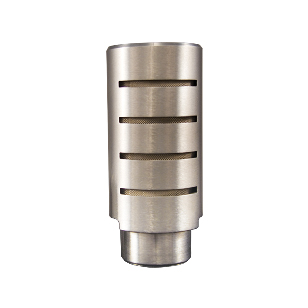
The model 3903 Heavy Duty Muffler

The final option for mufflers from EXAIR are the Heavy Duty Mufflers. These are available in two sizes from stock and are constructed of corrosion-resistant aluminum with a stainless steel internal screen. These can be installed in any orientation and are ideal for protecting exhaust ports from contaminants that may clog or damage the device they are attached to. The typical noise reduction from installation is 14 dB with these mufflers.

These are available in two sizes from stock and are constructed of corrosion-resistant aluminum with a stainless steel internal screen. These can be installed in any orientation and are ideal for protecting exhaust ports from contaminants that may clog or damage the device they are attached to. The typical noise reduction from installation is 14 dB with these mufflers.

To summarize, EXAIR offers a multitude of options when it comes to lowering sound levels in operation areas that are caused by exhausted compressed air. Each of the mufflers discussed above are shipped same day from stock to meet your immediate need. If you are unsure of which muffler to use for your application, feel free to contact an Application Engineer.

Brian Farno
Application Engineer
Ph. 1-513-671-3322
BrianFarno@EXAIR.com
@EXAIR_BF

Brian Farno
Application Engineer
BrianFarno@EXAIR.com
@EXAIR_BF

What is Sound and Interesting Facts About Sound

In physics, sound is a wave of pressure. It occurs in a medium, which can be a solid, liquid or gas. Sound cannot travel through a vacuum, such as in space. The wave of pressure reaches our ears and causes the ear drum to vibrate, which then goes through a complex process to ultimately be perceived as audible sound.

There are several characteristics of sound waves that can be measured and help define the sound. A sound wave can be visualized as a repeating sinusoidal wave (see below), and can be described by these properties – frequency and wavelength, amplitude, and speed.

Sound Wave
Sound Wave

  • Frequency is the number of cycles in 1 second, and is measured in Hertz (Hz)
  • Wavelength is the distance over which 1 cycle occurs, and for audible sound is  between 17 m and 17 mm long
  • Amplitude is the measure of its change over a single period, and normally a measure of sound loudness
  • Speed is the distance traveled per unit time

The speed of sound in air can be found using the equation:  a = Sqrt (γ•R•T)

where for air:
γ = ratio of specific heats = 1.4,
R = gas constant = 286 m²/s²/K
T = absolute temperature in °K (273.15 + °C)

At room temperature, 22°C (71.6°F), the speed of sound is 343.8 m/s (760 mph)

Some interesting facts about sound:

  • Sounds generally travels faster in solids and liquids than in gases.
  • You can estimate the distance from a lightning strike by counting the seconds that pass between seeing the lightning flash and hearing the thunder.  Take this duration an divide by 5 to get the distance away, in miles.
  • Humans normally hear sound frequencies between 20 Hz and 20,000 Hz.
  • Sound waves above 20,000 Hz are known as ultrasound, and sound waves below 20 Hz are known as infrasound.
  • Sound travel through water close to 4 times faster then through air.
  • The sound of a cracking whip occurs because the speed of the tip has exceeded the speed of sound.

Sound that is too loud can be a problem. The Occupational Safety and Health Administration (OSHA) has set limits on the noise exposure that an employee can be subjected. Exceeding these values can cause permanent damage to your ears and cause noise induced hearing loss. So, knowing and reducing the sound levels within a manufacturing operation is important.

OSHA Chart

EXAIR has many products that can help reduce the sound levels in your processes.  With products such Air Knives, Air Wipes, Air Amplifiers, Air Nozzles and Jets, and Safety Air Guns, strong, quiet and efficient blowoff, drying, and cooling can be performed.

Quiet Products

If you have questions about sound and keeping your sound levels in check or any of the 15 different EXAIR Intelligent Compressed Air® Product lines, feel free to contact EXAIR and myself or any of our Application Engineers can help you determine the best solution.

Brian Bergmann
Application Engineer
Send me an email
Find us on the Web 
Like us on Facebook
Twitter: @EXAIR_BB

Understanding Decibels & Why OSHA Pays Attention to Your Noise Exposure

In the simplest of metric terms, a decibel is one-tenth of a bel.  But, historically, bel was a unit created to honor Alexander Graham Bell who invented the telephone.  In the early days with telephone wires, they noticed that the signal strength would decay over a long distance.  In order to determine power requirements to connect people for communications, they determined that they could use the ratio of power levels.  As a start, it had to be based on a minimum amount of power required for a person to hear on the telephone.  They found that the signal power level to generate an angular frequency of 5000 radians per second would be that minimum value as determined by an average number of people.  They used this mark as a reference point in the ratio of power levels.  Because of the large variations in values, they simplified the equation on a base-10 log scale and dividing the bel unit by 10.  Thus, creating the measurement of decibel.

Today, this same method is used to measure sound.  Like frequency waves that travel through the telephone wires, pressure waves travel through the air as sound.  This sound pressure is what our ears can detect as loudness, and it has a pressure unit of Pascals (Pa).  As an example, a small sound pressure would be like a whisper while a large sound pressure would be like a jet engine.  This is very important to know as high sound pressures, or loudness, can permanently damage our ears.

With sound pressures, we can determine the Sound Pressure Level (SPL) which is measured in decibels (dB).  Similar to the equation for the telephone power signals above, the SPL also uses a ratio of sound pressures in a base-10 logarithmic scale.  For a minimum reference point, an average human can just start to hear a sound pressure at 0.00002 Pa.  So, the equation for measuring sound levels will use this minimum reference point as shown in Equation 1.

Equation 1:

L = 20 * Log10 (p/pref)

where:

L – Sound Pressure Level, dB

p – Sound pressure, Pa

pref – reference sound pressure, 0.00002 Pa

Why is this important to know the decibels?  OSHA created a chart in 29CFR-1910.95(a) that shows the different noise levels with exposure times.  This chart was created to protect the operators from hearing loss in work environments.  If the noise level exceeds the limit, then the operators will have to wear Personal Protection Equipment (PPE), or suffer hearing damage.  EXAIR offers a Sound Level Meter, model 9104, to measure sound levels in decibels.  It comes calibrated to accurately measure the sound to determine if you have a safe work environment.

Sound Level Meter

There is a term that is used when it comes to loud noises, NIHL.  This stands for Noise Induced Hearing Loss.  Once hearing is damaged, it will not come back.  To keep your operators safe and reduce NIHL, EXAIR offers many different types of blow-off products that are designed to decrease noise to a safe level.  So, here’s to Alexander Graham Bell for creating the telephone which can be used to contact EXAIR if you have any questions.

John Ball
Application Engineer
Email: johnball@exair.com
Twitter: @EXAIR_jb


Photo of Telephone by Alexas_FotosCC0 Create Commons

Know What to Look For – Are Your Compressed Air Guns OSHA Safe?

One of the easiest ways to find out if your compressed air guns are safe for operation is by looking at the nozzle.  First, take your current compressed air gun and disconnect it from the compressed air line.  Second, look directly into the end of the nozzle where the air comes out.  If you can see the inside of the nozzle, then your air gun or blow-off device is unsafe.  Nine out of ten compressed air guns are considered to be dangerous.  In this blog, I will go through the dangers and violations of compressed air guns and nozzles that are very common in the market place.

Occupational Safety and Health Administration, OSHA, is an organization that enforces standards for safe and healthy working environments.  They have training, outreach programs, and educational assistance for manufacturing plant.  But, they will also enforce these standards with heavy fines for violations.  The two most common violations with compressed air guns and nozzles are 29CFR 1910.242(b) for dead-end pressure/chip shielding and 29CFR 1910.65(a) for maximum allowable noise exposure.  If you are unfortunate in receiving an audit, the OSHA agent will target your compressed air guns and blow-off devices.

Unsafe Nozzle

Here is the first example of a nozzle that I would like to discuss.  As you can see, there is only one opening where the air can come out from the nozzle.  Other types of nozzles that would fall into this category will include copper pipes, extensions, or worn nozzles.  They are dangerous as the compressed air cannot escape if it is blocked by your skin.  An air embolism could occur within the body which can cause bodily harm or death.  If operated above 30 PSIG (2 bar), these nozzles would violate the OSHA 29CFR 1910.242(b) for dead-end pressure.  This is a hazard which can be avoided by using EXAIR Super Air Nozzles and Safety Air Guns.  The nozzles are designed to utilize fins to allow air to escape and not penetrate your skin.  With EXAIR products, you will not violate this standard even if you go above the 30 PSIG (2 bar).

Safety Air Gun

To counteract the dead-end pressure violation, some nozzle manufacturers created a hole through the side of the nozzle (Reference photo below).  This will allow for the compressed air to escape, but, now the issue is noise level.  With an “open” section in the nozzle, the compressed air is very turbulent and very loud.  They state that 70% to 80% of all hearing loss within a manufacturing plant is caused by compressed air.  For this, OSHA 29CFR 1910.65(a) was created to show the maximum allowable noise exposure.  This chart shows the time and noise limits before requiring hearing protection.  The EXAIR Super Air Nozzles are designed to have laminar flow which is very quiet.  With our typical Safety Air Gun, model 1210, the sound level is only 74 dBA; well under the noise exposure limit for 8 hours.

Unsafe Air Gun

Hearing loss is the best known, but not the only, ill effect of harmful noise exposure. It can also cause physical and psychological stress, impair concentration, and contribute to workplace accidents or injuries.

Why do I bring these points up?  Because safety is everyone’s responsibility.  The National Institute for Occupational Safety and Health, NIOSH, has an overview of how to handle hazards in the workplace.  They call it the Hierarchy of Controls (click).  This is a means to best protect workers from dangers.  The most effective way is by eliminating the hazard or substituting the hazard.  The least effective way is with Personal Protective Equipment, or PPE.  For your unsafe compressed air nozzles and guns, EXAIR can help by substituting the hazardous air gun and nozzle with an engineered solution designed with safety in mind.

In my opening statement, I explained a quick and easy method to determine if your compressed air guns are dangerous.  To keep your company compliant and safe, EXAIR offers a variety of different types of nozzles and Safety Air Guns to best fit your requirement.  If you find that you are using hazardous blowing equipment, you can contact an Application Engineer to find a safe and effective alternative.

John Ball
Application Engineer
Email: johnball@exair.com
Twitter: @EXAIR_jb