
Sound – It Adds Up! How to Calculate Decibel Levels

Keeping noise levels in check and at safe levels is very important to ensure employee safety and well being.  OSHA (the Occupational Safety and Health Administration) through standard 29 CFR-1910.95(a) has studied the situation and set Maximum Allowable Noise Exposure limits in Hours per Day based on the Sound Level, in dBA, of exposure.

For existing processes, a Digital Sound Meter is a valuable tool to measure the sound level to ensure that the source of loud noises can be quickly identified and isolated for immediate corrective action.

For new processes, or changes to an existing process, it is important to estimate the sound level prior to installation and start-up, so that precautions can be taken as needed.

For example, let’s say we are going to add a blow off station to clean off a part on a conveyor to improve the process and increase the throughput.  A typical set-up might be a 12″ Super Air Knife (model 110012) blowing off the top and a pair of Super Air Nozzles (model 1100) to blow off the sides.
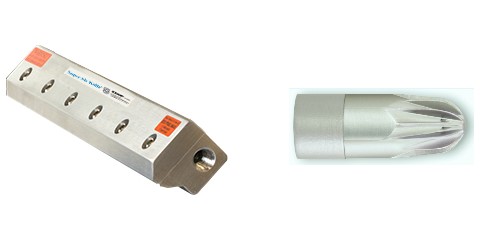
SAK and ASAN
12″ Super Air Knife and Super Air Nozzle

If we look at the performance data for the (2) different blow off devices, we find that the Super Air Knife is rated at 69 dBA and the nozzles at 74 dBA, when operated at 80 PSIG of compressed air supply.

SAK and ASAN

When asked, “what is the sound level for (1) of the knives, and (2) of the nozzles” a little Acoustic Engineering is in order. The decibel scale is logarithmic, and determining the total sound level when all (3) devices are in operation is not as easy as adding up the three sound level values (which would equal 218 dBA, way off the charts!).  Thankfully, both the actual sound level and the numerical value are determined another way.  I’ll spare you a lot of the math but the equation is as below.

Capture

… where SL1, SL2, SL3, … are the sound levels in dBA of the each sound makers, for as many that are being combined (in our example SL1 = 69, SL2 = 74 and SL3 = 74)

Plugging in the numbers into the equation, the combined sound level works out to be a quiet 77.65 dBA — well within the OSHA limit for exposure for a full 8 hour period.

To discuss your application and how an EXAIR Intelligent Compressed Air Product can make your process better and quieter, feel free to contact EXAIR and myself or one of our other Application Engineers can help you determine the best solution.

Brian Bergmann
Application Engineer

Send me an email
Find us on the Web 
Like us on Facebook
Twitter: @EXAIR_BB

OSHA At 35,000 Feet

Early one morning I was on a flight to the West coast to start up a system that I had designed and built for a large food producer.  After the flight attendants had passed out our first beverage and snack I struck up a conversation with the passenger next to me.  We engaged in the typical banter about how hilarious it is to watch some passengers try to stuff an oversized bag into the overhead compartment and ultimately have to check it.

I then asked the reason for her trip and she explained that she worked for OSHA and had conducted a study on flight crew safety and was in route to give her report on the findings.  I was naturally intrigued and asked her what the risks were for a flight crew other than the obvious perils of being 35,000 Ft. above the ground for long periods of time.

Her reply was radiation exposure from the sun!  I had never considered that flight crews spend long periods of time above the thickest layer of our atmosphere.  Flight crews are exposed to significantly greater amounts of radiation compared to us folks who are on the ground more and consequently develop certain health conditions at a higher rate than the general population.

While EXAIR can’t help you with radiation exposure, we can bring you into OSHA compliance with noise, OSHA Standard 29 CFR – 1910.95 (a).

This standard is concerned with the level of noise that personnel are exposed to over a given period of time.  Often times in plants compressed air noise exceeds the OSHA noise level requirements which unfortunately results in hearing loss.  Noisy air blow-offs can produce noise in excess of 100 dBA.  Studies have proven that noise levels that are sustained for varying periods of time can ultimately result in permanent hearing loss.  Similar to the way flight crews are exposed to the radiation, some employess may not realize they are being exposed to a harmful level of noise from compressed air usage.  This is why OSHA generated the standard that has allowable limits for sustained noise levels in order to mitigate the risks for personnel in the area.  Utilizing EXAIR Super Air Nozzles the noise can be reduced to only 74 dBA.  EXAIR Engineered Air Nozzles reduce the noise without losing the hard hitting force.

dBA Chart

EXAIR also meets OSHA Standard 29 CFR 1910.242(b) for “Dead End Pressure”. This standard addresses how dangerous compressed air can be when the outlet pressure of a hole, hose or open pipe is higher than 30 PSIG (2 Bar).  If the opening is blocked (dead-ended) into any part of the body, air could enter the bloodstream through the skin.  This may result in serious injury.  All EXAIR Nozzles and Jets are designed for safety and can’t be dead-ended into the skin therefore can be safely operated above the 30 PSIG (2 Bar) limit.

sag-osha-compliant

If you would like to discuss noise levels, dead end pressure or any of EXAIR’s engineered solutions, I would enjoy hearing from you…give me a call.

Steve Harrison
Application Engineer
Send me an email
Find us on the Web 
Follow me on Twitter
Like us on Facebook

Small, Precise Blowoff at Your Fingertips

For many blowoff applications, stronger isn’t necessarily better.  For applications and processes where a light, but effective blast of air is needed for cleaning and drying, the VariBlast Compact Safety Air Gun with the Atto, Pico, or Nano nozzle fits the bill. The smallest of the EXAIR engineered Super Air Nozzle family, the Atto, Pico, and Nano have been designed to provide the smallest, most precise blowoff possible. The focused airflow pattern allows for very accurate control and placement of the air stream.  The nozzles are available in both Type 316 Stainless Steel and PEEK plastic (useful for harsh environments, and is non-marring)

img_7480.jpg
The Atto, Pico, and Nano Super Air Nozzles (Scale is in Inches)

The new VariBlast Compact Safety Air Gun is a great choice for putting the power and performance of the nozzle into a small and lightweight air gun. Designed with a variable flow trigger, the airflow can be throttled from a whisper to full force, simply by varying the trigger pull distance.

1698SS
VariBlast Model 1698SS, with Stainless Steel Nano Super Air Nozzle

The Atto, Pico, and Nano nozzles use very little compressed air and are extremely quiet, easily meeting OSHA Standard 29 CFR 1910.95(a) for Noise Exposure.  The design incorporates engineered solutions for safety and can be supplied with higher pressure compressed air and meet OSHA Standard 29 CFR 1910.242(b), relating to dead end pressure requirements.

The table below provides performance data, including the compressed air consumption, force, and sound level for the various configurations.

VariBlast With Small Nozzles

Note that the VariBlast air guns can be had with extensions from 6″ to 72″ and chip shields to meet the performance and safety needs of any application.

The Atto, Pico and Nano Nozzles can also be configured to work with the Soft Grip style of Safety Air Gun.  Consult an Application Engineer for assistance in choosing.

If you have any questions about the Atto, Pico, or Nano nozzles, the VariBlast Compact Safety Air Gun, or any EXAIR compressed air product, feel free to contact EXAIR and myself or one of our Application Engineers can help you determine the best solution.

Brian Bergmann
Application Engineer

Send me an email
Find us on the Web 
Like us on Facebook
Twitter: @EXAIR_BB

Digital Sound Level Meter Identifies Harmful Noise in the Workplace

slm-newlabel EXAIR offers the model 9104 Digital Sound Level Meter.  It is an easy to use instrument for measuring and monitoring the sound level pressures in and around equipment and other manufacturing processes.

Sound meters convert the movement of a thin membrane due to the pressure waves of sound into an electric signal that is processed and turned into a readable output, typically in dBA.  The dBA scale is the weighted scale that most closely matches the human ear in terms of the sounds and frequencies that can be detected.


To protect workers in the workplace from suffering hearing loss OSHA has set limits to the time of exposure based on the sound level.  The information in the OSHA Standard 29 CFR – 1910.95(a) is summarized below.

OSHA Noise Level

The Digital Sound Meter can be used to monitor and measure sound levels of manufacturing processed such as blowoffs for cooling or drying.  Many blowoffs, especially open or drilled pipes are very inefficient and can be identified as a source of excessive noise, outside the OSHA exposure ranges.  Once the noise violators are identified, a review can be done and the implementation of engineered solutions such as Super air Nozzles or Super Air Knives can be investigated. Keeping harmful noise levels in check benefits everyone involved.

The EXAIR Digital Sound Level Meter is an accurate and responsive instrument that measures the decibel level of the sound and displays the result on the large optionally back-lit LCD display. There is an “F/S” option to provide measurement in either ‘slow’ or ‘fast’ modes for stable or quickly varying noises. The ‘Max Hold’ function will capture and hold the maximum sound level, and update if a louder sound occurs.

Certification of accuracy and calibration traceable to NIST (National Institute of Standards and Technology) is included.

There is an informative Video Blog, presented by @EXAIR_LE that can be found here.

If you have questions about the Digital Sound Level Meter, or would like to talk about any of the quiet EXAIR Intelligent Compressed Air® Products, feel free to contact EXAIR and myself or one of our Application Engineers can help you determine the best solution.

Brian Bergmann
Application Engineer

Send me an email
Find us on the Web 
Like us on Facebook
Twitter: @EXAIR_BB