EXAIR Super Air Amplifier used for scrap material removal
A few months ago I wrote a blog about using a Super Air Amplifier to remove film from an application workspace and direct it to a waste container. Earlier this week I had a different end user contact me about a very similar application.
An image of the complete setup in this application
In this application the Super Air Amplifiers are used in an automotive manufacturing facility to direct scrap material from car doors into the large bags below each station. The scrap material is lightweight and proves to be problematic if not fed into a contained system.
The bags where the scrap material is collected
This particular customer was in need of some assistance to duplicate their existing setup, shown in the photos above, into four more workstations. So, they reached out to us to confirm the model number of the units (which have been “working perfectly”) based on dimensions.
Dimensions of the units in place; used to determine model number
Using the provided dimensions I was able to confirm the model number is 120022, our 2” Super Air Amplifier. After confirming this I was able to provide a quotation for the requested Super Air Amplifiers, available to ship from stock.
If you have a similar application or think an EXAIR product may be able to help solve an application problem in your facility, contact an EXAIR Application Engineer.
This week I worked with a candy company who was looking to improve their overflow product recovery. When their bulk bagging machine is inoperable, the wrapped candy bars are sent to an overflow container where they are manually scooped out by an operator. This process was causing damage to the bars and wrappers, as well as presenting an ergonomic hazard to the employee, so they called EXAIR for a solution.
I recommended using our Line Vac Air Operated Conveyor. The Line Vac connects to hose or pipe to create an inline conveyor and is able to move large amounts of material over long distances, requires no electricity, has no moving parts, and provides maintenance free operation, making it the ideal choice for this application.
After discussing the details with the customer, they were concerned that the candy bars and wrappers, getting picked up by the airflow and transported through the hose, might continue to be damaged. I advised that by using a pressure regulator they could control the vacuum/conveying rate by increasing or decreasing the supply pressure, but their concern remained. I then offered to perform a conveyance test at our facility, if they were willing to send product. The customer agreed and was kind enough to send some of the candy, with some extra bags inside for the staff here at EXAIR. (Which is pretty awesome! I mean, FREE candy? Who doesn’t love that?!)
Available in 11 sizes and different materials to meet many application requirements. Line Vacs have smooth ends for connecting hose with a clamp or threaded ends to connect with standard pipe sizes.
Our set up included our 3″ Line Vac with a 10′ section of 3” conveyance hose on the vacuum side and a horizontal conveyance run of approximately 35′, with a 13′ vertical run into a soft sided hopper. We were successful in conveying approximately 9.9 lbs. per minute, when operating at 80 PSIG, with no broken candy bars and no damage to the wrappers. We also determined that 40 PSIG inlet pressure was the lowest they could run the operation, if they were okay with a lower convey rate.
We provided the results to the customer and included a short video of our testing. Intrigued by the results, they are now looking in to other possible applications throughout their facility.
Of all the tools that I own, my cordless drill has to be just about my favorite. I’m remodeling a bathroom in my house right now, and last night I was setting the new toilet flange onto the new tile floor. I had to drill some holes for this through the new tile. I’d never done this before, and was definitely feeling some heartburn about it. Especially after finding out just how fragile and brittle ceramic tile is…I cracked two pieces, just trying to cut a hole for the heat & AC vent register. Luckily, that was BEFORE I mortared & grouted it in, so it wasn’t a big deal…they’re about a buck a piece, and I got five extra anyway.
I know how to do this but I have no idea how to fix this.
THIS one, though, was fully installed, and, despite all the internet videos I found & watched on how to install a tile floor, I haven’t yet had the need to find one that shows me how to replace a broken tile. And I don’t really want to, so I went slowly and carefully with the drill, using the special glass & tile bit that I bought. On my first hole, when I got the bit through the tile itself, I changed to a different (smaller) bit to pilot the screw hole through the subfloor. Then, I put a Phillip’s head bit in to drive the screw. It occurred to me that I was performing these three related but separate tasks, with the same tool…I just thought that was very cool.
Over the course of the last couple of days, I’ve talked to three different callers, with three different Line Vac applications:
*One wants to use a Model 150200 2” Heavy Duty Line Vac to convey cement. They’re currently hauling the bags, by hand, up to a hopper, where they cut them open and dump them in.
*One needs to move small springs, one at a time, from a hopper to an automated assembly turret machine. The springs are 5/8″ in diameter, and they’ll be fed through a length of PVC pipe. Our Model 151100 1″ NPT Heavy Duty Threaded Line Vac will be easily installed in the pipe line using standard threaded fittings, and the springs will pass through the 0.75″ throat nicely.
*One has a auger-type chip conveyor that removes machining debris from a lathe, and it’s broken…again. They needed a Model 6066 3” Stainless Steel Line Vac, in a hurry, to use until they get their chip conveyor fixed. In fact, if it works, they may not fix the chip conveyor.
With a wide range of sizes and materials of construction, we’ve got your solution. Call us.
So, kind of like my cordless drill, our Line Vac Air Operated Conveyors have a variety of uses, right out of the box. If you have an application that you think a Line Vac may be able to solve, give me a call. By the way, if you order one before the end of October, 2014we’ll give you a FREE 2″ Flat Super Air Nozzle. Really.
Russ Bowman
Application Engineer
EXAIR Corporation
Visit us on the Web
Follow me on Twitter
Like us on Facebook
The birth of the internet and personal computer brought to light a new form of hacking. For many years now hacking has been considered a negative action, even criminal. However, within the past several years the term lifehacking has come to mean a process of bettering your life through tips and tricks. There are entire blogs and TED talks about life hacking, so that has gotten me thinking of how can EXAIR hack your compressed air system and turn it into a life hack?
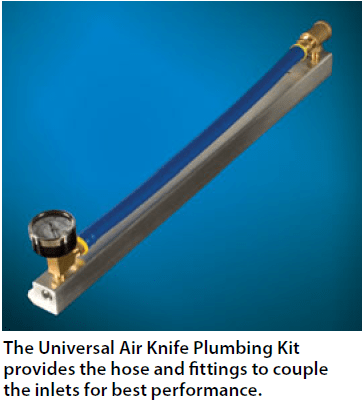
All of our products are designed and engineered to make your life easier and better. The best product I can think of to demonstrate this is our Super Air Knife With Plumbing Kit Installed. This is an option for any of our Super Air Knives which are longer than 24″ that makes installation even easier on your end. The plumbing kit has already connected air to each port on the Super Air Knife so all you have to do is plumb air to a single port at the end of the kit assembly. See the picture below for a better idea.
Another item that has helped many customers is our Chip Trapper System. This is essentially a modified or hacked Reversible Drum Vac System which adds the benefit of filtering the liquid you are sucking up to a 5 micron level. (Other filter levels/sizes available.) This means you can make your cutting fluid last longer and cut that rancid coolant smell in your machine shop down because the bacteria in the coolant doesn’t have any solids to live upon. This also means that you won’t be giving your coolant reclamation company any of your valuable solids so you keep more of your scrap profits.
So if you are looking for a way to make your life easier while you are working with compressed air, let us know, we’ll see how you can hack your compressed air applications.