
Part 3 of 6 in Our Journey to Optimizing your Compressed Air System

After the last poll it appears that quite a few of our readers could benefit from a leak test on their compressed air system.  In case you missed the previous part for this blog series it’s located here.  Now it’s time for the next step in optimizing your compressed air system.  This is the part within the process where our Application Engineers experience can help you.
The third step in the process is to implement our engineered solutions.  Whether your application calls for Air Knives, Super Air Nozzles, or any of our multitude of products we can help you to select the appropriate one.  We can then help you calculate the savings you will see if you know the consumption rates of your existing compressed air operation.  Now it’s time for the poll.


This is the step where most customers truly begin to see the savings. When you can install an engineered solution on your open pipe or non-engineered blow off the amount of compressed air used for your operation will in most cases decrease considerably.  This is really noticeable when you hear your compressor stop running throughout the day because it doesn’t need to.  In some cases customers are even able to turn off secondary compressors because they are now using a more efficient compressed air operation.
In the next segment of our blog series to compressed air optimization we’ll discuss yet another way to further your compressed air savings through simply turning it off.  So until next week keep those compressed air systems optimized.

Brian Farno
Application Engineer
BrianFarno@EXAIR.com
Twitter: EXAIR_BF
Working With Metal and a “Whole Lot of Love”

Just imagine having to remember in minute detail what you did over forty years ago and repeat it in front of five hundred people. That’s what happened to me earlier this summer.

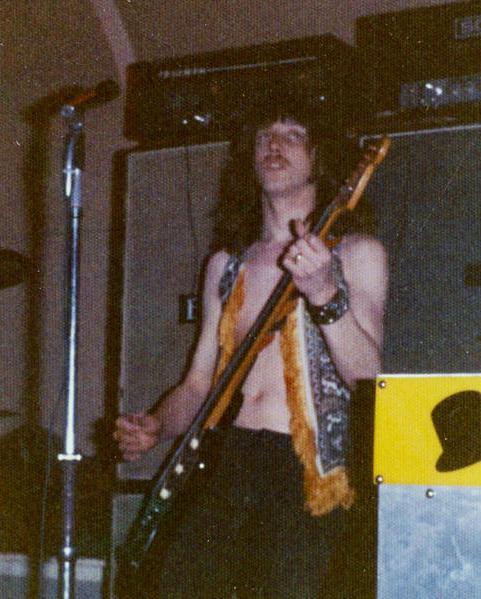
Many years ago I lived in the heart land of England, just a stone’s throw  from Birmingham, known as Brum by the locals. Like many would be musicians I began my singing career in a band at the ripe old age of twelve. I soon found out that everyone wanted to be the lead guitarist but me I loved the bass guitar. I took lessons with this old guy (he was probably thirty) called Horace Jonson and soon I was playing bass at Youth clubs, Pubs (bars), Social clubs, Weddings, in fact anywhere “our manager, the lead guitarists father” could get us a gig and get paid. Three or four nights a week we learned our trade sometimes playing four hours a night.

By this time the influence of Elvis, the Mersey sound of the Beatles and the London groups like the a Rolling Stones had seen better times. New bands called power trio’s like Cream and Jimmy Hendrix’s Experience were the rage so our band reformed and became a trio. Amps and speaker cabs suddenly became larger than life, towering over band members at college gigs like South Bank Polytechnic. Where we played with bands like Hendrix, Cream, Super Tramp, Roy Woods Wizard (later to become ELO) and many others. Glen Hughes soon to be of Deep Purple even used my gear. We had several different names over a three or four-year period in the seventies but a musical change was on its way.

Back in Brum Heavy Metal was on the rise, bands like Judas Priest and Black Sabbath with Ozzy (John Osborne) were on the rise. It was a crazy time rubbing shoulders with Robert Plant at JB’s but the music was something else. Just listen to the musical progression of the albums from Led Zeppelin.

Many people ask where the name heavy metal came from? Well if you’d have been in Brum forty years ago you would hear it, see it, smell it and work in it, it was “metal bashing”. The whole area was one massive manufacturing hub and the sound day and night was like a deep rumble. The only way you can experience the sound is if a bass player is playing bottom E through four 15 inch and eight 12 inch speakers at around 200 watts of sheer power.

This summer with two friends Nathan (guitar) and George( on skins), we played live after many hours of rehearsal  for five hundred friends for two hours.  I did remember most  of the music I played and loved over the years. But I do wish I had taken an EXAIR Digital Sound Level Meter with me……WOW!

Ivan Banks
Business Development
ivan.banks@exair.com

Autum Leaves, Winter Blues, and Leaping Arcs of Energy

I spent the weekend enjoying the crisp autumn air raking leaves. Rover and I had a great time together. I did all the work and he playfully spread them out again. During one of my breaks, which in each passing year has become more frequent, the thought of winter came to mind. Not just the snow shoveling but the static electricity.

Around the office I am referred to as Mr. Static. I don’t know why it is, but I generate an inordinate amount of static electricity during the winter months. The sound of snap and crackle can be heard as I rush about the office. It may be humorous but it stops being funny when I blow out equipment; 3 cordless phones, 1 cell phone, and my desk phone. Rover won’t even come near me during the winter months. Some man’s best friend he is.

Co-workers are always there for you. It’s been suggested that I wrap my shoes in aluminum foil, wear a drag line, shower myself with Bounce ®, someone even went through the trouble of making me a tin foil hat! What I found to really do the trick is to carry with me a LED key chain discharger. The LED’s slowly allow the stored charges to go to ground eliminating my pain and ensuring the integrity of whatever I touch.

Static electricity is not only a personal issue. It rears its ugly head in manufacturing too. I’ve seen a bottle filling application   where the static charge was enough to divert the flow of liquid so it missed the bottle. EXAIR has a cool video on static electricity. Need help controlling your static. Fill out your application form and an application engineer will evaluate your needs and make the appropriate recommendations.

Joe Panfalone
Application Engineer

Phone (513) 671-3322
Fax   (513) 671-3363
Web: www.exair.com 
Twitter: www.twitter.com/exair_jp
Facebook: http://www.facebook.com/exair

Holey Leaky Air System Batman! I mean Prof. Penurious!

Well weekly blog readers, it is now time for poll two of six in our effort to see how many of our readers can benefit from our 6 Steps to Optimizing Your Compressed Air System.   If you noticed the results from last week’s blog, quite a few of our readers could benefit from our Digital Flowmeter and Summing Remote Display to get them on the path to an optimized compressed air system.  Now it’s time to see how many of our blog readers can say they run a tight air system.    So now for the poll.

Step 2 in our process is to find and fix the leaks in your compressed air system.   If you do a quick search on the all mighty Interwebs for “compressed air leaks”, you will find numerous articles on the matter.  This link will take you to an article from the Department of Energy that will help you get an idea of the average cost savings that you would see if you were to fix the leaks in your system.  From simply fixing 10 leaks in one compressed air system a company could save $57,069.  That is a lot of dough, not to mention this was from only 10 leaks in a system.  Every time you have a joint or connection in a system there is a possibility for a leak.   The size of the leak will determine how much money you are losing to it.  The best way to handle the leaks is to find them and permanently eliminate them.
The leak detection can be done in many ways; the method we offer is with the use of our Ultrasonic Leak Detector.  The ULD can detect leaks up to 20’ away and is also accurate even in a noisy industrial environment.   If you fix just one 1/16” diameter or equivalent leak, you will pay for the ULD in a year.  Not to mention the number of other leaks it will allow you to find and repair.  The amount of air you save by fixing the leaks will also be measured easily if, you are using our Digital Flowmeter from the previous blog

Once again, it is time for the blog to end.  Don’t forget to chime in on the poll and check back next week for step three in our blog series.
If you would like to discuss any of the information in today’s blog please do not hesitate to contact us.

Brian Farno
Application Engineer
BrianFarno@EXAIR.com
Twitter: EXAIR_BF