Vortex Tube Cools Molded Product to Prevent Defects

A manufacturer of synthetic roof shakes contacted me about a cooling application.  Their style of roof shake is made of a synthetic compound that is molded to look like cedar or stone in a variety of different colors.  They contacted EXAIR because they were getting a “bump” on the face of the roof shake.  It was determined that the vacuum cups used to move them were causing the defect.  The molded product did not have enough time to cool before the 2” (51mm) vacuum cups created an impression on the face.  In order to keep the quality department from rejecting the parts, they would have to wait for them to cool sufficiently before they could move them, costing them money.

Cooling with the Vortex Tube


The part was coming out of the machine at 300 deg. F (149 deg. C).  With the cycle time of the operation, they needed to try and cool the part just enough to harden the material before the vacuum was applied.  This would insure that the synthetic material would not deform.  The molding process created two shakes at a time.  A robot arm with the vacuum system would grab each shake using two suction cups.

Converting the size of the area to cool, I was able to calculate the estimated time to reduce the temperature to 200 deg. F (93 deg. C).  (This was from a previous blog, “Let’s Cool Things Down with Heat Transfer Equations”).  I recommended the 3225 Vortex Tubes.  It would only take 1 second to cool to the desired temperature.  And that was plenty enough time for this operation to resist the vacuum pressure.   I also recommended the model 3902 generator kit.  It would give the customer the ability to change the cooling capacity from 650 to 2,800 BTU/hr (164 to 706 Kcal/hr) for different weights and styles of roof shakes.  The Vortex Tube generators are easy to change for quick changes in cooling capacity.  I also suggested the 5901 single point hose kit to aim the cool air to the exact location.

EXAIR stocks our catalog products; so, the customer was able to be in full production status without defects within 24 hours of talking to an Application Engineer.

Vortex Kit
Vortex Tube Cooling Kit


John Ball
Application Engineer
Email: johnball@exair.com
Twitter: @EXAIR_jb

EXAIR’s Line Vac: An Ideal Solution For Scrap Trim Problems

I’m not a pro in the kitchen, but I know my way around most of the stuff in my kitchen drawers & cabinets. I know the value of sharp knives, cast iron skillets, crock pot liners, etc.

And I HATE plastic cling wrap.

That’s not to say I don’t USE plastic cling wrap…it might be about the quickest and handiest way to deal with open containers going back into the refrigerator, and it’s great for wrapping up leftovers that I can’t find the right container, or properly sized zipper lock bag for. It’s just that the tendency of cling wrap to, well, cling to itself, is very frustrating. Especially when I have a balled up handful of the awful stuff before I’ve even cut the piece I want, using the serrated edge of the box it comes in.

It turns out, I’m not the only one who suffers such aggravation. I had the pleasure of talking with a custom packaging materials producer who uses a bunch of our Line Vac Air Operated Conveyors to convey scrap trim away from their cutting lines to be recycled. Most of these were larger units, because the material was stiff and could be uneven, requiring the larger throat diameters of the 3” and 4” Line Vacs. A new material for them, though, was similar to the dreaded plastic cling wrap. It’s only about 1” wide, and the larger Line Vacs were plenty strong enough to convey it, but it turned out, the clinginess did its job all too well, and it would adhere to the inside wall of the hose. This would quickly crumple up (like the unusable handful you end up with when you don’t hold it just right while cutting it), and clog up the hose, making them stop what they were doing until they could fish it out.

They were wondering if there was a better solution. I thought that a smaller diameter Line Vac might keep the vacuum flow’s velocity high enough to prevent the trim from adhering. I offered the services of our Efficiency Lab to test my theory, and, after trying it with several different Line Vac sizes, we were able to consistently convey it at their desired rate of 700 feet per minute, using a Model 6081 1” Aluminum Line Vac. We found it best to install the Line Vac right in the middle of the specified 20 foot run, by using 10 feet of our Clear Reinforced PVC Conveyance Hose on both the suction and the discharge. This setup is a bit different than the typical 3 feet of vacuum hose we recommend for conveying dry bulk materials, but that’s why we test.

The Line Vac conveys scrap trim quickly and easily, and can be sized for most any product.

If you’ve got a frustrating application that an EXAIR Intelligent Compressed Air Product might be the solution to, give me a call. We can talk about what we can offer for you to try, or what we can test for you in our Efficiency Lab.

Russ Bowman
Application Engineer
Find us on the Web
Follow me on Twitter
Like us on Facebook

Custom Solutions: Special 6″ Flanged Air Amplifier

I recently worked with a customer who was looking to increase the airflow in their scrubber system.  (For reference, a scrubber system is designed to control the air pollution in industrial exhausts by removing dangerous gases or particulate). The customer was currently using a 4″ air amplifier to move hot, acidic gases through the line but the combination of the heat and gases in the air were beginning to break down the aluminum construction. Another concern was dealing with a slight pulsation in the system that would cause the ducting to become loose, resulting in small leaks at the inlet and outlet. Not sure where to turn, they called EXAIR for assistance.

If you are familiar with our catalog or our blog, you will notice that manufacturing “special” or “custom” solutions is one of our many capabilities. In this particular application, the customer was increasing their duct size from 4″ to 6″ and determined that our Adjustable Air Amplifier design would be the best option. The Adjustable Air Amplifier allows you to adjust the output airflow by turning the exhaust end to open or close the air gap. We currently don’t offer a 6″ size in our catalog but keeping their requirements in mind, our engineers hit the drawing board.

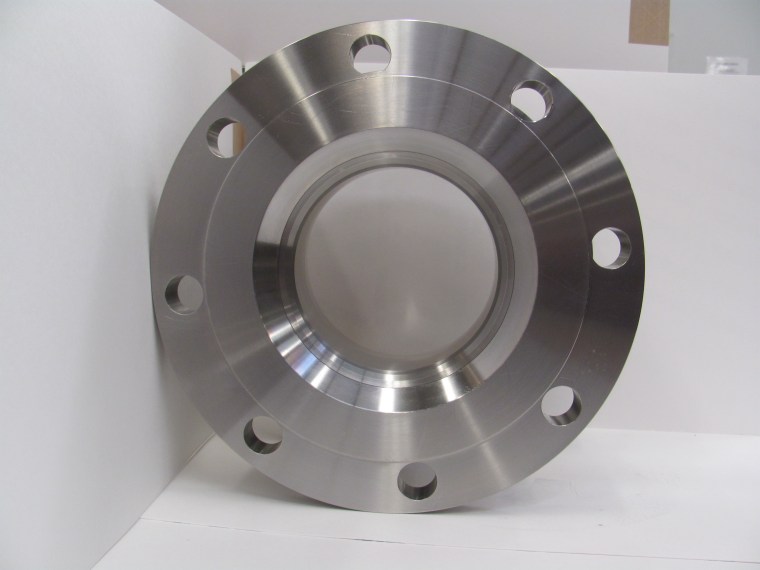
One of our main concerns with an adjustable design was clearance available by changing the overall length of the unit when making an adjustment. The customer advised they were going to incorporate an expansion joint which would allow them roughly 2 – 3″ of space. This extra real estate would allow for a unit to be unbolted, have the adjustment made to the desired performance, then re-bolted. For this customer’s specific need, we were able to design a special 6″ flanged, 304ss, Adjustable Air Amplifier.

IMG_5185
Special 6″ 304ss, Flanged Adjustable Air Amplifier
IMG_5192
ANSI 150# RF Flanges

You no longer need to fret over your unique compressed air requirement or difficult application, EXAIR is staffed to help you solve the problem. This is just one instance of how we are able to meet the demands of a unique application. If you have a specific need, give us a call, chances are we will be able to assist as well.

Justin Nicholl
Application Engineer
justinnicholl@exair.com
@EXAIR_JN

What is Ultrasonic Sound? How Does the Ultrasonic Leak Detector Work?

ULD
Ultrasonic Leak Detector locates compressed air leak

Many times when working with our customers and educating them about ultrasonic sound and how the Ultrasonic Leak Detector works, we will get questions like, “You sell the Ultrasonic Leak Detector for compressed air, but will it work to detect Helium or Nitrogen?”

The answer is yes, it has the capacity to sense either of these gases. When any gas flows through a small opening at a rate greater than 10-5 mL/second, the gas is generally understood to be in viscous flow. The greater the pressure difference across the opening, the greater the velocity of the gas moving from high pressure to low pressure side. When the velocity increases, the frequency of emitted ultrasonic noise also increases to higher frequency. And to be clear, the Ultrasonic Leak Detector has the capability to detect many different sources of ultrasonic noise. It does not have to be a gas leak, but for our purposes in dealing with the location of compressed air leaks we will stick to gas leaks in this discussion.

Ultrasonic frequencies range from 20 kHz to 100 kHz, a range that is above the perception of normal, human hearing (20 Hz – 20 kHz). The Ultrasonic Leak Detector consists of a microphone and some electronics that “tune” the device’s capability to sense frequencies in this range. And through a process called “heterodyning” the ultrasonic frequency is shifted down into a frequency range that can be heard through a set of headphones by the operator. Ultrasonic noise is highly directional. As the detecting microphone is aimed in the direction of an ultrasonic noise source, the “white noise” heard through the head phones will increase in volume thus indicating that the operator has the detector pointed in the correct direction and can proceed closer to the noise source (meaning compressed gas leak) so it can be identified, tagged and eventually repaired.

Compressed air leaks can result in a waste of up to 30% of a facility’s compressor output. A compressed air leak detection and repair program can save the facility this wasted air. You can even think of such a program as another way in which a facility can “find” additional air compressor capacity for new projects instead of having to purchase additional compressors to make up for the leakage. And the nice thing is that using the EXAIR Ultrasonic Leak Detector to identify only one leak has the great potential to pay for the tool you used to find the leak within the first 3 – 6 months. There aren’t many tools that can pay for themselves in that quick a time frame.

If you have any questions about ultrasonic noise, the EXAIR Ultrasonic Leak Detector or your specific application, kindly contact our Application Engineers to discuss your case today! If you would like to watch my video about how to operate the Ultrasonic Leak Detector, click here.

Neal Raker, International Sales Manager
nealraker@exair.com
@EXAIR_NR