UL Classified Explained

A UL Classified mark from UL Solutions signifies that a product has undergone testing for specific hazards or performance criteria under controlled conditions, rather than having completed a thorough and comprehensive safety evaluation. This classification is particularly relevant for industrial equipment, construction materials, and products designed to withstand fire, such as fire-resistant doors. It is important to understand that while a UL Classified mark indicates a level of safety and performance, it does not equate to a full UL Listing, which involves more extensive testing and evaluation processes. Therefore, products bearing the UL Classified mark should be viewed as having met certain safety standards, but users should remain aware of the limitations of this certification in terms of overall safety assurance.

Key Aspects of UL Classified Products

  • Targeted Evaluation — Targeted evaluation focuses on assessing specific characteristics, such as fire resistance, toxicity, and impact resistance, rather than adhering to comprehensive safety standards. This approach allows for a more precise understanding of a material’s performance in critical areas, ensuring that essential safety aspects are thoroughly examined.
  • Specific Usage — These products are designed for particular environments or applications, including hazardous areas, explosive settings, or specialized construction projects.
  • Distinction from Listed – Classified products differ from UL Listed products in that they are not subjected to the same rigorous safety evaluations. While UL Listed items are assessed for comprehensive safety standards, Classified products only comply with a subset of these requirements.
  • Labeling — Labeling typically features a statement that clarifies the limited scope of the evaluation, such as indicating that it is “Classified with respect to” a particular property. It is essential to adhere to the specified language when crafting responses and to consider any relevant modifiers without explicitly mentioning them.

Many of our products are UL Listed or UL Recognized; however, the Hazardous Location Cabinet Cooler Systems undergo additional evaluation to confirm their safety when utilized correctly in classified environments. UL Classified provides various levels of certification. These cooler systems are specifically engineered for use with purged and pressurized systems in designated hazardous locations.

Class I Div 1, Groups A, B, C, and D
Class II Div 1, Groups E, F, and G
Class III

If you have questions about our UL classification, or anything regarding EXAIR and our products, please do not hesitate to reach out.

Jason Kirby
Application Engineer
Email: jasonkirby@exair.com
Twitter: @EXAIR_jk

Finding and Fixing Compressed Air Leaks

One of the most significant challenges facing compressed air systems is the presence of leaks. The subtle hissing sound emanating from the pipelines can lead to substantial financial losses for your company. A university study revealed that in poorly maintained systems, approximately 30% of compressor capacity is wasted due to air leaks. Unfortunately, many organizations neglect to implement leak prevention programs, resulting in inefficient systems. To quantify the impact, an inaudible leak can cost as much as $130 annually, and this is just for a single leak within extensive compressed air lines. For audible leaks, the accompanying chart illustrates the potential financial waste based on the size of the leak. Unlike hydraulic systems, compressed air leaks do not create visible messes, making them harder to detect and requiring alternative methods for identification.

Leaks commonly occur at threaded fittings, connections, hoses, and pneumatic components such as valves, regulators, and drains. EXAIR’s Optimization products are specifically designed to enhance the efficiency of your compressed air system, with leak elimination being the most effective strategy. Utilizing Ultrasonic Leak Detectors allows for the identification of air leaks, while Digital Flowmeters enable monitoring of system flow, particularly during non-production periods. By incorporating these tools into a leak prevention program, you can significantly improve your ability to detect and address leaks, ensuring your compressed air system operates at peak performance.

When a leak occurs, it produces ultrasonic sounds due to turbulence, often at frequencies above 20 kHz, which are inaudible to the human ear. The EXAIR Ultrasonic Leak Detector, model 9207, is designed to detect these frequencies and convert them into audible sounds through a technique known as “heterodyning.” This device features a signal strength indicator and a bar graph display, enabling users to identify even the smallest leaks. It includes two attachments: a parabolic microphone for locating leaks from distances of up to 20 feet, and a tube attachment for pinpointing the exact source of a leak among multiple connections within a pipe. Once identified, leaks can be marked for repair.

Digital Flowmeters enable continuous monitoring for waste, particularly in pneumatic systems where air leaks can arise unexpectedly. By isolating different sections of your system, you can conduct systematic checks and analyze flow readings with the Digital Flowmeter. Additionally, tracking results over time can provide valuable insights into system performance. We also offer a USB Datalogger option, allowing you to set specific time intervals for recording air flows. After capturing the data, you can connect the USB to your computer and utilize downloadable software to review the information, which can also be exported to an Excel spreadsheet for further analysis. If you notice a consistent upward trend in flow readings for a particular process, you can employ an Ultrasonic Leak Detector to identify the presence and location of any leaks. Furthermore, the Digital Flow Meter serves as a proactive tool, helping to indicate potential failures in your pneumatic system by analyzing trends in the readings over time.

If you have questions about finding and fixing compressed air leaks, or anything regarding EXAIR and our products, please do not hesitate to reach out.

Jason Kirby
Application Engineer
Email: jasonkirby@exair.com
Twitter: @EXAIR_jk

The EXAIR Knowledge Base

At EXAIR, we are committed to providing our customers with the necessary tools to tackle challenges and enhance their workforce training through a comprehensive array of resources known as the Knowledge Base. This collection is systematically organized by various criteria to deliver practical, experience-driven solutions.

In our Knowledge Base, you can explore case studies that demonstrate our success in assisting clients with process optimization, reducing compressed air consumption to lower expenses, and improving workplace safety. Additionally, we provide a categorized FAQ section organized by product line, a range of calculators to estimate potential savings, and various application examples that showcase our capabilities.

We encourage you to utilize these resources to gain insights into our methodologies and the tangible benefits we offer. Each element is designed to support your understanding and application of our solutions effectively.

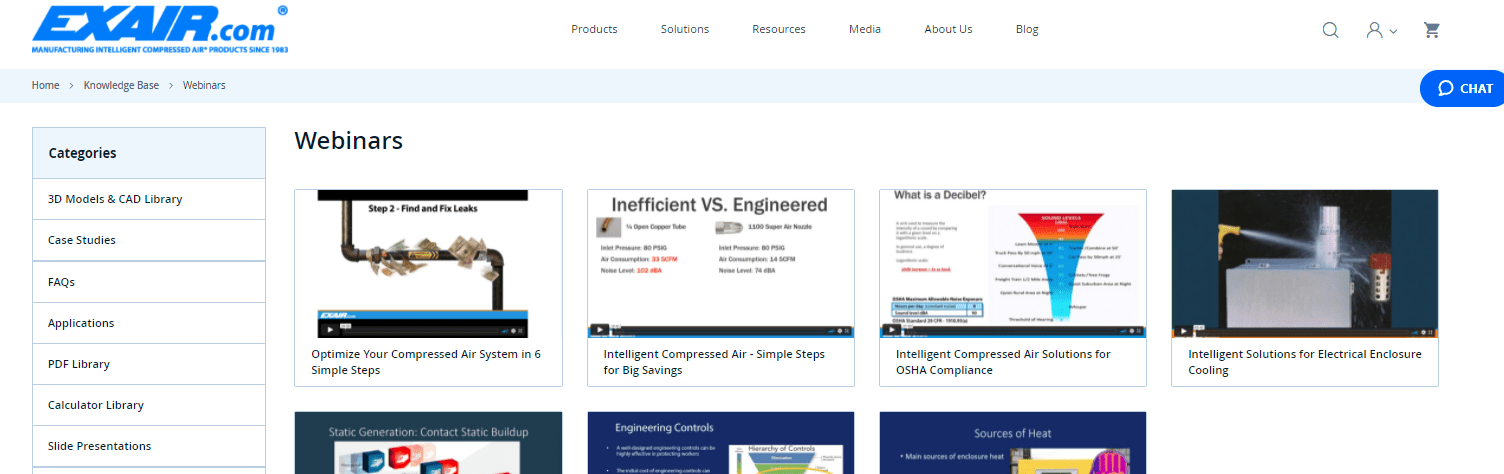
We provide a selection of on-demand webinars that you can access for free at your convenience. These sessions explore various topics, such as the distinctions between inefficient and engineered nozzles, static generation, and techniques for detecting and fixing leaks. Our video library also includes product demonstrations, casual content, and practical advice for optimizing the use of our products. Furthermore, we offer Application Assistance and an Efficiency Lab, which deliver customized recommendations and performance evaluations.

EXAIR’s Free Efficiency Lab

In addition to the comprehensive resources available in the Knowledge Base, EXAIR is supported by a team of experienced Application Engineers with expertise spanning various industries and processes. It is highly probable that one of our engineers has dealt with a similar application, and we are committed to helping you identify the most effective solution.

If you have questions about our Knowledge Base, or anything regarding EXAIR and our products, please do not hesitate to reach out.

Jason Kirby
Application Engineer
Email: jasonkirby@exair.com
Twitter: @EXAIR_jk

Laminar vs. Turbulent Flow

If the object you’re blowing off is flat, the laminar air flow from a Super Air Knife is ideal. They come in lengths from 3 inches to 9 feet long.

EXAIR often differentiates between laminar and turbulent flow in relation to our blow-off products. To clarify, laminar airflow is notably more efficient in blow-off applications, as it reduces pressure drops, enhances product displacement, and minimizes noise levels when compared to turbulent airflow. Understanding these distinctions is essential for optimizing performance in various applications.

Laminar flow describes a type of airflow where the velocity and direction remain uniform throughout a designated volume of air. This phenomenon results in air movement that occurs in straight lines, aligning parallel to any solid surfaces present in the area.

Laminar airflow is effective in reducing turbulence. However, the introduction of devices or materials on surfaces can unintentionally create swirls within the workspace. This chaotic turbulent flow can disrupt tasks that require a dust-free environment, leading to potential contamination. Furthermore, obstructions such as items left inside enclosures can exacerbate this issue.

The Super Air Knife by EXAIR serves as a prime example of a product that delivers laminar airflow. This cutting-edge tool offers an efficient solution for tasks such as cleaning, drying, or cooling various components, webs, or conveyors. It produces a steady sheet of laminar airflow that applies a consistent force along its entire length, ensuring optimal performance for a wide range of applications.

Turbulent airflow is characterized by its unpredictable and chaotic fluid dynamics, standing in stark contrast to laminar flow, where fluids move in smooth, parallel layers. In turbulent conditions, the fluid’s speed and direction are in constant flux, leading to the development of eddies and swirls within the flow.

If you have questions about laminar or turbulent airflow, please do not hesitate to reach out.

Jason Kirby
Application Engineer
Email: jasonkirby@exair.com
Twitter: @EXAIR_jk