Webinar Replay: SCFM, ACFM, ICFM, CFM – Why So Many Terms For Air Flows?

EXAIR’s latest addition to the Fall Webinar series was a discussion on the topic of volumetric air flow terms: SCFM, ACFM, ICFM, and CFM. In the compressed air world, these terms are used often to quantify the performance of a compressor or the point-of-use equipment on the supply side of your system. Since conditions will vary from one site location to another, it’s important that we understand how certain variables can change the performance of your system. The webinar is available to view on demand on the EXAIR.com.

The term SCFM (Standard Cubic Feet Per Minute) is used to allow us to make an apples to apples comparison across different equipment. The performance is rate at a set of “standard” conditions to remove any potential variables from the equation. CAGI, or the Compressed Air and Gas Institute, uses the standard conditions of: 14.5 psia, 0% relative humidity (RH), and 68°F. This allows us to compare different devices without needing to make any sort of adjustments.

Variables such as elevation (barometric pressure), relative humidity, and temperature all change the performance and must be considered.

With elevation, we’re looking at the atmospheric or barometric pressure at the location of operation. One way to illustrate this to consider a balloon. If you inflated a balloon at sea-level, or 14.5 psia, then carry that same balloon up to the top of Mt. Everest what would happen? Using Boyle’s Law (P1 x V1 = P2 x V2), we’re able to calculate the exact volume of the balloon. At the peak of Mt. Everest, pressure is significantly lower at roughly 4.5 psi. The balloon when taken to the peak at 4.5 psi would become 3.2x it’s original size as the pressure acting on the outside of the balloon decreases.

Relative humidity tells us how much moisture content is contained within a specific volume of air. Water molecules cannot be compressed, so when the air is compressed this water takes up the same volume. The water condenses in the inter-coolers and after-coolers or is removed via drains and dryers downstream. So, 1 cubic foot of air coming into the compressor weigh more than 1 cubic foot of air out due to this water vapor loss.

As temperature increases, so does air pressure as the molecules in the air speed up and come into contact with one another and the walls of its container at a more rapid pace. Air can also hold a greater volume of moisture at higher temperatures. So, the balance between RH and temperature is an important consideration when determining actual performance, or ACFM.

In the webinar, we walked through two different examples to highlight the changes in these variables and how it impacts the performance of a compressed air system. If you were unable to attend live, the webinar is available to view on demand on the EXAIR website. We have this latest webinar posted there on the website along with all prior webinars as well! There, we talk about topics ranging from compressed air system optimization, static electricity, OSHA Compliance, and more! Check out the available webinars on the Resources tab of the EXAIR.com page today for all the knowledge you’ll need about your compressed air system and processes.

Tyler Daniel, CCASS

Application Engineer

E-mail: TylerDaniel@EXAIR.com

Twitter: @EXAIR_TD

Video Blog: Chip Shield Kits

I have seen over the years where OSHA inspectors has visited manufacturing plants for violations.  One of the more common areas that they review are compressed air guns because many of them are very dangerous for Dead-End pressure and noise levels.  All of EXAIR Safety Air Guns are OSHA compliant.  But there is an additional OSHA guideline 1910.242(b) that deals with Chip guarding and shields for cleaning purposes.  With these types of applications, EXAIR offers Chip Shields; either as an option with our Safety Air Guns; or as Chip Shields only, or as a Chip Shield kit.  In this video, I will go over the Chip Shield Kits that will add a chip shield to your existing EXAIR Safety Air Gun.

John Ball
Application Engineer
Email: johnball@exair.com
Twitter: @EXAIR_jb

VariBlast® Precision Safety Air Gun

EXAIR’s new VariBlast® Precision Safety Air Guns provide a focused blast of air capable of handling tough jobs with remarkable strength. This CE compliant, lightweight air gun uses an engineered valve for variable flow.  It can produce an adjustable force upon a target simply by pulling the trigger to a variety of positions.  You can generate higher or lower force as needed for an application.

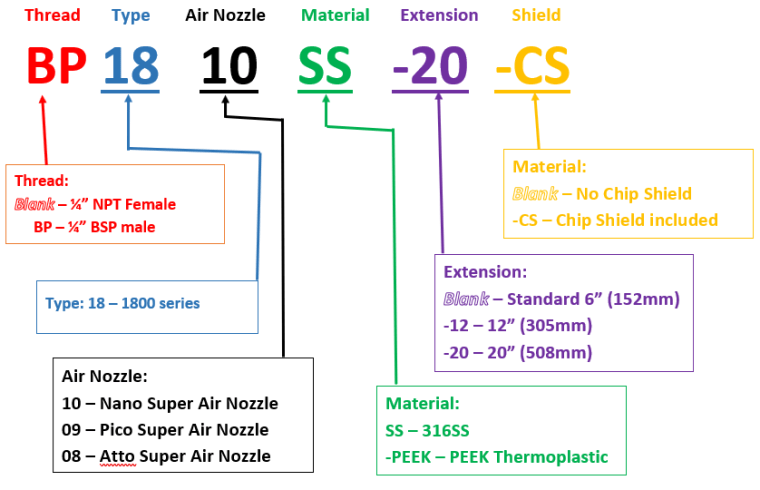
A comfortable full-finger trigger and a convenient hanger loop are built-in to the Variblast Precision Safety Air Gun.  It has a ¼” NPT female compressed air inlet at the base of the handle with an option for a BSP threaded adapter.  One of the unique features is the replaceable extensions.  They come standard with a 6” (152mm) extension.  For greater reach, we offer a 12″ (305mm) or a 20″ (508mm) extension for longer reach.  The body is made of high-impact, glass-reinforced nylon to resist breakage.  They can also be outfitted with an impact-resistant polycarbonate Chip Shield.  In combination with the EXAIR Safety Air Nozzles, the airflow that exits the nozzle can’t be blocked, assuring safe operation and compliance with OSHA standard 1910.242(b). Also, the Precision air gun has a low noise level, only 75 dBA, which is well below the limits of the OSHA noise exposure standard 29 CFR 1910.95(a).  EXAIR strives to manufacture safe and efficient safety air guns, and the VariBlast Precision fits that bill.

To expand on efficiency, the engineered nozzles are designed to entrain the free ambient air to add mass to the airstream.  With an amplification ratio of nearly 25:1, you only have to use a small amount of compressed air to generate a powerful, focused blast.  So, by using less compressed air, it will save you a lot of money.  EXAIR offers three different sizes in different materials.  The largest is the Nano Super Air Nozzle, which only requires 8.3 SCFM (235 SLPM) at 80 PSIG (5.5 Bar).  It is made from type 316SS or PEEK thermoplastic.  The PEEK nozzle is great for non-marring applications.  The smallest unit is our Atto Super Air Nozzle for very small holes.  It also comes in 316SS or PEEK thermoplastic.  It only uses 2.5 SCFM (71 SLPM) of compressed air at 80 PSIG (5.5 Bar).  For the “in-between” force rating, we offer the Pico Super Air Nozzle in 316SS and PEEK.  For the different combinations of model numbers, I created a VariBlast chart below.

A substandard blow-off gun is unsafe, loud, and wastes compressed air.  They are subject to dangerous conditions and OSHA fines.  EXAIR Safety Air Guns can help improve the situation in all these areas.  EXAIR stocks a wide range of safety air guns for almost any blow-off application.  We stock units ranging from our smallest size; the VariBlast Precision Safety Air Guns up to our largest size; the TurboBalst Safety Air Guns.  From August 1st to September 30th, 2022 for qualified purchases; EXAIR will give a 1” Flat Super Air Nozzle as a promotional item with a purchase of a VariBlast Precision, VariBlast Compact, Soft Grip, Heavy Duty, Super Blast, or TurboBlast Safety Air Gun; a $53.00 complimentary gift.  If you have any questions about the VariBlast Precision Safety Air Guns or any of our other safety air guns, you can contact an Application Engineer at EXAIR.  We will be happy to help you.

John Ball
Application Engineer
Email: johnball@exair.com
Twitter: @EXAIR_jb

EXAIR Compliance with OSHA 1910.242(b)

OSHA Standard 1910.242(b) discusses the use of compressed air for cleaning and blowoff. It states that the use of compressed air for cleaning purposes is prohibited if the dead-ended pressure exceeds 30 psig. This phrase means the downstream pressure of the air nozzle or gun, used for cleaning purposes, will remain at a pressure level below 30 psig for all static conditions. In the event that dead ending occurs, the static pressure at the main orifice shall not exceed 30 psi. If it does exceed this pressure, there is a very high potential for it to create an air embolism. An air embolism, left untreated, can quickly impede the flow of blood throughout the body. This can lead to stroke, heart attack, and sometimes death.

So making sure you are in compliance with 1910.242(b) is truly a life and death situation. Most people believe that lowering the pressure to the blow off device is the only method to keep their operators safe from an air embolism. However this can become a problem when you really need the force of greater than 30 PSIG to complete your operation. We at EXAIR want to give you the flexibility to run at any pressure with out the risk of building that 30 PSI of dead-end pressure! We do this with our line of Intelligent Compressed Air® nozzles! All of EXAIR’s Air Nozzles are designed so that the flow cannot be dead-ended. The fins on the Super Air Nozzles are not only useful in amplifying the force by drawing in ambient air, but they also prevent an operator from completely obstructing the airflow.

Another great example of this is our 2″ Flat super air nozzle. The design not only allows the nozzle to amplify the air flow in the blast of air, the over hang will not let the dead end pressure build as it can escape around the edges and bottom!

2″ Flat Super Air Nozzle

If you’ve got questions about compressed air safety or have an existing blowoff in place that does not adhere to this OSHA directive, give us a call. We’ll be sure to recommend a solution that will keep your operators and wallets safe!

Jordan Shouse
Application Engineer

Send me an Email
Find us on the Web 
Like us on Facebook
Twitter: @EXAIR_JS