How Does EXAIR Fit Into the NIOSH Hierarchy of Controls?

The Occupational Health and Safety Act of 1970 established the National Institute for Occupational Safety and Health, also known as NIOSH. This organization was founded with the goal of researching worker safety and health, and providing guidelines for employers to create safe and healthy workplace environments. A division of the Centers for Disease Control and Prevention (CDC), NIOSH has been diligently working to ensure that information is accessible to those who want to improve the safety of their operations.

On the NIOSH section of the CDC website, they’ve published a helpful guide for helping you to control and minimize the risk of exposure to hazards in the workplace. This hierarchy of controls provides a framework from most to least effective in terms of the way you manage these hazards and the exposure to your operators. This hierarchy of controls contains (5) levels of actions that can be taken to reduce or remove hazards from the workplace. In order of most to least effective, these controls are:

  1. Elimination
  2. Substitution
  3. Engineering Controls
  4. Administrative Controls
  5. Personal Protective Equipment (PPE)

 The least effective option for mitigating risks may not have been what you originally thought. PPE, or personal protective equipment, is something I’m sure you talk about often with your operators. Would you believe that this is ranked as the least effective method of preventing risks? This is because equipment can become easily damaged, may be uncomfortable and not always used when necessary, or simply used in an improper manner. We’ve all been guilty of doing something that we know we should’ve likely worn some PPE for, just out of convenience. Since it’s so easy to forget or simply not use, it makes PPE the least effective method when it comes to enhancing safety.

Moving up one notch on the scale we have administrative controls. These are also at the lower end of the effectiveness spectrum. These types of controls are centered around making changes to the way personnel works around the equipment. This can be achieved through implementation of training to correct operating procedures, cleanliness of the workplace, personal hygiene practices (proper hand-washing after handling hazardous materials for example). These, again, rely on the operator to listen and act in the way they’re trained.

Engineering controls reside in the middle of the effectiveness range. These are implemented by design changes to the equipment or process that reduces the risk of hazard. These controls can be very effective in protecting people regardless of the actions or behaviors of the operators. They are higher in cost generally than an administrative or PPE control, but can make operating costs lower and allow for a cost savings over the long-term.

Substitution is where EXAIR’s Intelligent Compressed Air Products come into play. By offering engineered solutions that meet or exceed OSHA Standards 29 CFR 1910.242(b) and 29 CFR 1910.95(a), EXAIR’s line of Safety Air Guns, Air Nozzles, and other engineered blowoffs will ensure your operators are not at risk when using our equipment. Anywhere you’re performing some sort of compressed air blowoff process, it’s important to be using equipment designed with safety in mind.

The most effective, but usually the hardest to implement, is elimination. This involves physically removing the hazard from the process. In many cases, a complete elimination is not going to be possible. That’s when you turn to the substitution method and look to EXAIR for a solution.

With years of industry experience under our belt, we’re well-equipped to help you improve safety in your workplace through a variety of off-the-shelf products. Give us a call today and we’ll be happy to discuss how we fit into your facility’s processes!

Tyler Daniel, CCASS

Application Engineer

E-mail: TylerDaniel@EXAIR.com

Twitter: @EXAIR_TD

Hierarchy of Controls Image:  used from  Public Domain

OSHA 1910.95(a) Explained: Occupational Sound Exposure

Hearing loss due to high noise levels is a common problem in many industrial facilities. Without the use of proper PPE, hearing loss can occur quickly. This is a serious concern as hearing loss is permanent and once the damage is done there’s no way to reverse it. Due to this risk, OSHA strictly enforces standard 29 CFR-1910.95(a).

This directive discusses the effects of noise and limits exposure based on the dBA. The table below indicates the maximum allowable exposure time to different noise levels. Sound levels that exceed these levels should first be addressed by proper engineering controls such as isolating the source of the sound from personnel or replacing the cause of the sound with something like an engineered compressed air nozzle. When such controls aren’t feasible, proper PPE must be worn to protect the operator.

Hearing loss can occur in as little as 30 minutes when exposed to sound levels 110 dBA or greater. Operators have a tendency not to use PPE as directed, if an OSHA inspector comes to your facility and notices that the sound levels exceed the maximum allowable level without protection hefty fines will be soon to follow. In this example from the United States Department of Labor, a company was fined a total of $143,000 for failing to protect their employees.

In order to identify the places or processes in your facility that are causing the problems, you’ll need a tool to measure the sound level. EXAIR’s easy to use Digital Sound Level Meter allows you to measure and monitor the sound level pressure in a wide variety of industrial environments. The source of the loud noise can then be identified and isolated so that corrective action can be taken. For compressed air related noise, EXAIR manufactures a wide variety of engineered compressed air products that can reduce the sound level dramatically. In many cases, EXAIR products are capable of reducing noise levels by as much as 10 dBA. Since the dBA scale is logarithmic, this equates to cutting the sound level in half!

If there are processes within your facility that are above these limits, and you’d like to eliminate relying on proper PPE, give an Application Engineer a call. We’ll help walk you through the selection process and make sure that when the OSHA inspector comes knocking you’re prepared!

Tyler Daniel, CCASS

Application Engineer
E-mail: TylerDaniel@exair.com
Twitter: @EXAIR_TD

Application Assistance & Application Database

EXAIR Products are used in countless applications across all facets of industry, we have been working to compile some in an easy to read Application Database on EXAIR.com!

Why do we have this database? Well that is simple, we are talking to people every day about applications and how our products can be the solution! Why not log those successful applications in an easy-to-access location for all to see! Also, to make it even more convenient we catalog them by industry and application goal!

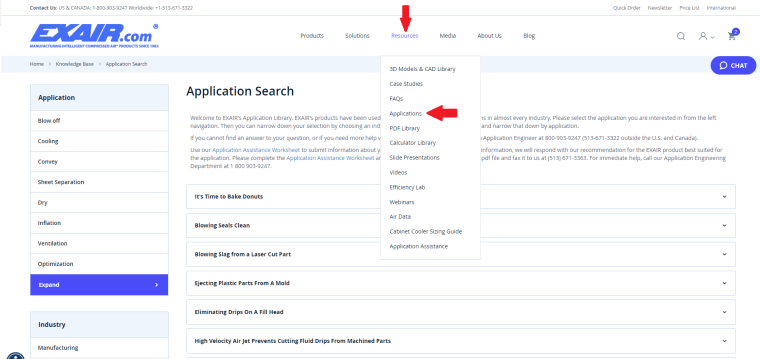
Here is how you can find this library.  First, you will have to sign in to EXAIR.  Click here: Log In.  Once you fill in the proper information, you can then retrieve a great amount of resources about EXAIR products that we manufacture.   The Application database is under the Resources tab also known as the Knowledge base.  (Reference photo below).

At the Application Search Library, we have over one thousand applications that we reference.  In the left selection pane, we organized then in alphabetical order under two categories, Application and Industry.

Scroll down in the selection pane until you come to the sub-category: Industry.  Under this Sub-category, you will find three selections that are related to this blog: Automation, Automobile Recycling, and Automotive.  We have other applications as well that may relate to your specific processes if you scroll up and down the list like; Part Ejection and Machining.  You will find many product applications that have already improved processes and solved problems.

If you can’t find an application in this library that matches yours reach out via our Application assistance form! This will be sent directly to the Application Engineering team, we strive to then reach out ASAP to get more information or recommend product! (Reference photos below).

How to find the Application Assistance Form
Application Assistance Form

In today’s market, companies are always looking for ways to cut cost, increase productivity, and improve safety.  EXAIR can offer engineered products to do exactly that.  With the “been there and done that” solutions already described in the Application Database; you can have confidence in finding a way in solving pneumatic issues.  If you do not sign up at www.EXAIR.com and take advantage of these offerings, you will be missing out on a great tool to optimize your compressed air system.

Jordan Shouse
Application Engineer
Send me an email
Find us on the Web 
Like us on Facebook
Twitter: @EXAIR_JS

What OSHA 1910.242(b) Means For Compressed Air Product Users

Medically speaking, our skin is an organ…and an amazing one at that. It protects our internals from an incredibly harsh environment as we’re bombarded by radiation (sunlight), subjected to summer’s heat & the cold of winter, attacked by fierce invaders (from viruses & bacteria to insects & spiders), all while we carry on at the bottom of a 60 mile-deep ocean (of air!)

Our skin requires some protection too: Sunscreen mitigates some of the harmful effects of solar radiation, shoes protect our feet from the ground, gloves & coats prevent frostbite, and compliance with OSHA Standard 1910.242(b) protects operators who use compressed air devices for cleaning purposes from air embolisms. That’s when air, under pressure, has enough energy to break the skin (tough as it is) and reach the tissue underneath. It’s painful, and serious enough that the victim should absolutely seek emergency medical treatment. If the air breaks a blood vessel and enters the pulmonary system, it can be deadly, in a hurry.

In 1971, the U.S. Occupational Health and Safety Administration (OSHA) determined that air under pressure higher than 30 pounds per square inch is capable of causing such injuries, if the pressurized source is dead-ended into the skin. Based on this determination, they included the following verbiage in Standard 1910.242, regulating the safe operation of hand and portable powered tools & equipment:


1910.242(b) Compressed air used for cleaning. Compressed air shall not be used for cleaning purposes except where reduced to less than 30 p.s.i. and then only with effective chip guarding and personal protective equipment.


In February 1972, OSHA issued Instruction STD 01-13-001 to clarify the meaning of 1910.242(b), with two illustrations of acceptable methods to meet compliance. The first is the use of a pressure reducer (or regulator):

While this method is compliant with the OSHA Standard, it’s kind of impractical, since you’re not going to get a whole lot of cleaning done with such a low energy air flow. If that’s not bad enough, it’s STILL going to be loud, and wasteful as far as the cost of compressed air goes.

The other method illustrated in the Instruction’s enclosures involves the nozzles themselves:

Compressed air product manufacturers use this method to make OSHA compliant Nozzles.

One design that complies with OSHA 1910.242(b) using this method is the cross drilled nozzle:

Unless it’s blocked off, practically all of the air flow goes straight out the end, but if you block off the end, it all goes out the cross drilled hole. As long that hole is properly sized, you won’t build up 30 psi at the main outlet.

If you’re not concerned about high operating cost or deafening noise, you can stop reading now; these are all you need for OSHA compliance with Standard 1910.242(b). If you DO care about spending less money on compressed air or complying with OSHA Standard 1910.95(a) (which you read all about here), let’s spend a minute on engineered compressed air nozzles:

EXAIR Super Air Nozzles discharge compressed air through an annular array of holes, recessed between a series of fins. This causes the primary (compressed air) stream to entrain an enormous amount of air from the surrounding environment.

In addition to making them cost less to operate (since most of the total developed air flow is entrained), they’re also VERY quiet (since the entrained air forms a boundary layer on the outside of the air stream), AND they can’t be dead ended:

Since the fins won’t allow for a complete blockage of the compressed air discharging from the Super Air Nozzle, this design is a prime example of a built-in “relief device” as defined by Instruction STD 01-13-001, above.

All EXAIR Intelligent Compressed Air Products, in fact, incorporate a form of built-in “relief device”:

The overhang of the cap on the Flat Super Air Nozzles and the Super Air Knives prevent them from being dead ended.

If you’d like to discuss safe use of compressed air, it’s one of our primary goals here at EXAIR – give me a call.

Russ Bowman, CCASS

Application Engineer
EXAIR LLC
Visit us on the Web
Follow me on Twitter
Like us on Facebook