Regulators and Filters for Compressed Air

I would like to dive into the realm of filters and regulators. Majority of EXAIR products use compressed air to coat, conserve, cool, convey or clean. So, to keep the product running efficiently, we need to supply them with clean, dry, pressurized air. We offer a line of filter separators, oil removal filters, and regulators that can supply enough pressure and flow to keep the EXAIR products performing for a very long time. If we look at each individual item, we can see how they can play an important part in your compressed air system.

Regulators are used to control the amount of air pressure being supplied to your EXAIR products. This is important if you are trying to control the flow, force, and/or conveyance rate. One issue with regulators is “droop”. Droop is the amount of pressure drop when you flow through a regulator. If you set the pressure of a regulator with no flow, to let’s say 80 psig (5.5 barg). Once you start flowing, you will see the downstream pressure fall. This is dependent on the size of the regulator and the valve inside. This is very important because if you need 80 psig (5.5 barg) downstream of the regulator feeding an EXAIR product and the droop brings it to 30 psig (2 barg), you will not have enough flow for your EXAIR product, losing performance. EXAIR recommends a specific regulator for each of our products. We tested our products with the recommended regulators to make sure that you are able to get the best performance. If you do use another manufacturer’s regulator, make sure you are able to flow the correct amount of air at the pressure you need. Not all ¼” regulators flow the same.

Pressure Regulator
Pressure Regulator

Filter separators are used to remove liquid condensate and contamination from the compressed air stream. They have a 5 micron filter and work very well if you get a slug of water or oil into your compressed air system. They use mechanical separation to remove the large particles of dirt and water from the air stream. Most facilities have some type of compressed air dryer in their system. This will dry the compressed air. But, if a system failure occurs, then water, oil, and dirt are pushed into the compressed air lines and perhaps into your EXAIR products. Even if you have good quality air, it is important to keep your products protected. An ounce of prevention ….

Oil Removal Filter
Oil Removal Filter


The oil removal filters are used to keep the compressed air even cleaner yet. They work great at removing very small particles of dirt and oil. Without an oil removal filter, dirt particles and oil particles can collect in “dead” zones within the compressed air lines. Over time, a tacky glob forms. As it grows, it can break off and get into the air stream affecting pneumatic devices. The oil removal filter will be able to help eliminate the long term effects in your compressed air system. As a note, oil removal filters are not great for bulk separation. If you have a system with lots of water, you will need a filter separator in front of the oil removal filter to optimize the filtration. With the oil removal filters, the media is a barrier to collect the small particles of dirt and oil. If a slug of water or oil tries to go through, it will block a portion of the element off until it is forced through. This will increase the velocity and pressure drop of the element. With the high velocity, as the slug makes its way through the media, it can spray, re-entraining the liquid particles.

Now that we went through our pneumatic products, how do we use them together to get the best supply of compressed air? With both types of filters, we always want them to be upstream of the regulator. This is because the velocity is lower at higher pressures. Lower velocities mean smaller pressure drops which is good in filtration. If we can analyze the compressed air systems, I would like to categorize it into a good and premium quality. To supply a good quality of compressed air, you can have the compressed air run through the filter separator then a regulator. To produce the premium quality of compressed air, you can have your compressed air run through the filter separator, the oil removal filter, and then the regulator. With clean quality air, your EXAIR products will provide you with effective, long-lasting performance without maintenance downtime.

John Ball
Application Engineer
Email: johnball@exair.com
Twitter: @EXAIR_jb

What’s an EXAIR?

Sometimes taking customer’s phone calls remind me of an Abbott and Costello bit (but I have to be Costello). Conversations can feel a bit like twenty questions. Instead of opening with mineral, vegetable, or animal, customers call in wanting more information on an “EXAIR”.  For our brand manager and marketing department, it is a clear sign that what they are doing is working, but to me can be a bit confusing.

Before you start thinking I don’t know my product, please remember an “EXAIR” can be quite few things. We make the broadest variety of problem solving end-use compressed air products for industry which equates to many possibilities of what an “EXAIR” may be. Is it an Air Nozzle, an Air Knife, an Air Wipe, an Air Amplifier, an Atomizing Spray Nozzle, a Safety Air Gun, a Static Eliminator, a Vacuum Generator, a Line Vac, an Industrial Vacuum, a Vortex Tube, a Cold Gun, or a Cabinet Cooler?   Unfortunately, with no moving parts to wear out, our products sometimes will outlast their labels, so the customers don’t have anymore information. Then, I have to ask what the product does.

So I ask the customer, “does the EXAIR blow off, vacuum, clean, dry, cool, convey, evacuate, coat, divert, dust, float, open, lift, purge, or spray?”

And then I wait for the customer’s detailed and eloquent response…”It works”, they sometimes say. But most of the time they respond with all of the details or enough to determine what product they have. In, in the end, an “EXAIR” is generally a Cabinet Cooler or a Vortex Tube (though it may be any of the above selection) – and we won’t complain that our company name can be so closely associated with our products.

We have so many products because compressed air is so versatile and useful.  We have taken our expertise in compressed air and used it to solve numerous problems for our customers. This is not as easy, as it sounds.  First, you need to know how well our compressed air products can perform. Second, you need to know what kind of performance the customer needs to get the job done. For instance when working on a Cabinet Cooler sizing exercise: A customer has a control box that is 24″ tall by  36″ wide by 12″ deep.  This box is reaching temperatures that cause the electronics to fail. Generally, this temperature is going to be between 110 degrees Fahrenheit to 130 degrees Fahrenheit. The temperature in the plant was 95 degrees Fahrenheit, when it failed.  The customer would now like a Cabinet Cooler System to protect his enclosure from future temperature failures.

To calculate the heat load of the electronics, first we need to calculate the surface area in square feet. In the example above that would be 22 square feet. Second, we need to calculate the temperature differential between the outside and the inside of the cabinet.  The maximum temperature differential is 130 F – 95 F, which is 35 degree differential. With the temperature differential chart from our website, we can calculate the BTU/HR per square foot.

Temperature Conversion Table

For our example, it would be 13.8 BTU/HR/ft^2. Multiply this by our surface area. Our Cabinet Cooler needs to cool at least 303.6 BTU/HR. Our 4308 Cabinet Cooler System would be a good cabinet cooler for this enclosure. It can cool 550 BTU/Hr. It is rated for a NEMA 12 enclosure to prevent dust and oil from entering the cabinet.

To help the customer, you have to first ask the right questions. Most of these questions are listed on the Cabinet Cooler Sizing Guide on our website. What is the internal air temperature in the cabinet? What is the ambient air temperature? Are their any fans in the cabinet? What is the NEMA rating for the Cabinet? Sometimes it is best to speak with an Application Engineer to know for sure you have your bases covered.

Dave Woerner
Application Engineer
DaveWoerner@EXAIR.com
@EXAIR_DW

Have You Ever Had a Bad Hookup?

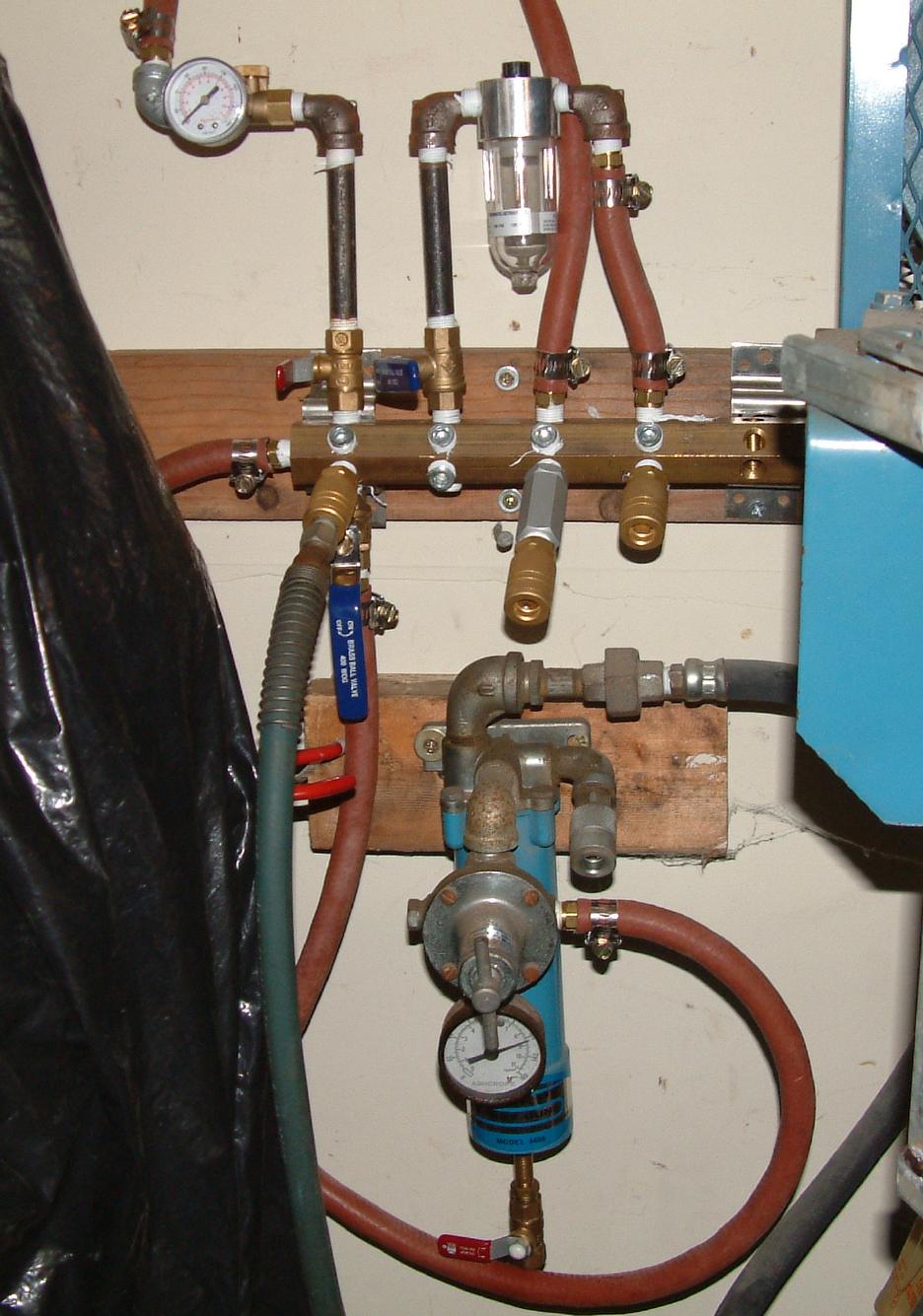
Now that I have your attention I can assure you I am only going to talk about compressed air.  At a compressed air seminar I attended yesterday, I saw many images of poorly connected air lines and fittings. The majority of the cases I saw all boiled down to one common denominator.  See if you can find anything wrong with the pictures below and then we’ll get into it.

The first picture shows the easy way to hook up a regulator and make it easy to take apart.   The issue is the quick disconnects may make it easy to hook something up or take the regulator out for maintenance but you are also restricting your flow considerably.  If you were to hook a Soft Grip Safety Air Gun up at the end of the line you would be limiting the amount of air you can flow to the gun before it even gets to the regulator.   The correct way to plumb this system would be to have a larger supply line and then have the regulator as close to the point of use as possible.  Also if you are setting all the regulators throughout your facility to the same point, i.e. 80 PSIG, then why pay to generate more at the source.  Reduce your compressor output to 80-90 PSIG.

The second picture has a lot going on and again the main problem here is all the leech hoses from the manifold are the same size, if not bigger than the supply line.  Not to mention the line that goes from one port on the manifold back to another port on it.  This means as soon as you turn on one leg of that manifold you might be at the capacity for that line and starving other processes.

The answer isn’t installing more compressors, the answer is to utilize the compressed air wisely making sure your system is plumbed properly.   We preach it every day here and can’t stress it enough.  If you have questions about your compressed air application or how to approach it, don’t hesitate to contact us.

Enjoy the weekend everybody!

Brian Farno
Application Engineer
BrianFarno@EXAIR.com
@EXAIR_BF