EXAIR’s Super Air Wipe removes water from a cooling bath on a plastic coated wire production line.
In an email sent to me from a Russian reseller I was asked for assistance with an Air Knife application, and whether we could make a circular knife to assist blow off of industrial oil. Fortunately, we not only can, but we do and we have them in stock. Our Super Air Wipe is a formidable product to assist with OD blow off of a variety of applications.
For example, one of our distributors is working with their client on a way to increase production line speed. The application has a plastic coated line that passes through a dip tank after a certain stage in the production process. After treatment and before the next stage which takes place in a closed-top container, the water on the surface of the plastic line needs to be removed.
To remove the water and allow for faster line speed (thereby allowing for greater throughput in the application) a Super Air Wipe is installed. The Super Air Wipe can blow off the excess water, preventing/removing a process disturbance at the next stage in production.
All EXAIR products are designed to maximize the use of compressed air, and to solve problems in industrial applications. If your application has a need for a compressed air based solution, contact an EXAIR Application Engineer.
The EXAIR Super Air Knife has a prominent place near the front of our catalog, and THIRTEEN pages of photos, application details, performance data & specifications. It’s the most efficient and quietest product of its kind on the market, and our most diverse product offering in terms of size range, operational adjustability, materials of construction, and accessories available. For almost any general industrial air blow off application, the EXAIR Super Air Knife is the superior choice in terms of air usage, sound level, and capability.
EXAIR Super Air Knives come in a wide range of lengths, for a wide range of possibilities.
As tireless champions of the causes of reducing air consumption and noise, we’re always going to promote these benefits of the Super Air Knife. Still, a caller asked me the other day, “Well, why do you still make the others?”…meaning, of course, our Standard and Full Flow Air Knives. Why, indeed:
*Given the same air supply pressure, the Standard Air Knife generates the highest force of our three styles. The amount of force applied isn’t always a prime consideration…if you think about one of the more “textbook” applications for an Air Knife, it doesn’t take a great amount of force to blow off dust and light debris from a conveyor belt…certainly this is a case where efficiency factors in: the lower air consumption of a Super Air Knife can pay for the cost difference between it and a Standard Air Knife in as little as three months of operation.
The Standard Air Knife has the highest force, for when it’s needed.
Of course, if you’re blowing stubborn debris out of tight spaces, like gummy, greasy dirt that’s accumulating in the recesses of a finned tube heat exchanger, that extra force can make all the difference. No; the Standard Air Knife isn’t as efficient or quiet as the Super Air Knife, but it’s still a far cry better than a drilled pipe.
*While the Super Air Knife is pretty compact – you only need a few square inches of profile area to successfully mount it – the Full Flow Air Knife is even smaller, requiring not much more than one square inch of profile for mounting. With ports on the rear face (instead of the ends & bottom for the Super Air Knife,) they can fit in very tight quarters.
Low profile and lightweight, the Full Flow Air Knives are a great fit for tight quarters.
The Full Flow Air Knife is also the lightest weight for a given length. A 36” Aluminum Super Air Knife, for instance, weighs about 8lbs. The 36” Aluminum Full Flow Air Knife weighs less than 4lbs. Most of the time, 8lbs is a very manageable amount of mass to support, but there are situations where every ounce matters, and if yours is one of them, you’re looking at the Full Flow Air Knife all the way.
*The biggest (in the most literal sense) factor in Air Knife selection is, well…size. We make the Standard Air Knives in lengths to 48”, and the Full Flow Air Knives come as long as 36”. The Super Air Knives, however, are stocked in lengths from 3” to 108”, and can be coupled together for as long of an uninterrupted, steady, laminar air flow as you need.
At the end of the day, a majority of blow off applications can be handled just fine with any of our Air Knives. If you’d like to discuss your application and see which one is best for you, give us a call.
Russ Bowman
Application Engineer
(513)671-3322 local
(800)923-9247 toll free
Find us on the Web
Follow me on Twitter
Like us on Facebook
This week I worked with a candy company who was looking to improve their overflow product recovery. When their bulk bagging machine is inoperable, the wrapped candy bars are sent to an overflow container where they are manually scooped out by an operator. This process was causing damage to the bars and wrappers, as well as presenting an ergonomic hazard to the employee, so they called EXAIR for a solution.
I recommended using our Line Vac Air Operated Conveyor. The Line Vac connects to hose or pipe to create an inline conveyor and is able to move large amounts of material over long distances, requires no electricity, has no moving parts, and provides maintenance free operation, making it the ideal choice for this application.
After discussing the details with the customer, they were concerned that the candy bars and wrappers, getting picked up by the airflow and transported through the hose, might continue to be damaged. I advised that by using a pressure regulator they could control the vacuum/conveying rate by increasing or decreasing the supply pressure, but their concern remained. I then offered to perform a conveyance test at our facility, if they were willing to send product. The customer agreed and was kind enough to send some of the candy, with some extra bags inside for the staff here at EXAIR. (Which is pretty awesome! I mean, FREE candy? Who doesn’t love that?!)
Available in 11 sizes and different materials to meet many application requirements. Line Vacs have smooth ends for connecting hose with a clamp or threaded ends to connect with standard pipe sizes.
Our set up included our 3″ Line Vac with a 10′ section of 3” conveyance hose on the vacuum side and a horizontal conveyance run of approximately 35′, with a 13′ vertical run into a soft sided hopper. We were successful in conveying approximately 9.9 lbs. per minute, when operating at 80 PSIG, with no broken candy bars and no damage to the wrappers. We also determined that 40 PSIG inlet pressure was the lowest they could run the operation, if they were okay with a lower convey rate.
We provided the results to the customer and included a short video of our testing. Intrigued by the results, they are now looking in to other possible applications throughout their facility.
Many times we will get the call from customers who are in the media blasting industry. Media blasting is used in many cases to clean or strip debris, residue, paint or other contamination from the surface of a variety of parts. This cleaning process is generally used to prepare a surface to receive further preparations or perhaps even a coat of primer or paint.
The media blasting process works very well. The only downside is that once the media is spent through the nozzle, it bounces off the part and lands on the ground or any other horizontal surface in the blasting room. So, clean-up after a session of blasting can become a real headache for the operators. Generally, they will want to recover the media for re-use as it can be quite expensive to purchase.
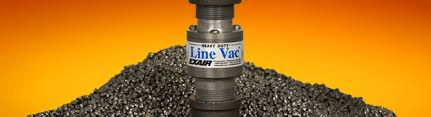
That’s where EXAIR comes in with our Heavy Duty Line Vac product. The Heavy Duty Line Vac has exceptionally high suction capability to move even the densest of blasting media back up into the supply hopper so it can be run through the system over and over. The highly abrasion resistant material of the Heavy Duty Line Vac has been tested with aggressive media such as ground glass and ground garnet and has a proven record of tolerance for moving such material without excessive wear. Other materials of construction like aluminum, stainless steel or hard anodized coatings will wear and degrade – the hardened alloy of the Heavy Duty Line Vac is the best choice for abrasive materials.
Normally, customers in this industry will opt for the 1-1/2” or 2” model of our Heavy Duty Line Vac for their post blasting clean-up processes. It really takes a task that is true drudgery and turns it into a simple task. It takes the pain away for sure.
If you are in the blasting industry and have similar issues, we invite you to contact us and ask about the Heavy Duty Line Vac range of products. You will be glad you did.