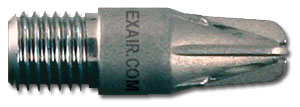
Sanitary Flange Line Vac Improves Rice Recovery Process for Food Manufacturer

In food manufacturing, process efficiency and cleanliness are absolutely critical. I recently worked with a customer in the food industry who processes and packages rice for large-scale distribution. Like many processors, they had an area of the facility dedicated to reclaiming excess or spilled product during transfer, but the method they were using was far from ideal.

For years, their team had been manually collecting the spilled rice from a transfer chute and returning it to a hopper using scoops and buckets. Not only was this time-consuming and labor-intensive, but it also posed potential contamination risks. Any time you’re dealing with open product and manual handling in a food facility, the door is open for quality issues.

The customer came to us looking for a more streamlined solution that could eliminate manual handling and improve process control. After evaluating the layout and requirements, we recommended our 2” Sanitary Flange Line Vac (Model 161200-316). Designed with Type 316 stainless steel sanitary flange connections, it was a perfect fit for their wash-down environment and met the necessary hygienic standards.

Once installed, the Line Vac was mounted to a short section of flexible tubing that connected directly to their recovery bin. It now continuously pulls excess rice from the catch tray beneath the transfer line and sends it directly back to the hopper.

The result? A safer, cleaner, and far more efficient process. What used to take one or two operators several hours throughout the shift is now handled automatically. It reduced labor costs, improved their ability to maintain a clean facility, and made the entire operation more consistent.

Whether you’re moving powders, granules, or in this case, rice, EXAIR’s Sanitary Flange Line Vac provides a reliable, easy-to-integrate conveying solution for food-grade applications. If you’re still using buckets and scoops to move product from Point A to Point B, it might be time to see what a little compressed air can do for your process.

EXAIR’s Sanitary Flange (and all other styles of Line Vac) are available to ship same-day from stock with an order received by 2:00 ET. They are backed by our unconditional 30-day guarantee. If your processes involve manual transfer of bulk materials, I would wholeheartedly encourage you to give one a try.

Tyler Daniel, CCASS

Application Engineer

E-mail: TylerDaniel@EXAIR.com

X: @EXAIR_TD

Stay Safe!!! Hazardous Location Cabinet Coolers

HazLoc Cabinet Cooler Systems are specifically designed and certified for use in purged electrical enclosures located in classified environments. These systems are approved for Class I Division I, Groups A, B, C, and D, as well as Class II Division I Groups E, F, and G, and Class III areas. EXAIR’s HazLoc Cabinet Cooler Systems have undergone rigorous testing by UL, ensuring compliance with the strict UL standards applicable to these environments.

Cabinet Cooler Systems offer an economical and dependable solution for cooling purged electric control panels in various environments. Utilizing Vortex Tube technology, these systems can generate up to 5,600 Btu/Hr without any moving parts, resulting in a low-maintenance option for cooling HazLoc purged cabinets.

EXAIR’s HazLoc Cabinet Cooler Systems distinguish themselves from competitors by receiving UL classification for Division I environments. These systems, which are thermostatically controlled for optimal efficiency, also feature UL-listed solenoids suitable for hazardous settings. Designed for quick installation on purged enclosures, EXAIR Cabinet Cooler Systems require minimal maintenance and are built to perform reliably in the most challenging industrial conditions.

EXAIR offers Hazardous Location Cabinet Cooler Systems in eight distinct cooling capacities, ranging from 1,000 Btu/Hr to 5,600 Btu/Hr. This variety enables you to select the optimal system tailored to your cooling requirements while minimizing compressed air waste. These Cabinet Cooler Systems effectively shield your electronic equipment from heat, dirt, and moisture, ensuring uninterrupted operation of your processes. They present a cost-effective alternative to cumbersome, high-maintenance coolant-based air conditioning systems and are designed for straightforward installation.

Components are prone to failure, sensors may provide inaccurate readings, controls can drift, and displays can become unreliable. EXAIR HazLoc Cabinet Coolers effectively address these issues, helping to maintain productivity and prevent costly shutdowns and the need for new components. If you have questions about HazLoc Cabinet Cooler Systems, or anything regarding EXAIR and our products, please do not hesitate to reach out.

Jason Kirby
Application Engineer
Email: jasonkirby@exair.com
Twitter: @EXAIR_jk

EXAIR’s Safety Air Gun Promotion Offers Free High Velocity Air Jet

From August 1st to September 30th, 2025, with qualified purchases, EXAIR will be giving away a free Model 6013 High Velocity Air Jet with a purchase of our Safety Air Guns, including the VariBlast PrecisionVariBlast CompactSoft GripHeavy DutySuper Blast and TurboBlast Safety Air Guns.  We are promoting the importance of safety in the workplace with the EXAIR Safety Air Guns.   

Compressed air guns are one of the most commonly used pneumatic products in manufacturing plants.  They are used at workstations to blow off debris and clean parts and tools.  Because of the large quantities that are used in a plant, they are the most targeted by OSHA (Occupational Safety and Health Administration).  The majority of the common brands of airguns fail to comply with two directives, rule 29CFR 1910.95(a) for noise levels and rule 29CFR 1910.242(b) for dead-end pressure.  The reason for this is due to the type of nozzles that come with the typical compressed air guns.  OSHA fines can be very expensive, and you can alleviate these penalties by purchasing an EXAIR Safety Air Gun.  Safety is everyone’s responsibility: management, the HSE department (Health and Safety Engineer), supervisors, and even the operators.   

With EXAIR Safety Air Guns, we supply an efficient, effective, and, most importantly, safe air nozzle with all of our air guns.  They are CE Compliant and exceed the OSHA sound level and dead-end pressure requirements, even above 30 PSIG (2 bar).  With substandard air guns, the operators will have to listen to loud noises all day or wear hearing protection.  And for the dead-end pressure, the EXAIR nozzles are engineered to not allow the operator to completely block the end of the nozzle with their hand or skin.  This is very important because if the pressure exceeds 30 PSIG, air can penetrate the skin and cause an air embolism.  With our design, the compressed air is able to escape, and the pressure against the skin will not exceed 30 PSIG, even with the compressed air pressure set at 100 PSIG.  Safety is a major concern for all of our customers and a priority for EXAIR in manufacturing our products.   

As I mentioned above, the nozzles are one of the most significant parts of making a compressed air gun safe and OSHA compliant.  Combining our engineered nozzles with a quality air gun makes the EXAIR Safety Air Guns one of the best products in the market.  We currently have six different styles; the VariBlast PrecisionVariBlast Compact, Soft GripHeavy DutySuper Blast, and TurboBlast Safety Air Guns.  These Safety Air Guns are ergonomically designed to comfortably fit in your hand. They come with quality trigger mechanisms and durable valve assemblies.  The VariBlast Precision Safety Air Guns are great for tight spaces and clearing out small holes.  The VariBlast Compact Safety Air Guns have a cast aluminum body for rugged use with our smaller air nozzles.  The Soft Grip Safety Air Guns provide extra comfort for long, extended uses, and the Heavy Duty Safety Air Guns are rugged, heavy-duty industrial air guns with nozzles for larger forces.  The Super Blast and TurboBlast Safety Air Guns use our largest nozzles for cleaning large areas quickly.  In combination with the EXAIR nozzles, the Safety Air Guns can offer another important attribute; we can save you money!!!  Compressed air is very expensive to make, and with our Safety Air Guns, we use less compressed air but still create a strong blowing force.  We do this by entraining the free ambient air into the air stream.  If you increase the mass of air at the target, it will give you a hard-hitting force to remove debris from surfaces or clean tools and holes.  The amplification ratio can be as high as 25 to 1.  That means that for every part of compressed air that it uses, the EXAIR Nozzles will entrain 25 parts of free ambient air.  This will add mass to the airstream, which provides for a powerful impact.  Also, the payback period for using an EXAIR Nozzle with our Safety Air Guns can be within weeks due to the savings in electrical costs from your air compressor.  With EXAIR products, we were able to partner with Energy Star and power facilities.  For the amount of energy saved, some power companies offer rebates for using EXAIR products.       

A substandard blow-off gun is unsafe, loud, and wasteful.  EXAIR Safety Air Guns can help improve these situations.  They are OSHA-compliant, very safe, and very quiet.  They use less compressed air, which saves you money.  And with a variety of different nozzles, they can better fit your application to decrease downtime.  In the U.S. and Canada, EXAIR offers a 30-day unconditional guarantee on our cataloged items so you can try them out.  You can see for yourself how effective these compressed air guns can be.  If you need help matching the best Safety Air Gun to your application, you can contact an Application Engineer.  And during the next two months, take advantage of the free Model 6013 High Velocity Air Jet, a $103.00 complimentary gift.     

Jordan Shouse, CCASS

Application Engineer

Send me an email
Find us on the Web 
Like us on Facebook
Twitter: @EXAIR_JS

How Much Air Am I Using?  A Story About the EXAIR Super Air Nozzle.

At EXAIR, we always recommend using the least amount of pressure to “do the job”.  This helps to save money and save on compressed air.  But some customers wish to use outdated methods, like open pipes, copper tubes, drilled pipes, etc.   These methods are unsafe as well as waste money and compressed air.   EXAIR has engineered nozzles to help enhance your blow-off devices. Here is a customer that I helped recently, to tell a story about the EXAIR Super Air Nozzles

Blow off station

I received an email from an engineer who was looking at our Super Air Nozzles.  The characters of the story were four blow-off lines that were made from 6mm ID copper tubes.  (Reference picture above) The system was designed to blow out holes after machining.  The engineer oversaw the task of optimizing 25 machining stations and this was the theme of the story.  He purchased four Nano Super Air Nozzles, model 1110SS, for a trial.  He was impressed with the performance, the low sound level and the design for safety.  I would consider the Nano Super Air Nozzles as the protagonist.  But, for the upper management in his company to sign off, he had to show cost savings and improvements.  He asked me to help him to present this story in calculating the compressed air savings. 

He gave me some additional details about their application to build the plot of the story.  He was using compressed air about 50% of the time throughout an 8-hour day at a pressure of 80 PSIG.  He asked me to find a happy ending to this story with the annual savings and the payback period.  I did many of these calculations for other customers, and I was happy to help.  It is sometimes easier to speak in terms of money for everyone to relate to a situation, especially management.  (The numbers below can be adjusted to match your application and blow-off devices).

Knowns:
Cost of compressed air: $0.25/1000 cubic feet of air (this is based on $0.08/Kwh electricity cost)
Flow: 1110SS Nano Super Air Nozzle = 8.3 SCFM at 80 PSIG

A 6mm ID copper tube flow rate = 19.8 SCFM at 80 PSIG

The difference in compressed air flows from a 6mm tube to the Nano Super Air Nozzle is (19.8 SCFM – 8.3 SCFM) = 11.5 SCFM.  At a 50% duty cycle, we get 11.5 SCFM * 0.5 = 5.75 SCFM (cubic feet/minute) of additional compressed air being used.  Per year, the amount of compressed air wasted is:
5.75 Ft3/min * 60 min/hour * 8 hours/day * 250 days/year = 690,000 cubic feet per year.

With the cost to make compressed air at $0.25/1000 cubic feet, we are saving:
690,000 Ft3/year * $0.25/1000 Ft3 = $172.50 per year per nozzle.

From these values, we get the payback period for a model 1110SS Nano Super Air Nozzle to be just around 97 days. 

The remaining life of the Super Air Nozzle will save the company a lot of money by using less compressed air.  The calculations above are only for one nozzle.  As discussed above with the engineer, they had 4 tubes/station and 25 stations in their plant.  So, if you multiply each figure by 100, you can see the amount of money that can be saved; a total of $172.50 * 100 = $17,250 per year.  The engineer presented the complete story to upper management, and it was an easy decision to replace the copper tubes with EXAIR nozzles.

The moral of the story is, don’t be fooled by the upfront low cost of a tube, pipe, drilled hole, or a substandard nozzle. The operational cost outweighs the acquisition cost every time. With the characters, plot, and the setting of this story, not going with an engineered solution will cost you a lot of money in the long run.  With a mindset of taking total cost of ownership into account, another positive attribute is the improvement in safety.  EXAIR engineered nozzles are designed to be OSHA compliant. 

If you want help to write your own storybook, happy ending, you can contact an Application Engineer.  We will be happy to assist you in finding a hero for your blow-off stories.   

John Ball
Application Engineer
Email: johnball@exair.com
Twitter: @EXAIR_jb

Photo: Book by PezibearPixabay license.