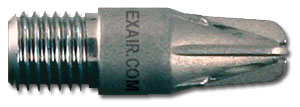
EXAIR’s Super Air Nozzles

Have you ever walked into a manufacturing facility during lunch, and it sounds like you’ve walked onto a plane full of snakes…? That’s a common issue across every sector of manufacturing. Compressed air is used for blowing off, cooling and cleaning everywhere you look. Below are the six steps to optimize your compressed air system. But today, let’s jump to step number 3 and see how upgrading those blow-offs with an engineered Safety Air Nozzle can help add to your bottom line.

If you’ve been tasked with reducing operating costs in your plant, upgrading your blow offs to EXAIR’s Engineered Air Nozzles & Jets might be just the ticket. When replacing a homemade or inefficient solution, EXAIR’s Super Air Nozzles can save you as much as 80% of your compressed air usage.

An open copper pipe or tube, even if “flattened” as we’ll commonly see, wastes an excessive amount of compressed air. This wasted compressed air can create problems in the facility due to unnecessarily high energy costs and the pressure drop that can be experienced affecting other processes. In addition to simply using too much compressed air, an open pipe or tube will often produce sound levels in excess of 100 dBA. At these sound levels, according to OSHA, permanent hearing damage will occur in just 2 hours of exposure.

Crushed open pipe in the top right corner

By simply replacing the open tubes and pipe with an EXAIR Super Air Nozzle, you can quickly reduce air consumption AND reduce the sound level. Sound level isn’t the only thing an OSHA inspector is going to be concerned about regarding an open pipe blowoff. In addition, OSHA 1910.242(b) states that a compressed air nozzle used for blowoff or cleaning purposes cannot be dead-ended when used at pressures in excess of 30 psig. I don’t know if you’ve ever tried to use an air gun with 30 psig fed to it, but the effectiveness of it is dramatically reduced. This is why there needs to be a device installed that’ll prevent it from being dead-ended so that you can operate at a higher pressure.

EXAIR’s Super Air Nozzles are designed with fins that serve two purposes. They help to entrain ambient air from the environment, allowing us to maximize the force and flow from the nozzle but keeping the compressed air consumption minimal. In addition, these fins are what prevent the nozzle openings from being completely blocked off. Using an OSHA-compliant compressed air nozzle for all points where a blow off operation is being performed should be a priority. Each individual infraction will result in a fine if you’re unfortunate enough to be the victim of an unannounced OSHA inspection.

If you think a few Engineered Safety air nozzles will help add to your bottom line, give us a call. We have a full team of application engineers ready and willing to get you a solution to make your facility safer and save money!

Jordan Shouse, CCASS

Application Engineer

Send me an email
Find us on the Web 

The Hidden Costs of Inferior Compressed Air Products

Compressed air is one of the most versatile utilities in industry. It’s used for everything from part drying and debris removal to cooling and conveying. But not all compressed air products are created equal. Too often, I come across shops and plants relying on drilled pipes, open tubes, or cheap plastic nozzles to get the job done. On the surface, these might seem like quick and inexpensive fixes. In reality, they end up costing much more in wasted energy, unnecessary noise, and lost productivity.

Let’s start with drilled pipes and open-ended blow offs, since they’re some of the most common culprits. At first glance, they look like an easy solution. Just drill a few holes, hook up compressed air, and let it blast away. The problem is they waste a tremendous amount of air. They’re also extremely loud, often well above OSHA’s permissible noise levels outlined in 1910.95(a). In many cases, the sound exposure can reach levels that require hearing protection just to operate nearby. Beyond that, drilled holes create a dead-end pressure condition that violates OSHA 1910.242(b), which states that compressed air used for cleaning must be regulated to 30 PSIG if dead-ended. This is a serious safety concern that’s often overlooked until an injury or compliance audit brings it to light (or even worse, an OSHA inspection).

These wasteful and loud modular plastic tube blow offs…

Cheap nozzles and modular coolant hoses being used for compressed air fall into the same trap. They’re not designed to handle the pressures and flows involved in compressed air applications. This means poor performance, higher operating costs, and, in many cases, premature failure. It’s not unusual to see these hoses break down or simply pop off, creating unsafe conditions on the floor. What seemed like a cost-saving shortcut turns into downtime, frustration, and more expense down the road. The high consumption of these devices also leads to pressure drops elsewhere in your compressed air system.

This is where engineered solutions from EXAIR make the difference. Every nozzle, air knife, and air gun is designed with efficiency and safety at the forefront. Engineered nozzles, for example, reduce compressed air consumption while maintaining or even amplifying force. They also dramatically reduce noise levels, often bringing them into full OSHA compliance. Products like the Super Air Knife provide uniform airflow across an entire length while using a fraction of the air compared to drilled pipes.

In a previous blog, we shared an example where a customer was using a ¾” drilled pipe for blowoff on their production line. By replacing it with a 12” Super Air Knife, they reduced their compressed air consumption by over 80 SCFM. At their energy rate, this translated into more than $5,000 in annual savings, with a payback period of just a few months. Not only did they cut their energy bill, but they also eliminated an OSHA noise hazard and brought their system into compliance with dead-end pressure regulations.

When you factor in the rising costs of energy, the difference is not small. Inefficient or inferior products consume more compressed air than necessary, which means compressors work harder, energy bills rise, and maintenance intervals shorten. On the other hand, using an engineered solution is an investment that pays itself back quickly, often in months (or days) rather than years.

With engineered EXAIR products, you’ll improve efficiency, cut costs, reduce noise, and create a safer workplace. The short-term convenience of “cheap and easy” rarely holds up against the long-term benefits of doing it right the first time.

Tyler Daniel, CCASS

Application Engineer/Intl Trade

E-mail: TylerDaniel@EXAIR.com

X: @EXAIR_TD

How Much Air Am I Using?  A Story About the EXAIR Super Air Nozzle.

At EXAIR, we always recommend using the least amount of pressure to “do the job”.  This helps to save money and save on compressed air.  But some customers wish to use outdated methods, like open pipes, copper tubes, drilled pipes, etc.   These methods are unsafe as well as waste money and compressed air.   EXAIR has engineered nozzles to help enhance your blow-off devices. Here is a customer that I helped recently, to tell a story about the EXAIR Super Air Nozzles

Blow off station

I received an email from an engineer who was looking at our Super Air Nozzles.  The characters of the story were four blow-off lines that were made from 6mm ID copper tubes.  (Reference picture above) The system was designed to blow out holes after machining.  The engineer oversaw the task of optimizing 25 machining stations and this was the theme of the story.  He purchased four Nano Super Air Nozzles, model 1110SS, for a trial.  He was impressed with the performance, the low sound level and the design for safety.  I would consider the Nano Super Air Nozzles as the protagonist.  But, for the upper management in his company to sign off, he had to show cost savings and improvements.  He asked me to help him to present this story in calculating the compressed air savings. 

He gave me some additional details about their application to build the plot of the story.  He was using compressed air about 50% of the time throughout an 8-hour day at a pressure of 80 PSIG.  He asked me to find a happy ending to this story with the annual savings and the payback period.  I did many of these calculations for other customers, and I was happy to help.  It is sometimes easier to speak in terms of money for everyone to relate to a situation, especially management.  (The numbers below can be adjusted to match your application and blow-off devices).

Knowns:
Cost of compressed air: $0.25/1000 cubic feet of air (this is based on $0.08/Kwh electricity cost)
Flow: 1110SS Nano Super Air Nozzle = 8.3 SCFM at 80 PSIG

A 6mm ID copper tube flow rate = 19.8 SCFM at 80 PSIG

The difference in compressed air flows from a 6mm tube to the Nano Super Air Nozzle is (19.8 SCFM – 8.3 SCFM) = 11.5 SCFM.  At a 50% duty cycle, we get 11.5 SCFM * 0.5 = 5.75 SCFM (cubic feet/minute) of additional compressed air being used.  Per year, the amount of compressed air wasted is:
5.75 Ft3/min * 60 min/hour * 8 hours/day * 250 days/year = 690,000 cubic feet per year.

With the cost to make compressed air at $0.25/1000 cubic feet, we are saving:
690,000 Ft3/year * $0.25/1000 Ft3 = $172.50 per year per nozzle.

From these values, we get the payback period for a model 1110SS Nano Super Air Nozzle to be just around 97 days. 

The remaining life of the Super Air Nozzle will save the company a lot of money by using less compressed air.  The calculations above are only for one nozzle.  As discussed above with the engineer, they had 4 tubes/station and 25 stations in their plant.  So, if you multiply each figure by 100, you can see the amount of money that can be saved; a total of $172.50 * 100 = $17,250 per year.  The engineer presented the complete story to upper management, and it was an easy decision to replace the copper tubes with EXAIR nozzles.

The moral of the story is, don’t be fooled by the upfront low cost of a tube, pipe, drilled hole, or a substandard nozzle. The operational cost outweighs the acquisition cost every time. With the characters, plot, and the setting of this story, not going with an engineered solution will cost you a lot of money in the long run.  With a mindset of taking total cost of ownership into account, another positive attribute is the improvement in safety.  EXAIR engineered nozzles are designed to be OSHA compliant. 

If you want help to write your own storybook, happy ending, you can contact an Application Engineer.  We will be happy to assist you in finding a hero for your blow-off stories.   

John Ball
Application Engineer
Email: johnball@exair.com
Twitter: @EXAIR_jb

Photo: Book by PezibearPixabay license.

VariBlast Safety Air Gun Overview

After mowing the lawn, I always blow the driveway & sidewalk off with a leaf blower. Then, before pulling the riding lawn mower back into the garage, I blow off the deck with the leaf blower too, and it always looks like it does a great job. The other day, though, I had to replace the drive belts, so I removed the deck and found an awful lot of grass trimmings had accumulated in the inner recesses. No matter how much air my leaf blower moves (and it moves a LOT), I would have needed a much more focused flow to get into some of those tight spaces.

Situations like this are EXACTLY what EXAIR Safety Air Guns – especially the VariBlast Precision and Compact models – are made for. Consider:

  • Tight, focused flow – the VariBlast Precision Safety Air Guns can be fitted with our three smallest, most focused Super Air Nozzles – Atto, Pico, and Nano:
Not only do they create the most focused airflow patterns, these Super Air Nozzles are also small enough to fit in pretty tight quarters themselves.
  • Hard-hitting force – VariBlast Compact Safety Air Guns can also be fitted with the Atto, Pico, or Nano Super Air Nozzles for the tightest airflow patterns, as well as several others if higher flow & force are required.
For more aggressive applications, VariBlast Compact Safety Air Guns with 1″ High Power Flat Super Air Nozzles can apply up to 1 pound of force.
  • Extended reach – the VariBlast Precision Safety Air Guns are available with 12″ and 20″ 316SS extensions, and the VariBlast Compact Safety Air Guns can come with straight rigid aluminum extensions up to 72″ long.
  • Chip Shields – regardless of whether you need extensions for extra reach, these can all be supplied with Chip Shields. These are especially useful (and are included as standard) on the VariBlast Compact Safety Air Guns with Back Blow Air Nozzles.
Atto Back Blow Air Nozzles can blow out recesses or holes as small as 1/4″ in diameter.
  • Operator control – this is the key feature of the VariBlast models. Most handheld airguns have spool valve-type triggers that are really just on/off operation. They can offer some crude amount of throttling, but the variable pull trigger of the VariBlast Safety Air Gun provides precise control, and they’re ergonomic to boot. Here’s a short video that shows just how precise the control is with a VariBlast Precision Safety Air Gun.

Compressed air isn’t cheap, and if you use cheap, non-engineered blow-offs, you’re going to pay WAY more to operate them than you have to. If you want to find out how the VariBlast Precision or Compact Safety Air Guns – or any EXAIR Intelligent Compressed Air Products – can help you get the most out of your compressed air system, give me a call.

Russ Bowman, CCASS

Application Engineer
Visit us on the Web
Follow me on Twitter
Like us on Facebook