EXAIR Receives the 2012 Environmental Protection Award

I know, I know, it’s not good to boast or brag.  I don’t write this blog to brag about how we maintain such a high service standard, product quality or 99.9% on time shipping record.  I write this to thank all of our customers who have voted for us and helped us to reach this point in our life as a company.   With the help of our customers we brought home another award.

2012EP_trophy330pxw

This is the 2012 Environmental Protection Award for New Products in the Energy category.  The EXAIR product that brought this home is our Data Logger for the Digital Flow Meter.

dfmpp_datalogger300x300

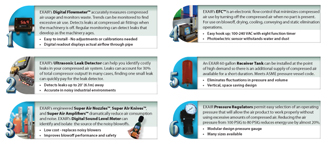
This product is not only able to help you monitor your compressed air use, but quantify and track it.  This is the perfect way to justify installing the Intelligent Compressed Air Product to your plant manager.

dataloggerPRce_559wide

It is one of thousands of products that EXAIR brings to you with the highest quality and customer service standards.  Thanks for all the support and we can’t wait to see what the future holds.

Brian Farno
Application Engineer
BrianFarno@EXAIR.com
@EXAIR_BF

Efficient Energy

As we welcome the return of Ivan Banks from a lengthy trip overseas, I’m reminded of the wide cultural variety over which we supply our products.  Reading through the travel brochures and noting the different customs proves to be a stark reminder of how isolated it can be to live within your comfort zone.

There’s a quote by Robert Louis Stevenson that says, “There are no foreign lands.  It is the traveler only who is foreign.”  Reading through expected differences on the CIBT website has shown me that this is indeed the case.  I like to relate this to a method of thinking as well.

We’re often taught how to do something and it can be strange to see things done in a different way.  In industry, however, we’re always looking for a more economical and efficient process to achieve the end goals.  It’s a frequent occurrence to see something pieced together in an ingenious way, or in a much different manner than would be expected.

Fortunately, along with the worldwide appreciation for ingenuity, there is also an appreciation for efficiency.  This has helped EXAIR to be transparent across multiple cultures and markets.  Our efficiency lab is a prime example of our efficiency appreciation, as well as a variety of posts by our very own, Professor Penurious.

Earlier this week I ran a calculation for an application currently using a 20 horsepower blower system to clean steel tanks.  The system was inefficient, and the results were poor.  The application needed a blow off with higher force and a more efficient use of the plant energy.  We were able to propose multiple setups of EXAIR Super Air Nozzles or Super Air Knives to accomplish the necessary blow off.  And, the operational cost of any EXAIR system was almost half that of the blower system.  (Approximately $2500.00/yr. to operate the blower system vs. approximately $1400.00/yr. to operate the EXAIR blow off components)  In addition to lower operating cost, the EXAIR products had a lower purchase price as well.  Just another prime example of the benefits to an EXAIR equipped blow off system.

We run calculations like this with great frequency.  And we do this for applications all over the world.  Efficiency and cost savings are a language everyone seems to speak.

The following calculations show electrical cost for operating a 20 Hp blower and do not include any maintenance costs associated with blower maintenance such as bearing replacement. The cost for generating compressed air ($0.25/1000 cubic feet) includes electrical costs and maintenance costs.

20 HP Blower  = 14.71 kW
14.71 kW x 0.083 = Operational cost per hour
14.71 kW x 0.083 = $1.22 per hour
1.22 cents per hour x 40 hours per week =$48.80
$48.80 per week x 52 weeks per year = $2537.60
Annual operating cost = $2537.60   

EXAIR Blow off (55 SCFM)
55 SCFM x 60 minutes = 3300 SCF/hour
3300 SCF x 40 = 132000 cubic feet per week
132000 x 52 = 6,864,000 cubic feet per year
6,864,000/1000 = 6864     6864 x $0.25 = $1716.00
Annual Operating cost = $1716.00

Operating costs based on electricity cost of 8.3 cents per kWh.  Annual cost reflects 40 hours per work week, 52 weeks per year.

(For those interested, the photo is of a concept to allow charging of a cell phone battery by swinging the battery around your finger.  Designed by Song Teaho & Hyejin Lee)

Lee Evans
Application Engineer
leeevans@exair.com
@EXAIR_LE

Summer Time = Vacation Time

I personally can’t believe I’m saying this but summertime is almost here.  With that comes vacations or the increasingly popular “Staycations”.  For myself I get to see a good friend from college get married as my vacation this year.   It will be the first time my wife and I have left our daughter for more than just one night.  With the vacation of course came a good amount of planning, both at home and at work.

At home we got lucky because our parents are going to take turns watching our daughter, house, and dogs.  (Can’t beat free baby/house/dog sitting.)  They’ll of course be eating it up because they get to spend so much time with their grand-daughter and getting to completely spoil her for several days.  For most people when they go on vacation they have to prepare the house for no one to be there during their vacation.  A few points we make sure to cover in the case no one will be home is to turn off the water at the main shut off, set the thermostat for around 80° F so the A/C isn’t running that much, get rid of as much food from the fridge as possible so there isn’t a loss in the case of a power outage.   We also stop the mail and the paper, and lastly we set a few lights to turn on and off so it still appears someone is home, this can be done through timers or trusted neighbors, which is what we use.  This makes sure that you aren’t wasting energy while you are gone and when you come back home everything is ready to go back to normal or in our case as close to normal it can get.

At work I have a similar checklist.  Make sure all my emails are taken care of that need to be, ensure the e-mail and voicemail messages are set correctly, clean the desk up, and make sure to log out of the computer so there is a lower risk of shenanigans involving my background image or desktop icons.  This makes sure than when I get back to the office I’m not spending time and energy trying to get to the point of caught up and working on new projects.

Preparing to leave for vacation is something you can very easily translate into how to prepare your compressed air system before you leave for a few days or even before you go home for the night.  You probably shut your compressor down so you can save money on your energy bill, the problem is if you don’t have a well maintained system you won’t have that stored air available when you come back.  If your system has leaks or if you are leaving a blow off on continuously even when the process is not needed then when you come in the next day or after a few days away the air isn’t there and you have to wait for the compressor to build up an initial charge to even begin work.  This not only causes additional work load on your compressor but it is down time that is easily avoidable.  With the help of our Six Steps to Compressed Air Optimization you can make sure you still have air in the storage tank when you get in on Monday rather than having to wait for the compressor.

So whether you are going on a vacation or just leaving for the day make sure you are doing everything you can to conserve, turn off those lights, seal up the leaks, and it will make the next time you come in that much easier.  Not to mention the savings you will see.

Brian Farno
Application Engineer
BrianFarno@EXAIR.com
Twitter: @EXAIR_BF

Phantom Power Load

I was reading an interesting article recently by Joe Schwartz of www.homepower.com. (Click here to read) In the article Mr. Schwartz discusses the issue of “standby loss” which is the electricity used by home appliances even when powered off. His point was that while the standby loss of a single item within a modern home is not significant, the cumulative standby loss of all the appliances we find in a home these days can be quite significant. Everything from DVD players to the small cube style transformers suck electricity 24 hours a day, even when the appliance they power is not in use. This is due to the fact that the primary side of the transformer is not switched off when not in use or there is some feature like a digital clock included. So, it keeps using electricity.

As I was reading the article I was able to draw some very clear parallels to a compressed air system. Since one of our main goals at EXAIR is to help customers save on energy costs for their compressed air systems at the point of use, it was quite easy to make comparable references to “phantom loads”, “standby loads” or just plainly put, those loads on a compressed air system which do not actually produce any positive benefit to the user and which make operation of the overall system quite expensive.

If it has not been stated often enough, compressed air is the most expensive utility used in industrial and manufacturing facilities. And, just like electricity, the proper and efficient use of compressed air is often overlooked as a source of tremendous savings for a company. Just read Joe Panfalone’s recent blog about a customer he worked with who made a simple change from open pipe blowing to using EXAIR Nozzles and saving a lot of money in the process. Besides the windfall savings that Joe’s customer experienced, there are lots of little ways in which you can eliminate completely the phantom power load on your air compressor system.

1. Make your own leak analysis – Walking through the plant during down-time when you can actually hear leaks in the system. Or better yet, use a tool such as the Ultrasonic Leak Detector to find the leaks you cannot hear with the un-aided human ear. Note and tag the leaks for repair and you can have an instant savings of up to 30% on your compressed air production.

2. During the leak analysis – Make note of processes where compressed air is flowing through some nozzle or other device even when the operation or machine is not in use. Installing a simple solenoid valve to shut the air flow off when the machine is not in use can be another huge source of savings. Un-controlled release of compressed air like this is just like walking out of your house when you have all the lights turned on, AC unit running, TV turned on and the water running at the sink, all at the same time!  The EXAIR EFC – Electronic Flow Control can even add further control of the air use by timing the air to come on only when absolutely needed in the application.

3. Install energy efficient nozzles – Even in today’s day and age, with all the talk about efficiency in many aspects of life, the end use portion of the compressed air system is overlooked. And so, installing an EXAIR compressed air nozzle engineered for the express purpose of creating force on a target, would be the home energy equivalent of purchasing an Energy star rated appliance for your home.

In conclusion, just as we have many sources of phantom electrical load in our homes, we also have many more sources of phantom compressed air load in our compressed air systems. When rooted out and repaired, can have a significant, cumulative effect on the overall cost to operate the system and improve system capacity to do more productive work for the business.

Neal Raker
Application Engineer
nealraker@exair.com