Understanding Noise: Sound Power Vs. Sound Pressure

Sound Power and Sound Pressure have been covered a few other times here on the EXAIR Blog. Once here by Brian who made the visual correlation in regards to a speaker and a musical instrument. And here by Russ who breaks down how you calculate sound power level with the below equation!
Sound Power Equation
too lou Sound Power Level Equation
All machines generate sound when they are in operation. The propagated sound waves cause small changes in the ambient air pressure while traveling. A sound source produces sound power and this generates a sound pressure fluctuation in the air. Sound power is the cause of this, whereas sound pressure is the effect. To put it more simply, what we hear is sound pressure, but this sound pressure is caused by the sound power of the emitting sound source. To make a comparison, imagine for example a simple light bulb. The bulb’s power wattage (in W) represents the sound power, whereas the bulb’s light intensity represents the sound pressure.
7179304430_8101287900_c
Light Bulb
Sound power does not generally depend on the environment. On the contrary, the sound pressure depends on the distance from the source and also on the acoustic environment where the sound wave is produced. In the case of indoor installations for example, sound pressure depends on the size of the room and on the sound absorption capacity of the surfaces. For instance, say the room walls don’t absorb all the sound but reflect parts of it, then the sound pressure will increase due to the so called reverberation effect. (reverberation time is broadly defined as the time it takes for the sound pressure to reduce by 60 dB after the sound emitting source has been shut off). OSHA puts the following limits on personnel exposure to certain noise levels:
Working in areas that exceed these levels will require hearing protection.
EXAIR’s line of Intelligent Compressed Air Products are engineered, designed, and manufactured with efficiency, safety, and noise reduction in mind.  If you’d like to talk about how we can help protect you and your folks’ hearing, call us. Jordan Shouse Application Engineer Send me an email Find us on the Web  Like us on Facebook Twitter: @EXAIR_JS Light Bulb image courtesy of  josh LightWork  Creative Commons License

Sound: What Is It … More Importantly, Weighted Scales of Frequencies

We’ve blogged about sound and what exactly it is before, see the link. Understanding that sound is vibration traveling through the air which it is utilizing as an elastic medium.  Well, rather than me continue to write this out, I found a great video to share that is written in song to better recap how sound is created.

Now that we have that recap and understand better what sound is let’s dig a little deeper to better understand why some sounds may appear louder to a person when they may not appear different on a sound scale that is shown by something like a Digital Sound Level Meter.

Loudness is how a person perceives sound and this is correlated to the sound pressure of the frequency of the sound in question.  The loudness is broken into three different weighing scales that are internationally standardized. Each of these scales, A, C, and Z apply a weight to different frequency levels.

  1. The most commonly observed scale here in the USA is the A scale. A is the OSHA selected scale for industrial environments and discriminates against low frequencies greatly.
  2. Z is the zero weighting scale to keep all frequencies equal, this scale was introduced in 2003 as the international standard.
  3. C scale does not attenuate these lower frequencies as they are carrying the ability to cause vibrations within structures or buildings and carry their own set of risks.

To further the explanation on the A-weighted scale, the range of frequencies correlates to the common human hearing spectrum which is 20 Hz to 20kHz. This is the range of frequencies that are most harmful to a person’s hearing and thus were adopted by OSHA. The OSHA standard, 29 CFR 191.95(a), that corresponds to noise level exposure permissible can be read about here on our blog as well.

When using a handy tool such as the Digital Sound Level Meter to measure sound levels you will select whether to use the dBA or dBC scale.  This is the decibel reading according to the scale selected. Again, for here in the USA you would want to focus your measurements on the dBA scale. It is suggested to use this tool at a 3′ distance or at the known distance an operator’s ears would be from the noise generation point.

Many of EXAIR’s engineered compressed air products have the ability to decrease sound levels in your plant. If you would like to discuss how to best reduce sound levels being produced within your facility, please contact us.

Brian Farno
Application Engineer
BrianFarno@EXAIR.com
@EXAIR_BF


1 – Fun Science: Sound – @charlieissocoollike – https://youtu.be/xH8mT2IQz7Y


Limiting Noise Exposure with Mufflers for Compressed Air

Mufflers come in many shapes and sizes. Each with their own benefits.

If you have ever walked into a manufacturing facility and heard the hiss or even worse the banshee scream of compressed air being exhausted to ambient, whether it be from a cylinder discharge, a timed drain going off, or a bypass valve being activated, they all could be hushed with a muffler. A muffler for compressed air comes in several shapes and sizes. EXAIR offers four separate types from stock to help attenuate the noise disruption within your facility.

The OSHA standard for allowable noise exposure is 29 CFR-1910.95(a) and outlines the number of hours per day any individual can be exposed to a particular noise level. These noise levels are expressed in decibels (dbA).

Hearing loss is the best known, but not the only, ill effect of harmful noise exposure. It can also cause physical and psychological stress, impair concentration, and contribute to workplace accidents or injuries.
Reclassifying Mufflers attenuating the exhaust of a pneumatic cylinder.

The first type I would like to showcase are the Reclassifying Mufflers. These are ideal for cylinder exhausts or valves which commonly contain an oil mist within the air stream which can easily contaminate the surrounding area. The patented design of the removable element separates oil from the exhausted air so virtually no atomized oil is released into the environment. They also attenuate the exhaust noise level up to 35 decibels. The filter element helps the exhaust to meet the OSHA Standard 29 CFR 1910.1000, a worker’s cumulative exposure to oil mist must not exceed 5 mg/m³ by volume in any eight hour shift of a forty hour work week.

The chart below helps to properly size the Reclassifying Muffler for a pneumatic cylinder. One key to proper installation of these mufflers is they must be installed vertically in order to properly trap and drain the oil.

Reclassifying Muffler Quick Pick Chart
Sintered Bronze mufflers are excellent choices for tight installation locations and are easily sized.

The next type of muffler to discuss are the Sintered Bronze Mufflers that are offered in ten different sizes. These are an excellent low cost solution which easily install into new or existing ports. Each size is designed to provide minimal back pressure and restriction for the individual port size. The quick pick chart below helps to easily select the correct size for attenuating the exhaust of a pneumatic cylinder. One key difference between these and the Reclassifying Mufflers is, these do not have to be oriented vertically as they do not collect the oil out of the exhaust air.

undefined

The model 3913 – 3/4″ NPT Straight Through Muffler

If the process air needs to be directed or plumbed away from the operator then the Straight Through Mufflers are the ideal selection as they offer an NPT threaded inlet and exhaust. They are available in three standard NPT sizes from stock. These mufflers can be installed in any orientation and work well with our Vortex Tubes to help pass the cold air through while lowering the operating sound level of the tube. The average noise reduction of the Straight-Through Mufflers is 20 dB. This can easily reduce the noise level of an operation to below the OSHA standard requiring hearing protection for operators in the area.

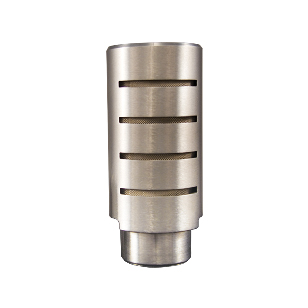
The model 3903 Heavy Duty Muffler

The final option for mufflers from EXAIR are the Heavy Duty Mufflers. These are available in two sizes from stock and are constructed of corrosion-resistant aluminum with a stainless steel internal screen. These can be installed in any orientation and are ideal for protecting exhaust ports from contaminants that may clog or damage the device they are attached to. The typical noise reduction from installation is 14 dB with these mufflers.

These are available in two sizes from stock and are constructed of corrosion-resistant aluminum with a stainless steel internal screen. These can be installed in any orientation and are ideal for protecting exhaust ports from contaminants that may clog or damage the device they are attached to. The typical noise reduction from installation is 14 dB with these mufflers.

To summarize, EXAIR offers a multitude of options when it comes to lowering sound levels in operation areas that are caused by exhausted compressed air. Each of the mufflers discussed above are shipped same day from stock to meet your immediate need. If you are unsure of which muffler to use for your application, feel free to contact an Application Engineer.

Brian Farno
Application Engineer
Ph. 1-513-671-3322
BrianFarno@EXAIR.com
@EXAIR_BF

Brian Farno
Application Engineer
BrianFarno@EXAIR.com
@EXAIR_BF

Sound Power Level and Sound Pressure

Energy…all day (and night) long, we humans are surrounded by – and bombarded by – all kinds of energy. Sometimes, the effects are pleasant; even beneficial: the warmth of the sun’s rays (solar energy) on a nice spring day is the sure-fire cure for Seasonal Affective Disorder, and is also the catalyst your body needs to produce vitamin D. Good things, both. And great reasons to get outside a little more often.

Sometimes, the effects aren’t so pleasant, and they can even be harmful. Lengthy, unprotected exposure to that same wonderful sun’s rays will give you a nasty sunburn. Which can lead to skin cancer. Not good things, either. And great reasons to regularly apply sunblock, and/or limit exposure if you can.

Sound is another constant source of energy that we’re exposed to, and one we can’t simply escape by going inside. Especially if “inside” is a factory, machine shop, or a concert arena. This brings me to the first point of today’s blog: sound power.

Strictly speaking, power is energy per unit time, and can be applied to energy generation (like how much HP an engine generates as it runs) or energy consumption (like how much HP a motor uses as it turns its shaft) For discussions of sound, though, sound power level is applied to the generation end. This is what we mean when we talk about how much sound is made by a punch press, a machine tool, or a rock band’s sound system.

Sound pressure, in contrast, is a measure of the sound power’s intensity at the target’s (e.g., your ear’s) distance from the source. The farther away you get from the sound’s generation, the lower the sound pressure will be. But the sound power didn’t change.

Just like the power made by an engine and used by a motor are both defined in the same units – usually horsepower or watts – sound power level (e.g. generation) and sound pressure (e.g. “use” by your ears) use the same unit of measure: the decibel.  The big difference, though, is that while power levels of machinery in motion are linear in scale, sound power level and pressure scales are logarithmic.  And that’s where the math can get kind of challenging.  But if you’re up for it, let’s look at how you calculate sound power level:

Sound Power Level Equation

Where:

Wis reference power (in Watts,) normally considered to be 10-12 W, which is the lowest sound perceptible to the human ear under ideal conditions, and

W is the published sound power of the device (in Watts.)

That’s going to give you the sound power level, in decibels, being generated by the sound source.  To calculate the sound pressure level:

Sound Power Level to Sound Pressure Equation

Where:

Lis the sound power level…see above, and

A is the surface area at a given distance.  If the sound is emitted equally in all directions, we can use the formula for hemispheric area, 2πrwhere r=distance from source to calculate the area.

These formulas ignore any effects from the acoustic qualities of the space in which the sound is occurring.  Many factors will affect this, such as how much sound energy the walls and ceiling will absorb or reflect.  This is determined by the material(s) of construction, the height of the ceiling, etc.

These formulas may help you get a “big picture” idea of the sound levels you might expect in applications where the input data is available.  Aside from that, they certainly put into perspective the importance of hearing protection when an analysis reveals higher levels.  OSHA puts the following limits on personnel exposure to certain noise levels:

Working in areas that exceed these levels will require hearing protection.

EXAIR’s line of Intelligent Compressed Air Products are engineered, designed, and manufactured with efficiency, safety, and noise reduction in mind.  If you’d like to talk about how we can help protect you and your folks’ hearing, call us.