Customizing Air Amplifiers

EXAIR’s line of Air Amplifiers can be found in a multitude of different applications across the world. They solve problems as simple as blowing debris off parts to exhausting fumes or circulating air. The Air Amplifier comes in two different styles either the Super Air Amplifier or the Adjustable Air Amplifier. Super Air Amplifiers come in a stock Aluminum Body with a diameter that ranges from ¾” to 8”. This differs from the Adjustable Air Amplifier which comes in either type 303 Stainless Steel or Aluminum and are Sized from ¾” to 4”.

The main difference between the Super Air Amplifier and the Adjustable Air Amplifier is the fact the Super Air Amplifier has a shim inside of it that sets the gap for the air flow. The standard shim thickness for the Super Air Amplifier in sizes of 3/4″ to the 4″ is 0.003” which is suitable for most applications. These shims can be exchanged for a thicker shim of thickness of either 0.006″ or 0.009″. The 8″ Super Air Amplifier is the only air amplifier that comes with a standard stock shim of 0.009″ and can be exchanged for a 0.015″ shim if needed.

Flanged Stainless Steel Adjustable Air Amplifier
Sanitary Flanged Adjustable Air Amplifier

Even though there is a wide variety of sizes and materials for the Stock Air Amplifiers they may not meet a customer’s specific application or need. Over the years EXAIR has produced many different custom Air Amplifiers for a customer’s specific need and the images throughout this blog are just a few of what we have done.

High Temp Air Amplifier

• Depending on the environment certain specific materials may be required like the food industry which requires specific Stainless Steel for various applications. One customer had a special PTFE plug made for the Adjustable Air Amplifier to help pull a sticky material through the process. The PTFE helped prevent the material form depositing on the Amplifier.
• For applications were mounting may be an issue, special attachments have been made to assist. For instances were an Amplifier may need to be mounted to a pipe a custom Stainless-Steel Adjustable Air Amplifier with a class 150 raised face flanges.
• Applications that are in a hot environment may require a special high temperature version which has be developed to operate in areas up to 700°F. The High Temperature Air Amplifier was so widely sought after that we turned it into a stock item. It is commonly used in large roto-molds and ovens to circulate air in order to maintain consistent temperatures.

Adjustable Air Amplifier with PTFE Plug Installed

No matter what your application needs are EXAIR will to work with you to create any custom Air Amplifier that fits your specific application needs.

If you have any questions about compressed air systems or want more information on any of EXAIR’s products, give us a call, we have a team of Application Engineers ready to answer your questions and recommend a solution for your applications.

Cody Biehle
Application Engineer
EXAIR Corporation
Visit us on the Web
Follow me on Twitter
Like us on Facebook

Laminar Flow Compared to Turbulent Flow

turbulent vs laminar

Fluid mechanics is the field that studies the properties of fluids in various states.  There are two main areas; fluid statics and fluid dynamics.  Fluid dynamics studies the forces on a fluid, either as a liquid or a gas, during motion.  Osborne Reynolds, an Irish innovator, popularized this dynamic with a dimensionless number, Re. This number determines the state in which the fluid is moving; either laminar flow, transitional flow, or turbulent flow.  Equation 1 below shows the relationship between the inertial forces of the fluid as compared to the viscous forces.

Equation 1:  Re = V * Dh/u

Re – Reynolds Number (no dimensions)

V – Velocity (feet/sec or meters/sec)

Dh – hydraulic diameter (feet or meters)

u – Kinematic Viscosity (feet^2/sec or meter^2/sec)

The value of Re will mark the region in which the fluid (liquid or gas) is moving.  If the Reynolds number, Re, is below 2300, then it is considered to be laminar (streamline and predictable).  If Re is greater than 4000, then it is considered to be turbulent (chaotic and violent).  The area between these two numbers is the transitional area where you can have eddy currents and some non-linear velocities.  To better show the differences between each state, I have a picture below that shows water flowing from a drain pipe into a channel.  The water is loud and disorderly; traveling in different directions, even upstream.  With the high velocity of water coming out of the drain pipe, the inertial forces are greater than the viscous forces of the water.  This indicates turbulent flow with a Reynolds number larger than 4000.  As the water flows into the mouth of the river, the waves transform from a disorderly mess into a more uniform stream.  This is the transitional region.  A bit further downstream, the stream becomes calm and quiet, flowing in the same direction.  This is laminar flow.  Air is also a fluid, and it will behave in a similar way depending on the Reynolds number.

Turbulent to Laminar Water

Why is this important to know?  In certain applications, one state may be better suited than the other.  For mixing, suspension and heat transfer; turbulent flows are better.  But, when it comes to effective blowing, lower pressure drops and reduced noise levels; laminar flows are better.  In many compressed air applications, the laminar region is the best method to generate a strong force efficiently and quietly.  EXAIR offers a large line of products, including the Super Air Knives, Super Air Amplifiers and Super Air Nozzles that utilizes that laminar flow for compressed air applications.  If you would like to discuss further how laminar flows could benefit your process, an EXAIR Application Engineer will be happy to help you.

John Ball
Application Engineer
Email: johnball@exair.com

Twitter: @EXAIR_jb

Calculating CFM of Air Needed for Cooling

It’s easy to know that EXAIR’s Vortex Tubes can be used to cool down parts and other items, but did you know that our other engineered compressed air products can be used to cool down these same things? It’s the same process as cooling down hot food by blowing on it. And we can use the physical properties of any material – whether it’s the massive billets of steel in the photo up top, or the bowl of soup to the right, to calculate the amount of air flow required to change a certain mass of the material from one temperature to another.

For any material, there’s a certain amount of energy required to cause a certain temperature change of a certain mass of the material. This property is called Specific Heat (Cp), and it’s commonly expressed in Joules per gram per degree Celsius (J/g°C), or Btu’s per pound (mass) per degree Fahrenheit. (Btu/lbm°F). The Specific Heat of the material allows us to calculate the amount of heat that has to be removed to cool it from its starting to its desired temperature, using a standard heat transfer equation:

q = mCp ΔT, where:

  • q is the amount of energy it’ll take to cause the temperature change.
  • m is the mass of the material that you want to change the temperature of.
  • Cp is the Specific Heat we talked about above.
  • ΔT is the starting temperature, minus the desired temperature.

Once we know the amount of heat to be removed, we can then apply units of time, and calculate the rate of cooling you’ll need to achieve in order to get the material to the temperature you want, in the time that you want. Let’s work through an example, using a piece of steel weighing 50lbs that needs to be cooled from 300 °F to 200°F:

q = m * Cp * ΔT, where:

  • m = 50lbm
  • Cp = 0.117 Btu/lbm°F
  • ΔT = 300°F – 200°F = 100°F
  • q = 50lbm * 0.117 Btu/lbm°F * 100°F = 585 Btu of energy (heat) to be transferred

Now, let’s say we have two minutes to cool this piece of steel:

585 Btu/2 minutes X 60 minutes/hr = 17,550 Btu/hr

That’s the rate of cooling required for this application. Now, we can use another equation that’s commonly used in the HVAC industry to determine the amount of room temperature (70°F) air flow that’ll remove that amount of heat. It’s called the cooling power formula:

Q̇ = 1.0746 * ΔT * ṁ, where:

  • Q̇ is the rate of heat transfer
  • 1.0746 is a constant
  • ΔT is the difference between the desired temperature and the air temperature
  • ṁ is the flowrate of air in cubic feet per minute

Since “Q̇” is the unknown value, we have to get to use a little algebra and rearrange the equation:

ṁ = Q̇/(1.0746 * ΔT), where:

  • Q̇ = 17,550 Btu/hr
  • 1.0746 = 1.0746 (remember, it’s a constant)
  • ΔT = 100°F – 70°F = 30°F
  • 17,550 Btu/hr/(1.0746 * 30°F) = 544.4 cubic feet per minute

Now, this assumes that equilibrium will be reached (i.e. all of the heat than CAN be transferred to the air flowing past the steel WILL be transferred), but that’s not going to happen. Depending on the geometry of the material to be cooled, there are ways to maximize the contact time between the material and the cooling medium. For example, constructing a tunnel over a section of a conveyor so the airflow can blow in the opposite direction that the material is traveling. Even then, though, it’s unlikely you’ll reach equilibrium, so we’ll apply a service factor, and say our airflow is going to be 30% efficient in cooling the steel (which is really quite high) so we’ll need:

544.4 CFM/0.3 = 1,815 CFM

EXAIR Air Amplifiers are an excellent option for providing this kind of cooling flow. They’re compact, quiet, and efficient. Using the following table, we see that a 3″ Adjustable Air Amplifier supplied at 80psig has a total developed flow rate (Air Volume at Outlet) of 774 SCFM:

So, three of them will generate a total cooling flow of 2,322 SCFM, and that’s not counting the air entrained in the immediate discharge (Air Volume at 6″). That’s even more than we THINK we need…but that can be adjusted and/or regulated.

Another thing I like about the Adjustable Air Amplifiers for an application like this is that they’re, well, adjustable (it’s right there in the name). Turning the exhaust plug in or out will decrease or increase the air flow – this is how you can make gross adjustments to the air flow. A Pressure Regulator in the supply line then allows for precise ‘tweaks’ so you can dial in the performance to the level you need, without using any more compressed air than you have to.

With sixteen distinct models to choose from, EXAIR Air Amplifiers are a quick and easy way to provide a tremendous amount of cooling air flow from a compact, lightweight product.

If you have any questions about using compressed air for cooling, give me a call.

Russ Bowman, CCASS

Application Engineer
Visit us on the Web
Follow me on Twitter
Like us on Facebook

People of Interest: Daniel Bernoulli

Daniel Bernoulli

Whenever there is a discussion about fluid dynamics, Bernoulli’s equation generally comes up. This equation is unique as it relates flow energy with kinetic energy and potential energy. The formula was mainly linked to non-compressible fluids, but under certain conditions, it can be significant for gas flows as well. My colleague, Tyler Daniel, wrote a blog about the life of Daniel Bernoulli (you can read it HERE). I would like to discuss how he developed the Bernoulli’s equation and how EXAIR uses it to maximize efficiency within your compressed air system.

In 1723, at the age of 23, Daniel moved to Venice, Italy to learn medicine. But, in his heart, he was devoted to mathematics. He started to do some experiments with fluid mechanics where he would measure water flow out of a tank. In his trials, he noticed that when the height of the water in the tank was higher, the water would flow out faster. This relationship between pressure as compared to flow and velocity came to be known as Bernoulli’s principle. “In fluid dynamics, Bernoulli’s principle states that an increase in the speed of fluid occurs simultaneously with a decrease in static pressure or a decrease in the fluids potential energy”1. Thus, the beginning of Bernoulli’s equation.

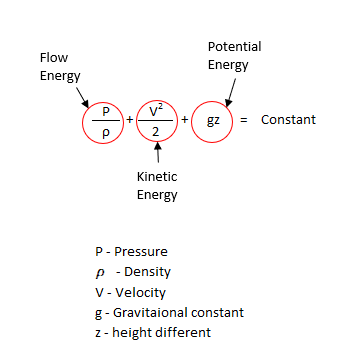
Bernoulli realized that the sum of kinetic energy, potential energy, and flow energy is a constant during steady flow. He wrote the equation like this:

Equation 1:

Bernoulli’s Equation

Not to get too technical, but you can see the relationship between the velocity squared and the pressure from the equation above. Being that this relationship is a constant along the streamline; when the velocity increases; the pressure has to come down. An example of this is an airplane wing. When the air velocity increases over the top of the wing, the pressure becomes less. Thus, lift is created and the airplane flies.

With equations, there may be limitations. For Bernoulli’s equation, we have to keep in mind that it was initially developed for liquids. And in fluid dynamics, gas like air is also considered to be a fluid. So, if compressed air is within these guidelines, we can relate to the Bernoulli’s principle.

  1. Steady Flow: Since the values are measured along a streamline, we have to make sure that the flow is steady. Reynold’s number is a value to decide laminar and turbulent flow. Laminar flows give smooth velocity lines to make measurements.
  2. Negligible viscous effects: As fluid moves through tubes and pipes, the walls will have friction or a resistance to flow. The surface finish has to be smooth enough; so that, the viscous effects is very small.
  3. No Shafts or blades: Things like fan blades, pumps, and turbines will add energy to the fluid. This will cause turbulent flows and disruptions along the velocity streamline. In order to measure energy points for Bernoulli’s equation, it has to be distant from the machine.
  4. Compressible Flows: With non-compressible fluids, the density is constant. With compressed air, the density changes with pressure and temperature. But, as long as the velocity is below Mach 0.3, the density difference is relatively low and can be used.
  5. Heat Transfer: The ideal gas law shows that temperature will affect the gas density. Since the temperature is measured in absolute conditions, a significant temperature change in heat or cold will be needed to affect the density.
  6. Flow along a streamline: Things like rotational flows or vortices as seen inside Vortex Tubes create an issue in finding an area of measurement within a particle stream of fluid.

Super Air Knife has 40:1 Amplification Ratio

Since we know the criteria to apply Bernoulli’s equation with compressed air, let’s look at an EXAIR Super Air Knife. Blowing compressed air to cool, clean, and dry, EXAIR can do it very efficiently as we use the Bernoulli’s principle to entrain the surrounding air. Following the guidelines above, the Super Air Knife has laminar flow, no viscous effects, no blades or shafts, velocities below Mach 0.3, and linear flow streams. Remember from the equation above, as the velocity increases, the pressure has to decrease. Since high-velocity air exits the opening of a Super Air Knife, a low-pressure area will be created at the exit. We engineer the Super Air Knife to maximize this phenomenon to give an amplification ratio of 40:1. So, for every 1 part of compressed air, the Super Air Knife will bring into the air streamline 40 parts of ambient “free” air. This makes the Super Air Knife one of the most efficient blowing devices on the market. What does that mean for you? It will save you much money by using less compressed air in your pneumatic application.

We use this same principle for other products like the Air Amplifiers, Air Nozzles, and Gen4 Static Eliminators. Daniel Bernoulli was able to find a relationship between velocities and pressures, and EXAIR was able to utilize this to create efficient, safe, and effective compressed air products. To find out how you can use this advantage to save compressed air in your processes, you can contact an Application Engineer at EXAIR. We will be happy to help you.

John Ball
Application Engineer
Email: johnball@exair.com
Twitter: @EXAIR_jb

  1. Wikipedia https://en.wikipedia.org/wiki/Bernoulli%27s_principle