
Many of us have had the opportunity to take the ALS ice bucket challenge outside of work. Once our own Professor Penurious took the challenge, EXAIR made it a bit more interesting for us…in exchange for our own cold selves.
Thanks EXAIR.
Many of us have had the opportunity to take the ALS ice bucket challenge outside of work. Once our own Professor Penurious took the challenge, EXAIR made it a bit more interesting for us…in exchange for our own cold selves.
Thanks EXAIR.
Of all the tools that I own, my cordless drill has to be just about my favorite. I’m remodeling a bathroom in my house right now, and last night I was setting the new toilet flange onto the new tile floor. I had to drill some holes for this through the new tile. I’d never done this before, and was definitely feeling some heartburn about it. Especially after finding out just how fragile and brittle ceramic tile is…I cracked two pieces, just trying to cut a hole for the heat & AC vent register. Luckily, that was BEFORE I mortared & grouted it in, so it wasn’t a big deal…they’re about a buck a piece, and I got five extra anyway.

THIS one, though, was fully installed, and, despite all the internet videos I found & watched on how to install a tile floor, I haven’t yet had the need to find one that shows me how to replace a broken tile. And I don’t really want to, so I went slowly and carefully with the drill, using the special glass & tile bit that I bought. On my first hole, when I got the bit through the tile itself, I changed to a different (smaller) bit to pilot the screw hole through the subfloor. Then, I put a Phillip’s head bit in to drive the screw. It occurred to me that I was performing these three related but separate tasks, with the same tool…I just thought that was very cool.
Over the course of the last couple of days, I’ve talked to three different callers, with three different Line Vac applications:

*One wants to use a Model 150200 2” Heavy Duty Line Vac to convey cement. They’re currently hauling the bags, by hand, up to a hopper, where they cut them open and dump them in.

*One needs to move small springs, one at a time, from a hopper to an automated assembly turret machine. The springs are 5/8″ in diameter, and they’ll be fed through a length of PVC pipe. Our Model 151100 1″ NPT Heavy Duty Threaded Line Vac will be easily installed in the pipe line using standard threaded fittings, and the springs will pass through the 0.75″ throat nicely.

*One has a auger-type chip conveyor that removes machining debris from a lathe, and it’s broken…again. They needed a Model 6066 3” Stainless Steel Line Vac, in a hurry, to use until they get their chip conveyor fixed. In fact, if it works, they may not fix the chip conveyor.

So, kind of like my cordless drill, our Line Vac Air Operated Conveyors have a variety of uses, right out of the box. If you have an application that you think a Line Vac may be able to solve, give me a call. By the way, if you order one before the end of October, 2014we’ll give you a FREE 2″ Flat Super Air Nozzle. Really.
Russ Bowman
Application Engineer
EXAIR Corporation
Visit us on the Web
Follow me on Twitter
Like us on Facebook
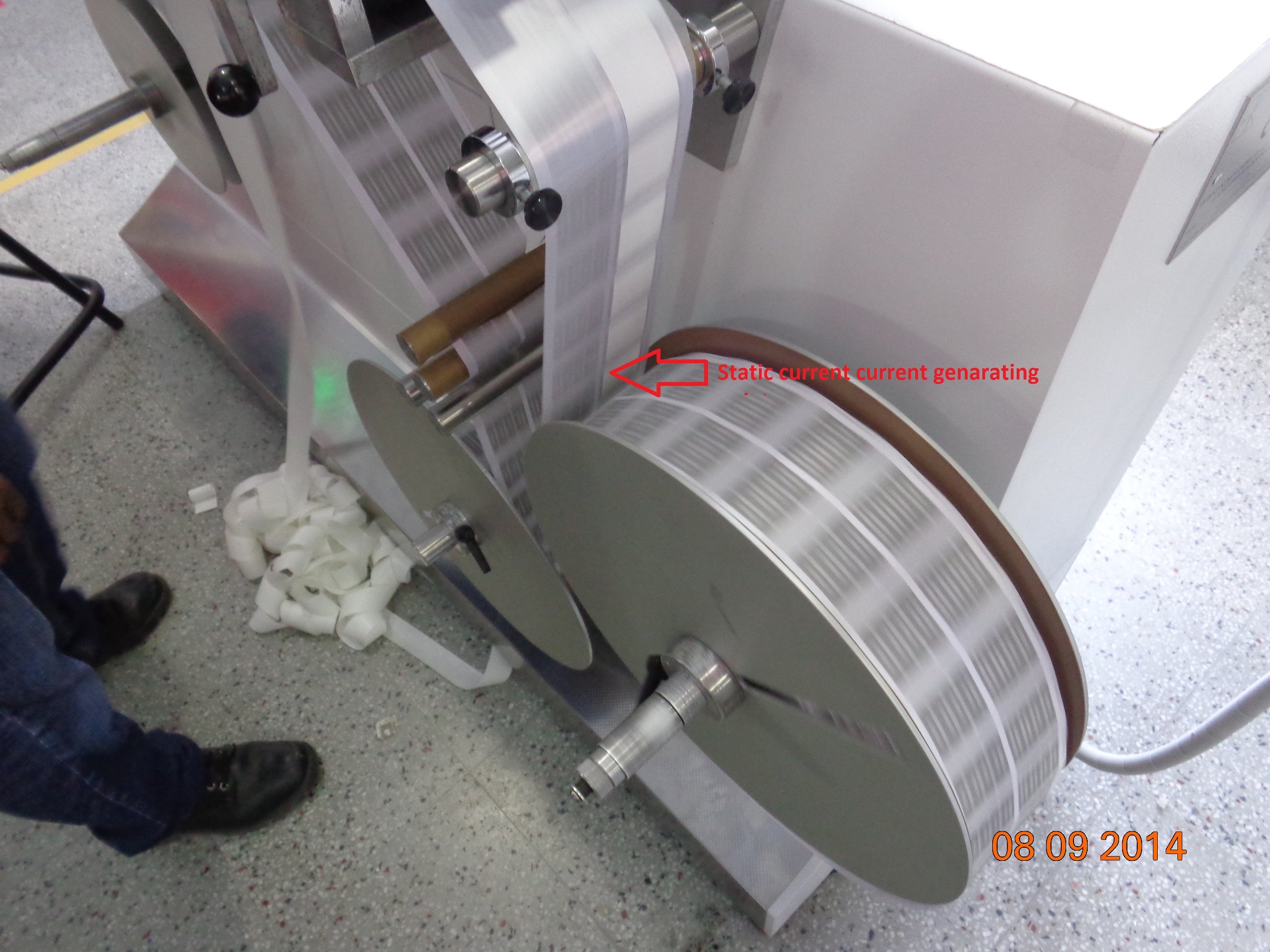
A customer contacted me from the narrow web / label industry recently and provided the image above (please excuse the typo). They have a static problem on their narrow web processing machine. While that isn’t a big surprise, the symptom of their problem was quite interesting. The customer is applying RFID tags to this narrow web and re-winding the web back onto the roll you see bottom right in the photo above. And their problem is that the static being generated within the re-winding process is enough to cause as many as 25% of their RFID tags to go dead as a result of discharges within the roll itself. Figuring that static was his problem, the customer contacted EXAIR and we recommended that he use two model 7006 Ion Bars and one model 7907 Power Supply to treat both sides of the web just before it is re-wound onto the roll. The point where the red arrow is located indicates the suggested mounting point. The web was travelling slowly enough that simply passing through a couple of ion bars would remove the charge down to a more manageable level that would not interfere with operation of the RFID tags.
Once installed, the customer was able to eliminate the damage to the RFID tags caused by static discharge.
Neal Raker, Application Engineer
nealraker@exair.com

One of the easiest ways to solve a blow off application is to install an open pipe or tube; it’s generally quick and available. They are easy to make, mainly you just need some pipe, maybe a hacksaw and hammer, and a way to hook them up to your compressed air system. They will provide a good amount of force but at the cost of safety, noise level, and air consumption. That’s right: it will cost you in SAFETY, NOISE EXPOSURE and COMPRESSED AIR CONSUMPTION. I’m going to go out on a limb here (not really) and wager there are a number of folks in any organization unwilling to pay those costs – if you are willing, you may want to reconsider.
I have been to many manufacturing facilities where they have used copper line to bend into a tight space and then pump 85 psi into the pipe in order to try and blow a piece of lint out of a roller or to keep trim from getting caught in a pulley system. In some cases I have seen 3/8″ ID pipe to keep dust and lint out of a pulley.
This is not needed at all. The estimated flow through a 3/8″ ID tube that is around 3′ long would be roughly 109 SCFM when powered at 85 psig. All to keep dust off and loose fiber out of a certain area. The reason they plumbed this large of a piece of tubing into the area was simple, it’s what they had and it worked great (words from the maintenance worker). For additional reference, our 91 SCFM air nozzle produces 4.5 pounds of force which seems a bit of overkill when you can blow dust away with your breath.

In one instance I looked over the material and scrap they were trying to keep from getting to the outer workings of the machine I made the recommendation for them to utilize a model 1100SSW, – a 1/4 NPT Stainless Steel Super Air Nozzle w/ Swivel Fitting. This would give them flexibility to target the right area through the swivel and require them to change the existing tubing out to a schedule 40 threaded pipe, or use a compression style fitting.
By replacing the single nozzle, the customer was able to reduce compressed air consumption in just this single blow off point from 109 SCFM at 85 psig to 14 SCFM at 80 psig inlet pressure. This single replacement equates to saving 95 SCFM, or $11.40 per 8 hour shift that the blowoff is operated. If the customer operated this blowoff 24 hours a day it would take a mere 4 days to pay the unit back in air savings.
The above savings do not include the benefit of being able to reduce the overall operating pressure of the compressed air system feeding this application to 80 psig, instead of 85 psig. In case you weren’t aware, if you lower the pressure value where your compressor shuts off, say from 85 psig to 80 psig, it will save an estimated 2.5% of drive energy for their air compressor. Depending on the type and size of the compressor this could amount to a substantial savings. This system pressure reduction will also lower the operating pressure of any leaks that may be within the system which will also be another amount of savings. All of this is from simply replacing open pipe with an engineered nozzle.
This was just one area where the quick and easy way turned out to be the costly and dangerous path. The best part about our engineered solution is they are all in stock, ready to ship same day. This means you can find the problem today, have a solution waiting to be installed tomorrow.
Brian Farno
Application Engineer
BrianFarno@EXAIR.com
@EXAIR_BF