Keeping your Safety Air Gun right where you need it can make everyday tasks faster and tidier. EXAIR’sModel 5920 Air Cradle is a simple, magnetic loop designed to hold a Safety Air Gun (or a similarly sized tool) within easy reach on any strong magnetic surface. Whether you’re working at a machine center, assembly station, shipping area, or general shop bench, the Air Cradle keeps your air gun accessible while helping maintain a more organized workspace.
The design is straightforward and practical. A strong magnet secures the loop to metal surfaces so the Safety Air Gun can hang safely and conveniently when not in use. This reduces clutter, keeps tools from being misplaced, and makes it easier for operators to grab the gun and get right back to work. For shops that rely on safety guns for blowoff, cleaning, or drying tasks throughout the day, having that tool right where it belongs adds both convenience and productivity.
Don’t allow your operators to just toss your premium air guns around on the floor. Give them a space to keep them secure and stored for many years of useful life!
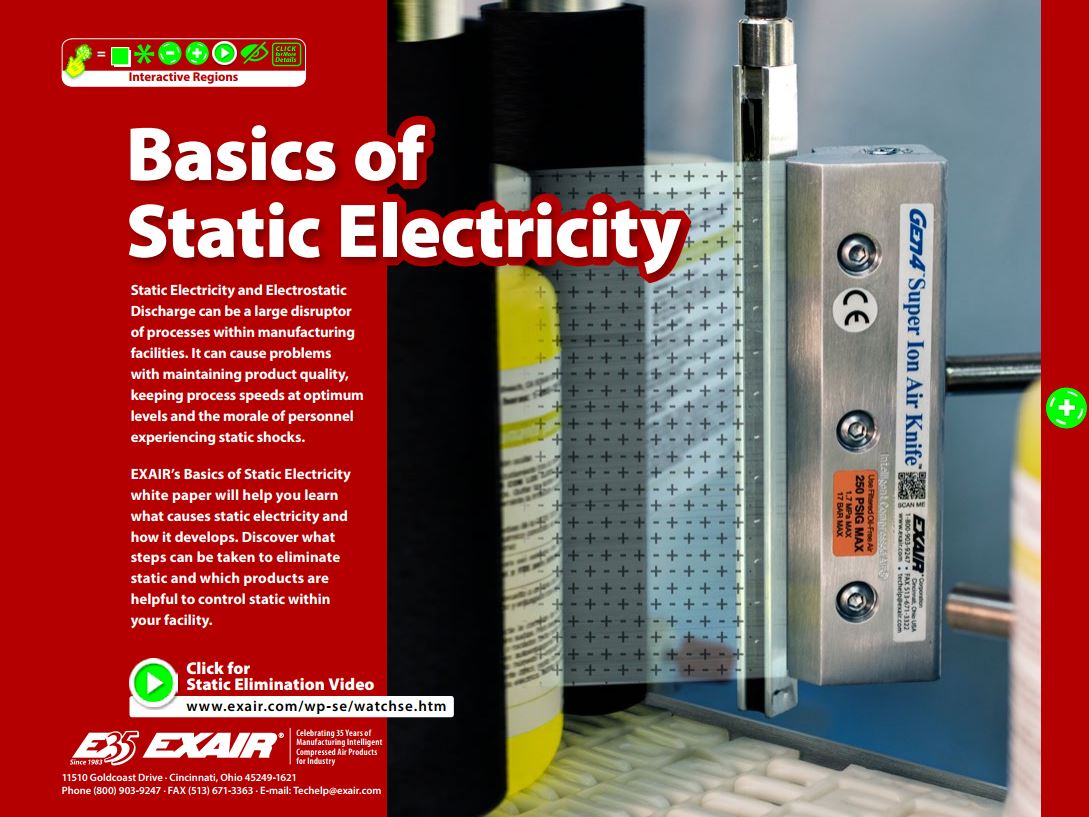
On a molecular level, the outer electrons surrounding the nucleus can be removed and transferred between atoms, leading to an imbalance of electrical charge known as static electricity. When an atom gains an extra electron, it becomes negatively charged, while the loss of an electron results in a positively charged atom. In non-conductive materials such as plastic, paper, rubber, and glass, these electrons cannot return to their original atoms. There are three primary methods through which static electricity can be generated, resulting in this phenomenon.
Contact — When objects collide, electrons can be transferred between their surfaces, with the amount of electrons exchanged depending on the specific triboelectric materials involved. In the case of plastic bottles or trays coming into contact on conveyor belts, static electricity can be generated quite easily.
Friction — When two materials are peeled apart, the electrons may not return to their original molecules, resulting in the creation of static electricity. This effect is especially prevalent with adhesive tapes and protective films, which possess larger surface areas that facilitate charge buildup. For example, peeling the backing from labels can generate a static charge that may malalign the labels or cause jams during the application process.
Separation — Static forces are often generated when two non-conductive surfaces are rubbed together, leading to the accumulation of electric charges. The friction created as these materials slide against each other increases the static charge, exemplified by the phenomenon observed when a balloon is rubbed on hair. With each additional rub, the static force intensifies, enabling the balloon to adhere to surfaces like walls. This effect is also evident when layers of material are stacked or when they move over rollers, highlighting the significance of friction in generating static electricity.
The generation of static electricity is influenced by the degree of contact, detachment, and friction between surfaces; increased interaction leads to a higher static charge. Even after static is discharged from a surface, it can accumulate through the same processes. Therefore, effective control of static electricity depends on both the treatment methods employed and the specific locations designated for its removal.
Humidity is another critical factor in static charge generation. Issues related to static electricity are often more pronounced during the winter months when the air tends to be drier. Lower relative humidity facilitates the easier and more potent development of static charges, which is why winter is commonly referred to as “static season.” A familiar example of this phenomenon occurs when one walks across a carpet and experiences a static shock upon touching a metal object, such as a door handle.
If you are experiencing static issues, or anything regarding EXAIR and our products, please do not hesitate to reach out. We offer a full line of Static Elimination products to suit your needs!
Static can be a big issue, whether it is shocking operators, causing jamming of machines, or collection of dirt and debris. This is especially true in the colder months. At EXAIR we have a wide range of Static Eliminators that can handle just about every static problem. However, sometimes the issue can be concentrated in smaller areas, and the solution needs to be more precise. For these types of situations, our Gen4 Ion Air Jet is perfect.
The Gen4 Ion Air Jet is a combination of our High Velocity Air Jet, and our Gen4 Ionizing Point. The Air Jet generates a high-speed air stream using a specially designed Coanda profile. This design creates a low pressure at the Air Jet’s entrance, allowing it to pull in surrounding air at a ratio of 5:1. As a result, the Air Jet operates efficiently, producing more ambient air in its output than compressed air. Additionally, thanks to the engineered design, they produce a smooth laminar air stream that can treat a surface up to 15 feet away.
Due to the laminar nature of the airflow, the ions generated by the Ionizing Point will be carried by the air stream all the way to the targeted area. When operated at a pressure of 80psig, the Ion Air Jet is capable of dissipating a 5kV charge in under 0.18 seconds. Although for more sensitive applications, the pressure can be regulated down to adjust the airflow from a blast to a breeze.
Ion Air Jet
In addition to being efficient in its use of compressed air, the Ion Air Jet boasts several other advantages. Due to the engineered design of the High Velocity Air Jet, and the laminar airflow produced, the Ion Air Jet is very quiet compared to other compressed air blow off options. At 82dBA (when operated at 80psig), the Ion Air Jet is well below OSHA’s allowable noise level. It also meets OSHA’s dead-end pressure requirements.
The Ionizing Point used in the Ion Air Jet takes advantage of a shockless design, so it is safe to handle while in operation. As it utilizes the corona discharge method, there are no radioactive materials needed to produce the static neutralizing ions.
In addition to our standard Ion Air Jet Kits, we also have systems that combine our Ion Air Jet with our Stay Set Hoses, making hands-free operation even easier. Whether you are looking for a new solution, or looking to upgrade an existing process, give us a call and see if our efficient, low-cost Ion Air Jets can help solve your static issues.
If you use compressed air for ANYTHING, odds are EVERYTHING you use it for has a minimum supply pressure for proper operation. And if the supply pressure drops below that:
Blowoff devices won’t develop enough flow & force to effectively clean or dry the object(s) you use them for.
Air-operated chucks on CNC machines won’t hold the piece steady enough for proper cutting, and tool changers will operate slowly/sluggishly. This is a bad combination…increasing the time it takes to make something, AND making it poorly.
Pneumatic cylinders will actuate slowly…if at all. This can cause a big problem if, for instance, they’re used to lift a lid on a mixing tank for an automated chemical add, which ends up pouring all over the partially closed lid of the tank instead of going inside it.
These are just a few of the problems that inadequate supply pressure can lead to, and I list them specifically because I experienced them all during my storied (and strange) career path before EXAIR made me the compressed air know-it-all expert I am today. It wasn’t my job to fix those problems (I was on site doing field service on a scale, a hydraulic motor, and a chemical pump, respectively), so I had no idea HOW to fix the compressed air-related problems…but I do now.
One quick & easy fix would have been to increase the compressor discharge pressure. That’d work just fine, but it comes with a cost. Every 2psi increase in discharge pressure increases the power consumption of the compressor’s motor by 1%. Let’s say you increased the discharge pressure from 100psig to 120psig – that’s a 10% increase in power consumption…and operating cost. To add insult to injury, that also increases the magnitude of any leaks in your system, making them more costly as well.
EXAIR Model 9500-60 60 Gallon Receiver Tank.
Actually, that probably IS what I’d have done as a scale, hydraulics, or industrial pump technician. The RIGHT answer, though, is intermediate storage. A properly sized Receiver Tank, located close enough to those operations, would have prevented those problems without increasing operating costs. In fact, it could have even brought them down, if the compressed air header pressure was already set to overcome any pressure drops on the way to those air guns, CNC machine, or mixing tank lid cylinders. Every 2% DECREASE in discharge pressure will also decrease the compressor motor’s power consumption by 1%. Which is actually Step 6 in our Six Steps To Optimizing Your Compressed Air System.
You electrical-types out there could also think of it as a capacitor – absorbing demand spikes & helping the circuit run more evenly.
Sizing a Receiver Tank is fairly straightforward, and we’ve written about it here, here, and here. You can, of course, always contact an Application Engineer to do (or check) the math…give me a call.
Russ Bowman, CCASS
Application Engineer Visit us on the Web Follow me on Twitter Like us on Facebook