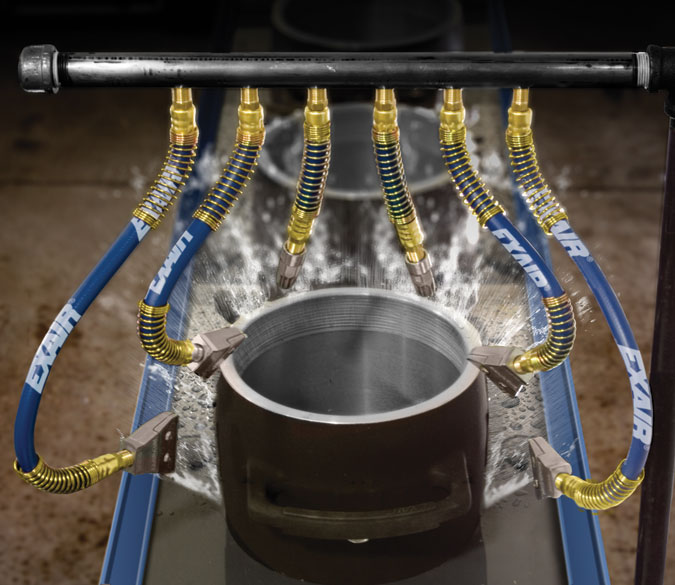
Over the years, EXAIR has come across many different types of blow-off devices. We have seen copper tubes, pipes with crushed ends, fittings with holes drilled into them, and modular flex lines. For compressed air use, these are very dangerous and very inefficient.
A plastic machining center was looking for a better way to blow compressed air. They were using modular flex lines, similar to Loc-line, which are mainly designed for spraying coolant. They had 14 blow-off lines in their plant that were about 18” (457mm) long and operated 8 hours a day at 40 PSIG (2.8 bar). They liked the positioning feature of the flex line, but they could tell by the loud noises that they were wasting compressed air. So, they contacted EXAIR.

When EXAIR started to manufacture compressed air products in 1983, we created a culture in making high quality products that are safe, effective, and very efficient. With our Super Air Nozzles, we engineered a way to entrain the ambient air to add mass to the air stream to use less compressed air with a strong force. This is done by the Venturi method. We create a high velocity which will make a low pressure at the exit. The surrounding air is drawn into the compressed air stream increasing efficiency. We also engineered fins to support OSHA compliance in noise levels and dead-end pressure. So, if your skin comes in contact with an EXAIR nozzle, the end will not be able to be blocked and allow air to penetrate the skin membrane; even above 30 PSIG (2 bar). I went over the cost savings and safety solutions that EXAIR’s products could give.

Since the modular flex lines had a ¼” (6mm) opening, I recommended the model 1100 Super Air Nozzle with a Stay Set Hose. This recommendation is from experience with these types of blow-off devices. The Stay Set Hoses will give them that possibility of manually adjusting and re-adjusting the Super Air Nozzles. The hoses have a “memory” function and will not creep or droop until you physically move it. They work well to direct air flows at specific target areas like the flex lines above. For the company above, I recommended the model 1100-9218 which is a model 1100 Super Air Nozzle with an 18” (457mm) long Stay Set Hose. It was easy to remove the flex line and replace it with a safer and more efficient product

Now, let’s look at the savings. The Super Air Nozzle with the 18” Stay Set Hose cost $92.00 each. The flex line is generally around $10.00 each. But this is not the total cost of ownership. As an efficiency comparison, the model 1100 Super Air Nozzle will only use 8 SCFM (227 SLPM) of compressed air at 40 PSIG (2.8 bar); and, the noise level is reduced to 70 dBA for each nozzle. At 40 PSIG (2.8 bar), the flex line had a noise level of 97 dBA and an air usage of 19 SCFM (538 SLPM).
For the annual savings and the payback period, I will look at the electrical cost. (Since the Super Air Nozzle is using less compressed air, the maintenance and wear on your air compressor is reduced.)
- The air savings is calculated from the difference in air usage; 19 SCFM for flex line – 8 SCFM for Super Air Nozzle = 11 SCFM savings per blow-off device.
- With 14 flex lines, the total compressed air savings will be 11 SCFM * 14 = 154 SCFM.
- To get into the cost, an air compressor can produce 5.36 SCFM/KW of electricity at a cost of $0.10/KWh. For an annual savings, we have the figures from the information above; 8 hours/day * 250 days * 154 SCFM * $0.10/KWh * 1KW/5.36 SCFM = $5,746.27/year.
- For a payback period, the model 1100-9218 has a price of $92.00 each, or $1,288.00 for 14 systems. The flex lines were $10.00 each, or $140.00 total. The payback period will be ($1,288 – $140) / ($5,746.27/year) * (12 months/year) = 2.4 months. Wow, what a savings!
Not all blow off devices are the same. With the customer above, they were able to cut their noise levels, remove the dead-end pressure concerns, and save $5,746.27 a year in compressed air. If your company decides to select an unconventional way to blow off parts without contacting EXAIR, there can be many hidden pitfalls; especially with safety. Besides, if you can save your company thousands of dollars per year as well, why go with a non-standard nozzle? If you are using compressed air for blowing, cooling, cleaning or moving material; you should contact an Application Engineer at EXAIR. What do you have to lose?
John Ball
Application Engineer
Email: johnball@exair.com
Twitter: @EXAIR_jb