Many Ways to $ave on Compressed Air Costs

Using compressed air in the plant is common for many types of processes.  Typical uses are drying, cooling, cleaning and conveying. Compressed air does have a cost to consider, and there are many ways to keep the usage and the costs as low as possible.  The first step is to use an EXAIR Intelligent Compressed Air Product, which has been engineered to provide the most performance while using the least amount of compressed air. The next step is to control the use of the air, to only have it on when needed.

EXAIR offers the EFC – Electronic Flow Control.  It offers the most comprehensive method to maximize the efficiency of compressed air usage.  It combines a photoelectric sensor with a timing control that operates a solenoid valve to turn on and off the air as required. With 8 different program types, an on/off mode that works with any process can be programmed ensuring that the minimum amount of compressed air is used.  You can use the online EFC Savings Calculator to see how quickly the savings add up!

EFCp4
EFC – Electronic Flow Control

Another method would be to use a solenoid valve with some other method of control. Depending on the process, the solenoid could be energized via a machine control output, or as simple as an electrical push button station. EXAIR offers solenoid valves in a variety of flow rates (from 40 to 350 SCFM) and voltages (24 VDC, 120 VAC and 240 VAC) to match the air flow requirements of the products we provide, while integrating into the facility and available supply voltages.

For control of the Cabinet Cooler Systems, the ETC – Electronic Temperature Control, uses a thermocouple to measure cabinet temperature and cycle the system on and off to maintain a precise cabinet temperature, and provides a digital readout of the internal temperatures and on the fly adjustment.  Also available is the Thermostat Control models, which utilize an adjustable bimetallic thermostat to control the solenoid valve, also cycling the unit on and off as needed to maintain a set cabinet temperature.

ETC CC
ETC – Electronic Temperature Control

There are several manual methods that can be used to control the compressed air.  A simple valve can be used to turn the air off when not needed, whether at the end of the work day, at break time, or whenever the air isn’t required.  We offer several options, from a foot controlled valve, to a magnetic base with on/off valve, to a simple quarter turn ball valve.

footpedalvalve (2)dualstand (2) manual_valves (2)


To discuss your processes and how an EXAIR Intelligent Compressed Air Product can control the air supply and save you money, feel free to contact EXAIR and myself or one of our other Application Engineers can help you determine the best solution.

Brian Bergmann
Application Engineer

Send me an email
Find us on the Web
Like us on Facebook
Twitter: @EXAIR_BB


EXAIR Helps Pharmaceutical Company with Cabinet Cooler System

Heated Desiccant Dryer

Many of us have walked into a compressor room.  They are typically a small room that is very warm as it contains an air compressor, a dryer, and other items that create heat.   To help remove the heat, a fan is placed near the ceiling to remove as much heat as possible.  But, when the days get warmer, it makes it more difficult to keep things cool inside the compressor room.  Recently I was working with a pharmaceutical company about the issues with the operation of his dryer.

For this customer, he was using a heated-type regenerative dryer in their facility to get a -40 deg. F dew point.  It was important in their process to have very dry compressed air because it was coming in contact with powders.  As the outside temperatures began to warm up, they started to see alarms and failures with their dryer system.  With a dryer shutdown, they had a potential of water going downstream into their process.  They contacted EXAIR for a solution.

He explained the situation in a bit more detail about his desiccant type dryer.  It had two towers next to each other.  One tower would dry the compressed air while the other tower would be heated to remove any water that was adsorbed by the desiccant.  The control panel was mounted in between the desiccant towers, and it operated the switching valves and heating cycle of the dryer.  When a tower was being regenerated by heat, the ambient temperature around the control panel was getting near 140 deg. F.  With this added heat, the electronics inside would malfunction and shut down the function of the dryer.  They did have a control fan near the ceiling to try and remove the heat from the room, but it was not very effective.  They needed an alternative way to keep the dryer running.  With the location of the control panel between the two towers, there was very little room to work.  He needed something very compact, easy to mount, and effective in maintaining a cool internal temperature.

EXAIR High Temp Cabinet Coolers

In calculating the high ambient heat and the size of the control panel, I recommended the HT4315 High Temperature Cabinet Cooler System.  It is able to handle the high ambient conditions from 125 – 200 deg. F.  With a dimension of 1.34” diameter and a length of 8”, this compact design had no problem fitting onto the panel between the towers.  Even with this small design, the model HT4315 had plenty of cooling capacity to keep the electronics inside from overheating, eliminating the concern with their dryer system shutting down.

To mount this Cabinet Cooler System, a 1 1/8” knock-out hole in the cabinet and a small wire connection hole for the thermostat are the main steps.  This makes it fast and easy to install onto the panel to start getting the cold air to  the electronics.  With a thermostat control, it will only operate the Cabinet Cooler during high temperature conditions, making the system very effective.  The design of the Cabinet Coolers has no moving parts, no motors, no Freon or condensers to clean.  Once they are installed, they are maintenance and worry-free.

If you wish not to have failures in your compressor room during the hot months, a Cabinet Cooler System can be the correct product for you.  If you need help in sizing, you can fill out the EXAIR Cabinet Cooler Sizing form and send it in to us.  For my customer mentioned above, the integrity of their compressed air system was sustained to keep their production process running smoothly.


John Ball
Application Engineer

Email: johnball@exair.com
Twitter: @EXAIR_jb


Heated Desiccant Dryer by Compressor1.  Creative Commons Attribution-NoDerivs 2.0 Generic.

EXAIR Cabinet Cooler System Used on Cement Barge

I joined the Navy, right after high school, to get out of Ohio, see the world, and never come back. “My recruiter said” (if you are considering military service, those can be famous last words, just so you know) that I would be a good candidate for Nuclear Power School, so I took the test. As a math & science nerd scholar, I qualified for admission easily.  About halfway through Nuke School, I volunteered for submarines.  My decision was based in no small part on the sea stories of our instructors, the strong reputation of better food, and my deep appreciation for the movie “Operation Petticoat.”

Upon graduation, I was assigned to a new construction Trident submarine.  I did not see the world…I saw the Electric Boat shipyard in Groton, Connecticut, and Naval Submarine Base King’s Bay, Georgia.  Hilarity occasionally ensued, but never in the context of that movie I so adored.  I moved back to Ohio (on purpose) soon after my enlistment was up.  The food WAS good…I can unreservedly vouch for that.

In the new construction environment of the shipyard, I became quite familiar, and developed a deep respect for, the high level of attention paid to the materials and workmanship that a seagoing vessel demanded…not to mention, one with a nuclear reactor on board.  Reliability and durability are obviously key factors.

I had the pleasure recently of assisting an electrical contractor who was looking for a cooling solution for a new Variable Frequency Drive enclosure installation on a cement barge.  The ship’s engineer (a Navy veteran himself) had told the contractor that his priorities were reliability, durability, and dust exclusion.  He couldn’t have made a better case for an EXAIR Cabinet Cooling System.

Based on the specified heat load of the VFD, the size of the enclosure, and its location, a Model 4380 Thermostat Controlled NEMA 12 Cabinet Cooler System, rated at 5,600 Btu/hr, was specified.  This equipment is internal to the ship; had it been exposed to the elements, a NEMA 4X system would have been presented.

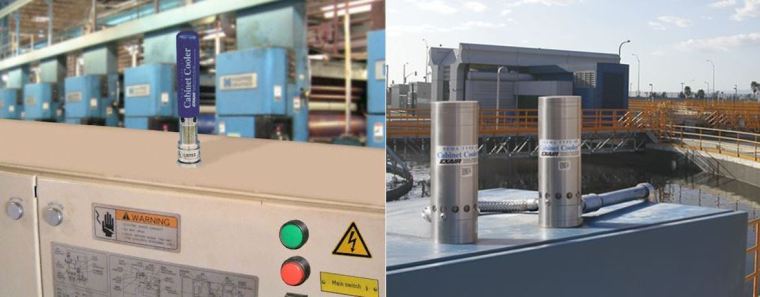
Up to 2,800 Btu/hr cooling capacity with a single Cabinet Cooler System (left) or as much as 5,600 Btu/hr with a Dual system (right.)

EXAIR Cabinet Cooler Systems have no moving parts to wear, no electric motor to burn out, and no heat transfer surfaces (like a refrigerant-based unit’s fins & tubes) to foul.  Once it’s properly installed on a sealed enclosure, the internal components never see anything but cold, clean air.

If you have a need to protect an electrical enclosure in aggressive environment, give me a call.  With a wide range of Cabinet Cooler Systems to meet a variety of needs, we’ve got the one you’re looking for, in stock and ready to ship.

Russ Bowman
Application Engineer
Find us on the Web
Follow me on Twitter
Like us on Facebook

Cabinet Cooler System Keeps Internal Panel Temperature Low

20151120_133449_resized
Stainless cabinet near steam vent

The photo above shows a stainless steel Cabinet at left which has been installed near to a steam exhaust (within 1 meter) in a beverage manufacturing plant.

20151120_133019_resized
150 mm diameter fan, lower right side


Inside the panel is a 150 mm diameter fan which is pulling in an air and steam mixture which is causing the temperature inside the cabinet to climb to unacceptable levels. The result is that the motor drives located inside the panel are failing, causing a tremendous cost for replacement and downtime.

Our local distributor worked with the customer to acquire the necessary data for us to calculate heat load within the panel. We determined the customer needed our model HT4880SS-240 Cabinet Cooler System to keep their internal panel temperature at a more reasonable level, year round, even in their worst case scenario with constant steam exhaust in the area.

One key component to success in this application will be removal of the fan and covering of the vent that it once occupied in order to keep the steam from being drawn into the inside of the panel. Historically, fans have been the go to strategy for keeping panels like this cool. However, in this situation, as in many others, the fans pull in un-wanted contamination. There isn’t any filter that can keep steam from getting inside and causing all sorts of problems with condensate forming on internal components, thus promoting corrosion and heat related failures.

The Cabinet Cooler System will provide a filtered, and dry source of cooling airflow which will produce a slight positive purge pressure on the panel to keep such harmful outside atmospheres from entering into the panel. This assures, long life for the panel components and much less hassle and problems associated with heat related failures.

Neal Raker, International Sales Manager
nealraker@exair.com
EXAIR_NR