More Efficient Compressed Air Use Could Lead To Energy Rebates

The use of compressed air can be found in almost any industry and is often referred to as a “fourth utility” next to water, gas and electric. The generation of compressed air accounts for approximately 1/3 of all energy costs in an industrial facility, in many cases, it’s the largest energy user in an industrial plant. With an average cost of $ 0.25 per every 1,000 SCF used, compressed air can be expensive to produce so it is very important to use this utility as efficiently as possible.

Utility companies recognize the benefit of using engineered products to reduce compressed air usage, like the ones manufactured by EXAIR, and offers rebate incentives for making a switch. Our local utility provider here in Cincinnati, Duke Energy, offers a $ 20 incentive for each replacement engineered nozzle.


Our Model # 1100SS 1/4″ FNPT and Model # 1101SS 1/4″ MNPT Super Air Nozzles

In their specification, the nozzle must meet a certain volumetric flow rate (SCFM) at 80 PSIG operating pressure for a given pipe size. For example, when looking at a 1/4″ nozzle, the flow rate must be less than or equal to 17 SCFM when operated at 80 PSIG. Our most popular nozzles for “general” blowoff applications would be our Model # 1100 (1/4″ FNPT) or our Model # 1101 (1/4″ MNPT) Super Air Nozzles. These nozzles require 14 SCFM @ 80 PSIG so this would be the ideal solution to reduce the air demand and take advantage of the rebate.

Here at EXAIR, much of our focus is to improve the overall efficiency of industrial compressed air operating processes and point of use compressed air operated products. If you’d like to contact one of our application engineers, we can help recommend the proper engineered solution to not only save on your compressed air usage but also assist with possible energy rebates available in your area.

Justin Nicholl
Application Engineer
justinnicholl@exair.com
@EXAIR_JN


Increase Safety and Gain OSHA Compliance By Using An Engineered Solution

In 1972, the US Department of Labor’s Occupation Safety & Health Administration (OSHA) established Standard 29 CFR 1910.242(b) to reduce the outlet pressure to less than 30 psi, of an open pipe, nozzle, air gun, etc. when being used for cleaning. The intent of this directive was to prevent injury to operators. They determined that 30 psi was the pressure in which the skin could be broken if the device were dead-ended against the operator’s body, causing an injury known as an air embolism…the dead-ended force of the air, under pressure, breaks the skin and introduces air flow inside the body. This is a VERY dangerous condition which can quickly lead to serious injury, possible stroke or ultimately death.

While OSHA doesn’t recommend any type or manufacturer of device, they do provide two methods you can follow to gain compliance.

The first would be to reduce the operating pressure below 30 PSI, as shown in the below line drawing.  This, of course, limits the strength and usefulness of the exhausting air flow before it reaches the nozzle and before it is used upon the application.


The other method indicates using a nozzle which includes a pressure reducer or a relief device which will reduce the air pressure to less than 30 psi if the nozzle is dead ended. All of EXAIR‘s products are engineered to meet or exceed this Standard. In the case of our Super Air Nozzles, the air exits through a series of jets, recessed behind an array of fins, so the outlet holes cannot be blocked directly, any potential obstruction of the outlet air holes results in the air having an alternative route to avoid injury to operators and personnel. This allows the full pressure (the highest energy) to reach the nozzle and the application

Open air lines and homemade blow offs violate OSHA standard 1910.242(b) because of harmful dead end pressures. If you would like to discuss how EXAIR products can help you gain OSHA compliance to increase personnel safety and avoid costly fines, please give me a call, I’d be happy to help.

Justin Nicholl
Application Engineer
justinnicholl@exair.com
@EXAIR_JN

Line drawings used from OSHA’s website

Super Air Knife is Most Efficent in Compressed Air Usage

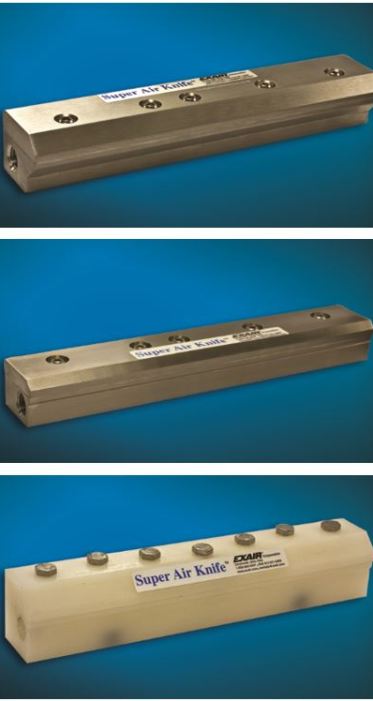
 Of the 3 styles of Air Knife offered by EXAIR, the Super, Standard and Full-Flow, the Super Air Knife is our most efficient, in regards to compressed air usage. Using a 40:1 amplification rate of entrained ambient air to compressed air consumed, it uses only 2.9 SCFM per inch of knife length when operated at 80 PSIG, while producing a low sound level of only 69 decibels (the quietest on the market today). The Super Air Knife provides  an even laminar flow of air across the length of the knife and is available in single piece lengths from 3″ up to 108″ in aluminum, 303 stainless and 316 stainless as well as up  to 54″ in PVDF (Polyvinylidene Flouride) construction for applications where aggressive chemicals may be present. 1/4″ FNPT air inlets are available on each end as well as on the bottom of the knife.

Aluminum, Stainless Steel and PVDF Super Air Knives

For Super Air Knives 24″ and longer, you need to plumb air to multiple inlets to maintain an even airflow. Our available Plumbing Kits includes the properly sized hose or pipe and fittings, to not only save valuable time looking for these parts yourself but also eliminates the potential of using undersized lines which will reduce the performance of the Super Air Knives.

For Super Air Knives in aluminum construction, the Plumbing Kits include cut to length PVC compressed air hose and the required brass fittings.

Plumbing Kit for aluminum Super Air Knives

The Plumbing Kits for our stainless steel and PVDF Super Air Knives, include 316ss cut to length pipe as well as 316ss fittings.

Plumbing Kit for 303ss, 316ss and PVDF Super Air Knives

The Super Air Knife is the ideal choice when looking to treat wide-area applications, like cleaning a conveyor or drying parts after a wash process. For help selecting the best product to fit your process, contact one of our application engineers for assistance.

Justin Nicholl
Application Engineer
justinnicholl@exair.com
@EXAIR_JN


Super Blast Safety Air Gun Saves Air vs. an Inefficient Homemade Lance

I was recently contacted by a Chicken Farm in Canada about a blow off application for cleaning the dust and debris off the walls and ceilings in their barns. They currently use a 185 SCFM portable, engine driven compressor and a lance made from 3/4″ open copper tube. The barns are rather large, approximately 10′ high by 500′ long, and they place the compressor in the middle of the barn and have a 250′ length of hose going to the homemade blowoff. This setup worked fine for a minute or so but then the airflow would start to weaken at the point-of-use and the compressor would run continuously as it wasn’t able to maintain pressure to keep up with the demand of the copper pipe.

Picture of existing homemade air lance

After discussing the details of the application, I recommend the customer use our Model # 1214-6 Super Blast Safety Air Gun with 6′ aluminum extension. This would reduce the air demand to 91 SCFM, more suitable for use with the existing 185 SCFM compressor.


Super Blast Safety Air Gun Model # 1214

The design of the Super Blast Safety Air Gun features a spring loaded manual valve, providing automatic shutoff and a comfortable foam grip. The 6′ extension provides the extra reach they need to effectively treat the walls and ceilings in the barn.

The Super Blast Safety Air Guns are ideal for wide coverage, long distance applications. They use our Large Super Air Nozzles and Super Air Nozzle Clusters, providing forces levels from 3.2 lbs. up to 23 lbs, depending on which nozzle is fitted on the assembly. Air inlets range from 3/8 FNPT up to 1-1/4 FNPT and aluminum extensions are available in 36″ or 72″ lengths.

If you have any questions or need further assistance, please contact an application engineer.

Justin Nicholl
Application Engineer
justinnicholl@exair.com
@EXAIR_JN