Understanding Decibels & Why OSHA Pays Attention to Your Noise Exposure

In the simplest of metric terms, a decibel is one-tenth of a bel.  But, historically, bel was a unit created to honor Alexander Graham Bell who invented the telephone.  In the early days with telephone wires, they noticed that the signal strength would decay over a long distance.  In order to determine power requirements to connect people for communications, they determined that they could use the ratio of power levels.  As a start, it had to be based on a minimum amount of power required for a person to hear on the telephone.  They found that the signal power level to generate an angular frequency of 5000 radians per second would be that minimum value as determined by an average number of people.  They used this mark as a reference point in the ratio of power levels.  Because of the large variations in values, they simplified the equation on a base-10 log scale and dividing the bel unit by 10.  Thus, creating the measurement of decibel.

Today, this same method is used to measure sound.  Like frequency waves that travel through the telephone wires, pressure waves travel through the air as sound.  This sound pressure is what our ears can detect as loudness, and it has a pressure unit of Pascals (Pa).  As an example, a small sound pressure would be like a whisper while a large sound pressure would be like a jet engine.  This is very important to know as high sound pressures, or loudness, can permanently damage our ears.

With sound pressures, we can determine the Sound Pressure Level (SPL) which is measured in decibels (dB).  Similar to the equation for the telephone power signals above, the SPL also uses a ratio of sound pressures in a base-10 logarithmic scale.  For a minimum reference point, an average human can just start to hear a sound pressure at 0.00002 Pa.  So, the equation for measuring sound levels will use this minimum reference point as shown in Equation 1.

Equation 1:

L = 20 * Log10 (p/pref)

where:

L – Sound Pressure Level, dB

p – Sound pressure, Pa

pref – reference sound pressure, 0.00002 Pa

Why is this important to know the decibels?  OSHA created a chart in 29CFR-1910.95(a) that shows the different noise levels with exposure times.  This chart was created to protect the operators from hearing loss in work environments.  If the noise level exceeds the limit, then the operators will have to wear Personal Protection Equipment (PPE), or suffer hearing damage.  EXAIR offers a Sound Level Meter, model 9104, to measure sound levels in decibels.  It comes calibrated to accurately measure the sound to determine if you have a safe work environment.

Sound Level Meter

There is a term that is used when it comes to loud noises, NIHL.  This stands for Noise Induced Hearing Loss.  Once hearing is damaged, it will not come back.  To keep your operators safe and reduce NIHL, EXAIR offers many different types of blow-off products that are designed to decrease noise to a safe level.  So, here’s to Alexander Graham Bell for creating the telephone which can be used to contact EXAIR if you have any questions.

John Ball
Application Engineer
Email: johnball@exair.com
Twitter: @EXAIR_jb


Photo of Telephone by Alexas_FotosCC0 Create Commons

Know What to Look For – Are Your Compressed Air Guns OSHA Safe?

One of the easiest ways to find out if your compressed air guns are safe for operation is by looking at the nozzle.  First, take your current compressed air gun and disconnect it from the compressed air line.  Second, look directly into the end of the nozzle where the air comes out.  If you can see the inside of the nozzle, then your air gun or blow-off device is unsafe.  Nine out of ten compressed air guns are considered to be dangerous.  In this blog, I will go through the dangers and violations of compressed air guns and nozzles that are very common in the market place.

Occupational Safety and Health Administration, OSHA, is an organization that enforces standards for safe and healthy working environments.  They have training, outreach programs, and educational assistance for manufacturing plant.  But, they will also enforce these standards with heavy fines for violations.  The two most common violations with compressed air guns and nozzles are 29CFR 1910.242(b) for dead-end pressure/chip shielding and 29CFR 1910.65(a) for maximum allowable noise exposure.  If you are unfortunate in receiving an audit, the OSHA agent will target your compressed air guns and blow-off devices.

Unsafe Nozzle

Here is the first example of a nozzle that I would like to discuss.  As you can see, there is only one opening where the air can come out from the nozzle.  Other types of nozzles that would fall into this category will include copper pipes, extensions, or worn nozzles.  They are dangerous as the compressed air cannot escape if it is blocked by your skin.  An air embolism could occur within the body which can cause bodily harm or death.  If operated above 30 PSIG (2 bar), these nozzles would violate the OSHA 29CFR 1910.242(b) for dead-end pressure.  This is a hazard which can be avoided by using EXAIR Super Air Nozzles and Safety Air Guns.  The nozzles are designed to utilize fins to allow air to escape and not penetrate your skin.  With EXAIR products, you will not violate this standard even if you go above the 30 PSIG (2 bar).

Safety Air Gun

To counteract the dead-end pressure violation, some nozzle manufacturers created a hole through the side of the nozzle (Reference photo below).  This will allow for the compressed air to escape, but, now the issue is noise level.  With an “open” section in the nozzle, the compressed air is very turbulent and very loud.  They state that 70% to 80% of all hearing loss within a manufacturing plant is caused by compressed air.  For this, OSHA 29CFR 1910.65(a) was created to show the maximum allowable noise exposure.  This chart shows the time and noise limits before requiring hearing protection.  The EXAIR Super Air Nozzles are designed to have laminar flow which is very quiet.  With our typical Safety Air Gun, model 1210, the sound level is only 74 dBA; well under the noise exposure limit for 8 hours.

Unsafe Air Gun
Hearing loss is the best known, but not the only, ill effect of harmful noise exposure. It can also cause physical and psychological stress, impair concentration, and contribute to workplace accidents or injuries.

Why do I bring these points up?  Because safety is everyone’s responsibility.  The National Institute for Occupational Safety and Health, NIOSH, has an overview of how to handle hazards in the workplace.  They call it the Hierarchy of Controls (click).  This is a means to best protect workers from dangers.  The most effective way is by eliminating the hazard or substituting the hazard.  The least effective way is with Personal Protective Equipment, or PPE.  For your unsafe compressed air nozzles and guns, EXAIR can help by substituting the hazardous air gun and nozzle with an engineered solution designed with safety in mind.

In my opening statement, I explained a quick and easy method to determine if your compressed air guns are dangerous.  To keep your company compliant and safe, EXAIR offers a variety of different types of nozzles and Safety Air Guns to best fit your requirement.  If you find that you are using hazardous blowing equipment, you can contact an Application Engineer to find a safe and effective alternative.

John Ball
Application Engineer
Email: johnball@exair.com
Twitter: @EXAIR_jb

EXAIR Safety Air Gun Promotion

From August 1st to September 30th, 2018, EXAIR will be giving away a 1” Flat Super Air Nozzle with the purchase of any promotional VariBlast, Soft Grip, or Heavy Duty Safety Air Gun.  EXAIR is stressing the importance of safety in the workplace with the EXAIR Safety Air Guns as well as the versatility of the different types of EXAIR Super Air Nozzles.

SAGpromoAD_500xsq

This promotional item, the model 1126 1″ Flat Super Air Nozzle, has a patented shim to blow a 1” wide stream of air to clean surfaces quickly and efficiently and is a $45.00 USD value. For more details on the Promotion, click on the photo/link above. For more information about the Flat Super Air Nozzles, click HERE.

Inexpensive air guns can be purchased just about anywhere- online, via catalogs, and through industrial supply companies. Typical quality is less than ideal – broken triggers, leaky valves – a short lifespan in an industrial setting are merely a few of the issues observed.  Most are loud and inefficient – they just blow large amounts of compressed air, and at noise levels that violate OSHA requirements.  Some may even generate dangerous dead end pressure situations that that can result in serious or fatal injuries if blocked.

EXAIR’s Safety Air Guns have been engineered and designed to eliminate these issues. They are durable for use in industrial situations and comfortable to use for extended periods of time.  With an EXAIR engineered air nozzle, each model provides top performance by entraining large volumes of surrounding air into the air-stream. Operation is assured to be safe along with low compressed air consumption and noise levels.  Due to the design, the airflow that exits the nozzle cannot be blocked, as required by OSHA Standard 29 CPR 1910.242(b).

Safety Air Guns
The EXAIR VariBlast, Soft Grip and Heavy Duty Safety Air Guns

The VariBlast style of safety air gun offers variable force based on the range of trigger pull. Force can be varies, form a light breeze, to full force maximum output. This cast aluminum air gun can be fitted with any of the EXAIR 1/8 NPT engineered air nozzles.

The Soft Grip style of safety air gun  has a durable cats aluminum body suited for rugged, industrial use. The ergonomic design has a soft vinyl cover, a large trigger for easy operation, and a hanger hook for easy storage.

The Heavy Duty style of safety air gun is powerful with a durable aluminum cast body and ergonomic composite rubber grip, best suited for rugged industrial environments. Hours of fatigue free operation are possible.

With all of the Safety Air Guns styles, Chip Shields and Extension Pipes are available, from 6″ to 72″ in length.

1210-6cs
Soft Grip Safety Air Gun, with Chip Shield and 12″ Extension

With many nozzle options, from a whisper quiet 58 dBA and 2.5 SCFM of flow up to 60 SCFM and 87 dBA (still below the OSHA 8 hour noise level threshold) there is a model that will fit practically any application. Application Engineers are available by phone, email, and chat to review your specific blow off needs, and help to select the best possible solution available.

We invite to you to try out an EXAIR Safety Air Gun, and get the free 1″ Wide Flat Super Air Nozzle as a bonus.

To discuss your application and how an EXAIR Intelligent Compressed Air Product can improve your process, feel free to contact EXAIR and myself or one of our other Application Engineers can help you determine the best solution.

Brian Bergmann
Application Engineer

Send me an email
Find us on the Web 
Like us on Facebook
Twitter: @EXAIR_BB

Sound – It Adds Up! How to Calculate Decibel Levels

Keeping noise levels in check and at safe levels is very important to ensure employee safety and well being.  OSHA (the Occupational Safety and Health Administration) through standard 29 CFR-1910.95(a) has studied the situation and set Maximum Allowable Noise Exposure limits in Hours per Day based on the Sound Level, in dBA, of exposure.

For existing processes, a Digital Sound Meter is a valuable tool to measure the sound level to ensure that the source of loud noises can be quickly identified and isolated for immediate corrective action.

For new processes, or changes to an existing process, it is important to estimate the sound level prior to installation and start-up, so that precautions can be taken as needed.

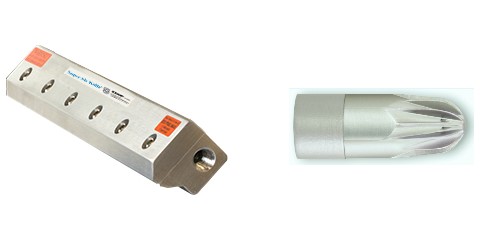
For example, let’s say we are going to add a blow off station to clean off a part on a conveyor to improve the process and increase the throughput.  A typical set-up might be a 12″ Super Air Knife (model 110012) blowing off the top and a pair of Super Air Nozzles (model 1100) to blow off the sides.

SAK and ASAN
12″ Super Air Knife and Super Air Nozzle

If we look at the performance data for the (2) different blow off devices, we find that the Super Air Knife is rated at 69 dBA and the nozzles at 74 dBA, when operated at 80 PSIG of compressed air supply.

SAK and ASAN

When asked, “what is the sound level for (1) of the knives, and (2) of the nozzles” a little Acoustic Engineering is in order. The decibel scale is logarithmic, and determining the total sound level when all (3) devices are in operation is not as easy as adding up the three sound level values (which would equal 218 dBA, way off the charts!).  Thankfully, both the actual sound level and the numerical value are determined another way.  I’ll spare you a lot of the math but the equation is as below.

Capture

… where SL1, SL2, SL3, … are the sound levels in dBA of the each sound makers, for as many that are being combined (in our example SL1 = 69, SL2 = 74 and SL3 = 74)

Plugging in the numbers into the equation, the combined sound level works out to be a quiet 77.65 dBA — well within the OSHA limit for exposure for a full 8 hour period.

To discuss your application and how an EXAIR Intelligent Compressed Air Product can make your process better and quieter, feel free to contact EXAIR and myself or one of our other Application Engineers can help you determine the best solution.

Brian Bergmann
Application Engineer

Send me an email
Find us on the Web 
Like us on Facebook
Twitter: @EXAIR_BB