Sound levels and ROI don’t immediately link together in a quick thought. Unless you are me and things seem to link up that don’t always go together, like peanut butter and a cheese burger. (Trust me, just try it, or if you are near West Lafayette, Indiana just go try the Purvis Burger across the street from Purdue University.) The truth behind tying sound levels being reduced and ROI together is actually pretty simple.
For this example, I am going to stay fairly high level as we could get into some pretty deep measurements of what exactly could be a cost savings. If we reduce the sound level being generated by point of use compressed air products that is easiest to do by implementing engineered blow off products as well as reducing the operating pressure. Let’s use this example: A 1/4″ copper tube that is being used as a blow off will give off a noise level of over 100 dBA from 3′ away. The table below shows that at an 80 psig inlet pressure the same tube will also consume 33 SCFM of compressed air.
By installing a model 1100 1/4″ FNPT Super Air Nozzle on the end of this copper tube, we reduce the noise level generated by the blow off to 74 dBA. This measurement is at the same 80 psig inlet pressure and from 3′ away, which is well below the OSHA standard for allowable noise level exposure. This also gives a broader more defined pattern to the air stream which may permit a reduction in compressed air pressure.
The other factor this changes is that the air consumption is reduced by 19 SCFM of compressed air which then results in energy savings. This ultimately ends in a simple ROI equation where we are simply using the compressed air reduction as the only variable for the return.
By reducing the air consumption of a process that operates 24/7, 250 days a year that equates to a savings of 6,840,000 SCFM per year and that equates to $1,710.00 USD. This does not account for any reduction in paying for hearing protection that may no longer be needed, or increase in production because the application functions better.
So you see, reducing noise levels in a facility can easily amount to a sizable cost savings in energy going towards compressed air consumption. If you would like to walk through any potential applications, please contact us.
Over the years, EXAIR has come across a variety of different types of blow-off devices. We have seen copper tubes, pipes with a crushed end, fittings with holes drilled into them, and modular flex lines. For compressed air use, these are very dangerous and very inefficient. In many instances, companies will go through a mixed bag of items to make a blow-off device for their application. It is inexpensive to do. But what they do not realized is that these items are very unsafe and will waste your compressed air, costing you much money in the long run.
When EXAIR started to manufacture compressed air products in 1983, we created a culture in making high quality products that are safe, effective, and efficient. Since we stand by our products, we created a program called the Efficiency Lab. We test blow-off devices against EXAIR products in noise levels, flow usage, and force measurements. With calibrated test equipment, we compare the data in a detailed report for the customer to review. If we are less effective, we will state that in the report, but this is very rare. With this quantified information, we can then determine the total amount of air savings and safety improvements that EXAIR products can offer.
With our Efficiency Lab, it is quite simple to do. For starters, you can go to our Product Efficiency Survey on our website to give the conditions for testing. If you wish for a side by side analysis, you can place your pneumatic device in a box and send it to EXAIR. We will run the tests at the specified conditions or in a range of settings. We will then return your pneumatic device back to you with a report of the comparison. This report can be used to show managers, executives, HSE, etc. on the improvements that EXAIR can provide in cost savings and safety.
In a recent Efficiency Lab, a customer sent us a water jet nozzle that he was using to blow off product passing on a conveyor (reference photo above). The customer supplied us with the required information to test. They had three water jet nozzles on a manifold that had ¼” NPT male connections. The air pressure was set at 75 PSIG (5.2 bar), and the air pattern was round. Their annual usage for this blow-off device was 7000 hours continuous, and their electric rate for their facility was $0.10/KWh. The reason that they sent their nozzle to EXAIR was because the operation was very loud, and they believed that they were wasting compressed air. They asked me for a recommendation and what the payback period might be with my selection.
Model 1101
I recommended the model 1101 Super Air Nozzle as our standard round pattern with a ¼” NPT male connection. With our engineered design, the Super Air Nozzle can entrain the “free” ambient air into the air stream to generate a hard-hitting force; using less compressed air. Also, with this suggestion, they will not have to redesign their blow-off station; just remove the water jet nozzles and replace them with the Super Air Nozzles. We tested the water jet nozzle, and we found that it used 17.5 SCFM (496 SLPM) at 75 PSIG (5.2 bar). The noise level was measured at 91.2 dBA for a single nozzle. As a comparison, the model 1101 Super Air Nozzle will only use 13.3 SCFM (376 SLPM) of compressed air at 75 PSIG (5.2 bar); and, the noise level was reduced to 73 dBA for each nozzle.
The first thing that is important to me is safety. High noise levels will cause hearing damage. OSHA generated a standard 29CFR-1910.95a with a chart for Maximum Allowable Noise Exposure. To calculate the noise level for three nozzles, I will reference a previous blog that I wrote: “Measuring and Adding Sounds”. With three water jet nozzles, the total sound is 96 dBA. From the OSHA table above, the usage without hearing protection is less than 4 hours a day. With the Super Air Nozzles, the noise level will be 78 dBA for all three nozzles; well below the requirement for 8 hours of exposure. It is difficult to put a monetary value on safety, but using PPE should never be the first step as a solution.
For the annual savings and the payback period, I will only look at the electrical cost. (Since the Super Air Nozzle is using less compressed air, the maintenance and wear on your air compressor is reduced as well).
The air savings is calculated from the comparison; 17.5 SCFM – 13.3 SCFM = 4.2 SCFM per nozzle. With three nozzles, the total compressed air savings will be 12.6 SCFM for the blow-off station. An air compressor can produce 5.36 SCFM/KW of electricity at a cost of $0.10/KWh. For an annual savings, we have the figures from the information above; 7000 hours/year * 12.6 SCFM * $0.10/KWh * 1KW/5.36 SCFM = $1,645.52/year. For the payback period, the model 1101 Super Air Nozzle has a catalog price of $44.00 each, or $132.00 for three. The customer above did not disclose the cost of the water jet nozzles, but even at a zero value, the payback period will be just under 1 month. Wow!
Not all blow off devices are the same. With the customer above, they were able to reduce their noise levels and compressed air consumption. If your company decides to select an unconventional way to blow off parts without contacting EXAIR, there can be many hidden pitfalls; especially with safety. Besides, if you can save your company thousands of dollars per year as well, why go with a non-standard nozzle? If you have a blow off application and would like to compare it against an EXAIR product, you can discuss the details with an Application Engineer. What do you have to lose?
EXAIR offers the model 9104 Digital Sound Level Meter. It is an easy to use instrument for measuring and monitoring the sound level pressures in and around equipment and other manufacturing processes.
Sound meters convert the movement of a thin membrane due to the pressure waves of sound into an electric signal that is processed and turned into a readable output, typically in dBA. The dBA scale is the weighted scale that most closely matches the human ear in terms of the sounds and frequencies that can be detected.
Noise induced hearing loss can be a significant problem for many workers in manufacturing and mining. To protect workers in the workplace from suffering hearing loss OSHA has set limits to the time of exposure based on the sound level. The information in the OSHA Standard 29 CFR – 1910.95(a) is summarized below.
The EXAIR Digital Sound Level Meter is an accurate and responsive instrument that measures the decibel level of the sound and displays the result on the large optionally back-lit LCD display. There is an “F/S” option to provide measurement in either ‘slow’ or ‘fast’ modes for stable or quickly varying noises. The ‘Max Hold’ function will capture and hold the maximum sound level, and update if a louder sound occurs.
If you have questions about the Digital Sound Level Meter, or would like to talk about any of the quiet EXAIR Intelligent Compressed Air® Products, feel free to contact EXAIR and myself or one of our Application Engineers can help you determine the best solution.
Mufflers come in many shapes and sizes. Each with their own benefits.
If you have ever walked into a manufacturing facility and heard the hiss or even worse the banshee scream of compressed air being exhausted to ambient, whether it be from a cylinder discharge, a timed drain going off, or a bypass valve being activated, they all could be hushed with a muffler. A muffler for compressed air comes in several shapes and sizes. EXAIR offers four separate types from stock to help attenuate the noise disruption within your facility.
The OSHA standard for allowable noise exposure is 29 CFR-1910.95(a) and outlines the number of hours per day any individual can be exposed to a particular noise level. These noise levels are expressed in decibels (dbA).
Hearing loss is the best known, but not the only, ill effect of harmful noise exposure. It can also cause physical and psychological stress, impair concentration, and contribute to workplace accidents or injuries.
Reclassifying Mufflers attenuating the exhaust of a pneumatic cylinder.
The first type I would like to showcase are the Reclassifying Mufflers. These are ideal for cylinder exhausts or valves which commonly contain an oil mist within the air stream which can easily contaminate the surrounding area. The patented design of the removable element separates oil from the exhausted air so virtually no atomized oil is released into the environment. They also attenuate the exhaust noise level up to 35 decibels. The filter element helps the exhaust to meet the OSHA Standard 29 CFR 1910.1000, a worker’s cumulative exposure to oil mist must not exceed 5 mg/m³ by volume in any eight hour shift of a forty hour work week.
The chart below helps to properly size the Reclassifying Muffler for a pneumatic cylinder. One key to proper installation of these mufflers is they must be installed vertically in order to properly trap and drain the oil.
Reclassifying Muffler Quick Pick Chart
Sintered Bronze mufflers are excellent choices for tight installation locations and are easily sized.
The next type of muffler to discuss are the Sintered Bronze Mufflers that are offered in ten different sizes. These are an excellent low cost solution which easily install into new or existing ports. Each size is designed to provide minimal back pressure and restriction for the individual port size. The quick pick chart below helps to easily select the correct size for attenuating the exhaust of a pneumatic cylinder. One key difference between these and the Reclassifying Mufflers is, these do not have to be oriented vertically as they do not collect the oil out of the exhaust air.
The model 3913 – 3/4″ NPT Straight Through Muffler
If the process air needs to be directed or plumbed away from the operator then the Straight Through Mufflers are the ideal selection as they offer an NPT threaded inlet and exhaust. They are available in three standard NPT sizes from stock. These mufflers can be installed in any orientation and work well with our Vortex Tubes to help pass the cold air through while lowering the operating sound level of the tube. The average noise reduction of the Straight-Through Mufflers is 20 dB. This can easily reduce the noise level of an operation to below the OSHA standard requiring hearing protection for operators in the area.
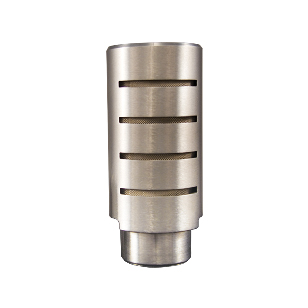
The model 3903 Heavy Duty Muffler
The final option for mufflers from EXAIR are the Heavy Duty Mufflers. These are available in two sizes from stock and are constructed of corrosion-resistant aluminum with a stainless steel internal screen. These can be installed in any orientation and are ideal for protecting exhaust ports from contaminants that may clog or damage the device they are attached to. The typical noise reduction from installation is 14 dB with these mufflers.
These are available in two sizes from stock and are constructed of corrosion-resistant aluminum with a stainless steel internal screen. These can be installed in any orientation and are ideal for protecting exhaust ports from contaminants that may clog or damage the device they are attached to. The typical noise reduction from installation is 14 dB with these mufflers.
To summarize, EXAIR offers a multitude of options when it comes to lowering sound levels in operation areas that are caused by exhausted compressed air. Each of the mufflers discussed above are shipped same day from stock to meet your immediate need. If you are unsure of which muffler to use for your application, feel free to contact an Application Engineer.