
How To Propose A Cost Saving Strategy To Management

Chances are if you have been on your job for a little while, you have noticed some processes or equipment that takes excessive time, wastes energy, etc.. and delivers less than optimal results.  So, just how do you communicate those observations to management in your organization?  You certainly do not want to embarrass yourself by having your idea torpedoed, nor let the company continue wasting money on inefficient processes or equipment.  The question becomes, how do you present your cost savings plan to the management team?  This blog will help you with that very question!

Your idea(s) for cost savings should be presented clearly and concisely with some key information highlighting the cost and the savings.  The simplest way to accomplish this is to quantify the savings for a given period of time and the payback schedule.  The payback schedule is generally calculated by dividing the cost of the project by the forecast savings.  Generally speaking, the shorter the time required for payback, the better the odds of your project being approved.

To start the process generate a (1) page overview that states the problem, cost of your proposal and the forecast savings.  A thorough and concise presentation will help sway any naysayers in the group, and you should include detailed information that includes current operating costs and how you arrived at those figures.

In the compressed air industry, EXAIR Intelligent Compressed Air products provide some easy installations and quick payback times without sacrificing production or quality – in many cases, we can improve production and quality.  Let’s consider the case below, where open tubes were being used to blow off punch presses.  We started by capping off (4) of the open tubes and trying one EXAIR 1100 Air Nozzle with a defined air pattern and we clearly needed more force.  That is when we attached the second super air nozzle, and voila! We had the amount of force and the air pattern required for this application, all while greatly minimizing air consumption and noise!  The image below shows what a sample air savings presentation sheet or test sheet may look like. 
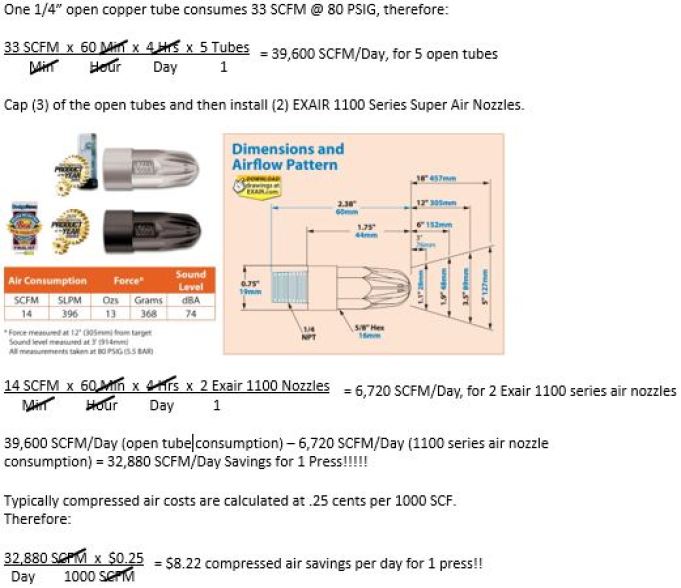
Open Tube Cost Comparison

Considering the EXAIR 1100 Super Air Nozzle are $39 each, you can calculate that the payback time is slightly less than 10 working days per press, since two nozzles were used for each press.

When considering larger and more in-depth projects, naturally more documentation and information will be required.  In addition to the requirements for the above example, just be sure to include the following points:

  • List the action items for your proposal and any purchases that may be necessary.
  • Outline your proposed savings and document how you arrived at that number.
  • Discuss anything that may cause delays or not go as planned, and if possible, suggest viable workarounds.
  • Create a milestone schedule for all the major points in your plan.
  • Create illustrations.

If you would like to discuss increasing the efficiency of your compressed air usage, quieter compressed air products, and/or any EXAIR product,  I would enjoy hearing from you. Give me a call.

Steve Harrison
Application Engineer
Send me an email
Find us on the Web 
Follow me on Twitter
Like us on Facebook


Super Air Nozzles; Rebates, Environmental Protection, and Energy Savings.

Family of Nozzles

Recently, I wrote a blog, “Flat Super Air Nozzles: Build Your Own System Overview”.  It described how the Flat Super Air Nozzles could be used singly or joined together with accessories for flexibility in your application.  In addition, it demonstrated the amount of compressed air savings and reduction in energy consumption to save you money.  Tyler Daniel, a colleague, wrote a similar blog on “ROI – Is it Worth the Investment?”  He explains the quick payback or ROI (Return on Investment) by using EXAIR Super Air Knives.  In both posts, the word “Super” is intertwined with the product name.  To expand a bit further, the word, “Super” is more than just a word.  It is about cost savings, efficiency, and energy conservation.   In this post, I will dive a bit more into the reasons why EXAIR uses the word, “Super”, and how it can help you.

When EXAIR started to manufacture compressed air products, we created a culture in making high quality products that are safe, effective, and efficient.  Being leaders in this industry, we created a program, the Efficiency Lab, to compare blow-off devices with EXAIR products in noise levels, flow requirements, and force measurements.  With calibrated test equipment, we compare the data in a qualified report to share with our customers.  This information can be helpful to determine the total amount of air savings and safety improvements that EXAIR products can offer.

With the total amount of energy savings that the EXAIR products can provide, EXAIR was able to partner with Energy Star and the Environmental Protection Agency.  This commitment by EXAIR for reducing energy to protect the environment for future generations is a cornerstone for our business model.  Compressors use electricity to produce compressed air.  In most industries, they consider compressed air as a fourth utility.  If you have pneumatics in your facility wouldn’t it be best to use it, and the electricity it requires, as efficiently as you can?

In conjunction with the Efficiency Lab, we created a Cost Savings Calculator.  It is a quick way to view payback periods and annual savings when using EXAIR products.  As an example, I used a 1” Flat Super Air Nozzle, model 1126, and compared it to a 1/8” open pipe.  (The reason behind the comparison is that the model 1126 can screw onto the end of the 1/8” NPT pipe.)  With an operation of 24 hours/day for 250 days a year, the amount of air used by an 1/8” open pipe is near 70 SCFM (1,981 SLPM) at 80 PSIG (5.5 Bar).  The model 1126 has an air consumption of 10.5 SCFM (297 SLPM) at 80 PSIG (5.5 Bar).  By putting the information in the Cost Savings Calculator, it determined that the ROI was in 2.1 days.  The annual savings was $5,355 per year.  Imagine if you replaced ten blow-off spots in your facility, the amount of money that could be saved.  Here is the worksheet below:

Why did I bring this up?  Besides showing the “hidden” extra cost that is wasted when using sub-standard blow-off devices, it also shows the amount of compressed air that was saved.  By using the model 1126, we were able to save 21,420,000 cubic feet of air per year (596,043 cubic meters of air per year).  With this amount of energy savings, people take notice.

The people that did take notice were the utility companies that make electricity.  Depending on your location, electrical suppliers initiated a rebate program to use engineered nozzles in your facility.  Similar to other energy saving rebates, like LED lightbulbs and high efficiency furnaces, the electrical providers notice a big savings when using EXAIR products.  If you qualify, the total cost to purchase and implement the EXAIR Super Air Nozzles are reduced.  (Even if a rebate program has not been implemented in your area, the idea of saving energy and compressed air makes it very profitable and environmentally sound in changing over to EXAIR products).  The website is DSIRE.  “DSIRE is the most comprehensive source of information on incentives and policies that support renewables and energy efficiency in the United States.”  Check it out to see if your area has instituted a rebate program.

When EXAIR uses the word “Super”, it is much more than just an adjective.  It shows the quality and precision that EXAIR uses in manufacturing our products, and the amount of cost and energy savings that can be generated.  Being backed by Energy Star, EPA, and rebate programs, EXAIR can help companies to upgrade their pneumatic systems.  Together, we can save energy, improve the environment, and reduce compressed air.  If you would like to discuss how EXAIR can work for you, you can contact an EXAIR Application Engineer to see if we can put the word, “Super”, into your compressed air program.

John Ball
Application Engineer
Email: johnball@exair.com
Twitter: @EXAIR_jb

Intelligent Compressed Air: How to Develop a Pressure Profile

An important part of operating and maintaining a compressed air system is taking accurate pressure measurements at various points in the compressed air distribution system, and establishing a baseline and monitoring with data logging.  A Pressure Profile is a useful tool to understand and analyze the compressed air system and how it is functioning.

Pressure Profile 1
Sample Pressure Profile

The profile is generated by taking pressure measurements at the various key locations in the system.  The graph begins with the compressor and its range of operating pressures, and continues through the system down to the regulated points of use, such as Air Knives or Safety Air Guns.  It is important to take the measurements simultaneously to get the most accurate data, and typically, the most valuable data is collected during peak usage periods.

By reviewing the Pressure Profile, the areas of greatest drop can be determined and the impact on any potential low pressure issues at the point of use.  As the above example shows, to get a reliable 75 PSIG supply pressure for a device or tool, 105-115 PSIG must be generated, (30-40 PSIG above the required point of use pressure.)  As a rule of thumb, for every 10 PSIG of compressed air generation increase the energy costs increase 5-7.5%

By developing a total understanding of the compressed air system, including the use of tools such as the Pressure Profile, steps to best maximize the performance while reducing costs can be performed.

If you have questions about getting the most from your compressed air system, or would like to talk about any EXAIR Intelligent Compressed Air® Product, feel free to contact EXAIR and myself or one of our Application Engineers can help you determine the best solution.

Brian Bergmann
Application Engineer

Send me an email
Find us on the Web 
Like us on Facebook
Twitter: @EXAIR_BB

ROI – Return on Investment

Return on Investment (ROI) is a measure of the gain (preferably) or loss generated relative to the amount of money that was invested.  ROI is typically expressed as a percentage and is generally used for personal financial decisions, examining the profitability of a company, or comparing different investments.  It can also be used to evaluate a project or process improvement to decide whether spending money on a project makes sense.  The formula is shown below-

ROI

  • A negative ROI says the project would result in an overall loss of money
  • An ROI at zero is neither a loss or gain scenario
  • A positive ROI is a beneficial result, and the larger the value the greater the gain

Gain from investment could include many factors, such as energy savings, reduced scrap savings, cost per part due to increased throughput savings, and many more.  It is important to analyze the full impact and to truly understand all of the savings that can be realized.

Cost of investment also could have many factors, including the capital cost, installation costs, downtime cost for installation, and others.  The same care should be taken to fully capture the cost of the investment.

Example – installing a Super Air Nozzles (14 SCFM compressed air consumption) in place of 1/4″ open pipe (33 SCFM of air consumption consumption) .  Using the Cost Savings Calculator on the EXAIR website, model 1100 nozzle will save $1,710 in energy costs. The model 1100 nozzle costs $37, assuming a $5 compression fitting and $50 in labor to install, the result is a Cost of Investment of $92.00. The ROI calculation for Year 1 is-

ROI2

ROI = 1,759% – a very large and positive value.  Payback time is only 13 working days.

Armed with the knowledge of a high ROI, it should be easier to get projects approved and funded.  Not proceeding with the project costs more than implementing it.

If you have questions regarding ROI and need help in determining the gain and cost from invest values for a project that includes an EXAIR Intelligent Compressed Air® Product, feel free to contact EXAIR and myself or one of our Application Engineers can help you determine the best solution.

Brian Bergmann
Application Engineer

Send me an email
Find us on the Web 
Like us on Facebook
Twitter: @EXAIR_BB