EXAIR Vortex Tubes are for a Variety of Spot Cooling Applications

Vortex tube
Cooling or Heating with the Vortex Tube

EXAIR Vortex Tubes are a low cost, reliable and maintenance free solution to a wide variety of industrial spot cooling problems.  They only requirement is a supply of compressed air as the power source.  Vortex Tubes have no moving parts and can produce temperatures that range from -50°F to +260°F (-46°C to +127°C).

Vortex Tubes produce two air streams one cold and one hot, the percentage of cold air flow from the inlet flow is referred to as the cold fraction.  The cold fraction is adjustable by the hot valve on the hot discharge side of the vortex tube.  Adjusting the hot valve results in both air temperature and air volume changes. The colder the air becomes, the volume of that cold air declines. So for very cold temperatures, a smaller volume of air is produced compared to a warmer air temperature.

For the vast majority of industrial cooling applications a larger volume of cool air will provide more efficient cooling than a lesser amount of very cold air.  Generally speaking the highest Btu/Hr values are in the 70-80% cold fraction range.

The exception to this would be in labs or special cases where the coldest temperatures are desired.  Adjusting a Vortex Tube is easy, simply insert a thermometer/thermocouple in the cold air exhaust and set the temperature by adjusting the valve on the hot end of the Vortex Tube.  You will know when you reach max refrigeration (80% cold fraction) as the cold air temperature will be 50°F (28°C) lower than the compressed air supply temperature.

EXAIR Vortex Tubes are constructed from stainless steel.  This ensures excellent wear resistance, corrosion resistance and assures years of reliable operation.  They are offered in 3 different size ranges (small, medium & large).  There are generators located inside the tube (user serviceable) that will change the volumetric flow.  The generators are available in a plastic construction or brass construction for high temperature applications.  The ranges 2 SCFM – 8 SCFM are designated as small Vortex Tubes, 10 SCFM – 40 SCFM are medium and 50 SCFM – 150 SCFM are large.  This feature allows you to customize or change your Vortex Tube for greater flexibility in a wide range of applications.

vortex_generator
Vortex generator

Large Vortex Tubes are specified when a high flow of cold air is needed. There are 16 models to choose from in total.  Capable of providing 3,400 BTU/HR up to 10,200 BTU/HR of cooling power.  These have been used to cool high heat loads that are centrally located or to help cool samples of gases for testing.

Medium Vortex Tubes are the most popular – there are twenty to choose from, depending on the cold air flow rate and temperature you’re looking for. These can produce temperatures as cold as -40°F (-40°C) when set to a 20% Cold Fraction (which is the percentage of total supply air that’s directed to the cold end) and cold air flows as high as 32 SCFM when set to an 80% Cold Fraction, which will produce a cold air temperature of about 20°F (-7°C). Some common uses are cooling ultrasonic welds and brazed joints.

The Medium Vortex Tubes are so popular, in fact, that they’re incorporated into our Adjustable Spot Cooler and Cold Gun Systems. They come ready-to-go with mufflers, cold air hose kits, and magnetic bases, so they couldn’t be easier to use.

Adjustable Spot Cooler

Cold Gun Lineup

Small Vortex Tubes are great when low flows (less cooling power) will succeed, or if compressed air supply is limited.  There are 12 models in total to choose from. These are specified for much smaller applications, like cooling the needle of a sewing machine, small drill bits, etc. You can also get one with a cold air hose & magnetic base…that’s the Mini Cooler System.

Mini Cooler

If you would like to discuss Vortex Tubes, Spot Cooling, efficiency of your compressed air usage, quieter compressed air products and/or any EXAIR product,  I would enjoy hearing from you…give us a call.

EXAIR team
Send us an email
Find us on the Web 
Follow us on Twitter
Like us on Facebook

Super Air Knife Cleans Baking Pans

A few weeks back I was contacted by a large baking company who was looking for a better way to pre-clean their cake and muffin pans before sending them to a wash cycle. After the pans exit the oven, an operator places the baked goods on a cooling conveyor then uses an air gun to blow out the residual crumbs. The pans are then placed on a separate conveyor and sent through a washer. The manual operation was taking a lot of extra time which resulted in reduced production.

Muffin Pan

After further discussion, I recommended they use our 24″ Super Air Knife. The Super Air Knife produces an even, high velocity curtain of air across the entire length of the knife which would provide a uniform blowoff of the pans, eliminating the manual cleaning.  Super Air Knives are extremely efficient and quiet. Operating at 80 PSIG, using a 40:1 amplification rate of entrained ambient air to compressed air consumed, they require only 2.9 SCFM per inch of knife length while maintaining a low sound level of only 69 dBA and produce a velocity of 11,800 feet per minute.

Efficient way to clean, dry or cool parts, webs or conveyors.

The Super Air Knives are available in lengths from 3″ up to 108″ in single-piece construction and offered in aluminum, 303ss or 316ss construction, they are the perfect choice for small scale or wide coverage blowoff applications. To discuss a particular application or for help selecting the best EXAIR product to fit your need, contact an application engineer at 800-903-9247.

Justin Nicholl
Application Engineer
justinnicholl@exair.com
@EXAIR_JN


Muffins Anyone? photo courtesy of Amy via creative commons license.

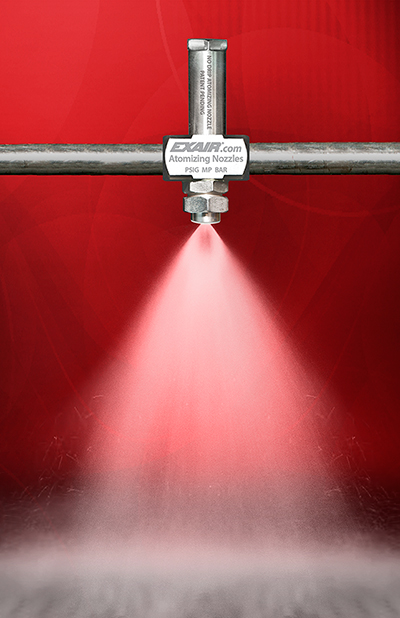
Product Overview: No Drip External Mix Atomizing Spray Nozzles

EXAIR’s Atomizing Nozzles are commonly used to clean, cool or coat parts as well as humidification or to control dust. They are constructed of 303ss, providing superior corrosion resistance and are able to withstand temperature up to 400°F (204°C).

The Atomizing Nozzles are separated into 3 categories – Internal Mix, External Mix and Siphon Fed.

For today’s topic, we will focus on the No Drip External Mix Atomizing Nozzles.

No Drip External Mix Atomizing Nozzles provide the highest flow rates

The External Mix Atomizing Spray Nozzles require a pressurized liquid source and compressed air source to produce a mist of atomized liquid. With the liquid and air being mixed external to the nozzle, they are able to handle higher viscosity fluids above 300 cP.

Our patented No Drip feature positively stops the liquid flow when the supply air pressure drops below 20 PSIG for 1/8″ NPT Nozzles or 30 PSIG for the 1/4″ or 1/2″ NPT. By incorporating this feature into the design, it eliminates the need for any additional valves or supply lines.

Available flow rates range from 2 GPH for our Model # EF9010SS 1/8″ No Drip External Mix Narrow Angle Flat Fan Pattern and up to 303 GPH for the Model # EF6010SS 1/2″ No Drip External Mix Narrow Angle Flat Fan Pattern.

When making a selection, there are 5 common considerations to take into account:

  1. How much liquid flow do I need?
  2. Is the liquid pressurized?
  3. What is the viscosity of the liquid?
  4. How wide of an area needs to be treated?
  5. What type of spray pattern fits the application?

If you have an application requiring a fine mist of atomized liquid or if you’d like to discuss another product or application, contact one of our application engineers for assistance.

Justin Nicholl
Application Engineer
justinnicholl@exair.com
@EXAIR_JN


Optimizing Your Current Compressed Air System Is Simple

A few weeks ago, we posted a blog discussing how artificial demand and leaks can lead to poor performance and expensive waste.  Today, I’d like to review how following a few simple steps can help optimize your current compressed air system and reduce compressed air usage.

The first step you want to consider is measuring the air usage in the system. To do this, you want to start at the compressor and check individual leads to each drop point to a blowoff device, record your findings to track the demand. By measuring your compressed air usage, you can locate the source of high usage areas and monitor the usage on each leg of the system. If the demand exceeds the supply, there is potential for problems to arise, such as lowered pressure and force from compressed air operated devices leading to irregular performance.

Digital Flowmeter with wireless capability

EXAIR’s Digital Flowmeters are designed to measure flow continuously and accurately to give you real-time flow measurements of your compressed air system to help identify problems areas.

Step 2 is to locate the source of waste. Again, compressed air leaks can result in a waste of up to 30% of a facility’s compressor output. A compressed air leak detection and repair program can save a facility this wasted air. Implementing such a program can be used as a way for a facility to “find” additional air compressor capacity for new projects. Whenever a leak occurs, it will generate an ultrasonic noise.

Model # 9061 Ultrasonic Leak Detector

Our Ultrasonic Leak Detector is designed to locate the source of ultrasonic sound emissions up to 20’ away. These ultrasonic sound emissions are converted to a range that can be heard by humans. The sound is 32 times lower in frequency than the sound being received, making the inaudible leaks, audible through the included headphones and the LED display gives a visual representation of the leak.

The 3rd step involves finding the source of noisy and wasteful blowoffs, like open pipes or homemade blowoffs, and replacing them with an energy efficient, engineered solution. By replacing these devices, you are not only reducing the amount of waste but also improving operator safety by complying with OSHA safety requirements.

Model # 9104 Digital Sound Level Meter

EXAIR’s Digital Sound Level Meter is an easy to use instrument that measures and monitors the sound level pressure in a wide variety of industrial environments. The source of loud noises can be quickly identified so that corrective measures can be taken to keep sound levels at or below OSHA maximum allowable exposure limits.

The easiest way to reduce compressed air usage and save on operating expense is to turn off the compressed air to a device when it isn’t needed, step 4 in the process. Not only will this save money, in many cases, it can also simplify a process for the operator.


Sizes from 1/4″ NPT up to 1-1/4″ NPT are available

A simple manual ball valve and a responsible operator can provide savings at every opportunity to shut down the air flow.


120VAC, 240VAC or 24VDC


For automated solutions, a solenoid valve can be operated from a machine’s control. For example, if the machine is off, or a conveyor has stopped – close the solenoid valve and save the air.


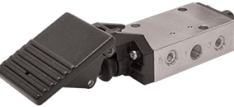
Model # 9040 Foot Valve

A foot pedal valve offers a hands free solution to activate an air operated device only when needed, such as being implemented in an operator’s work station.


EFC – Electronic Flow Control

For even more control, you can use a device like our EFC or Electronic Flow Control. This helps minimize compressed air usage by incorporating a programmable timing controlled (0.10 seconds to 120 hours) photoelectric sensor to turn off the compressed air supply when there are no parts present. It is suited for NEMA 4 environments and can be easily wired for 100-240VAC.


Step 5, intermediate storage. Some applications require an intermittent demand for a high volume of compressed air. By installing a receiver tank near the point of high demand, there is an additional supply of compressed air available for a short duration. This will help eliminate fluctuations in pressure and volume.

Model # 9500-60

EXAIR offers a 60 gallon, ASME approved vertical steel tank with mounting feet for easy installation near high demand processes.

Many pneumatic product manufacturers have a certain set of specifications regarding performance at stated input pressures. In many applications, or in the case of using a homemade blowoff device like open pipe, these wouldn’t necessarily require the full rated performance of the device or full line pressure. Controlling the air pressure at the point-of-use device will help to minimize air consumption and waste, step 6.

Pressure Regulators permit easy selection of the operating pressure

By simply installing a pressure regulator on the supply side, you can start off at a low pressure setting and increase the pressure until the desired result is achieved. Not only will this help to conserve energy by only using the amount of air required for the application, it also allows you to fine tune the performance of the point-of-use device to match the application requirements.

If you have any questions, please contact an application engineer at 800-903-9247.

Justin Nicholl
Application Engineer
justinnicholl@exair.com
@EXAIR_JN