Good Communication is Needed to Discover the Best Solution

I had a call the other day about a Cabinet Cooler System that was not working properly. In talking over the problem, the customer decided a picture might help me understand what he was trying to explain, so he sent one for to me to look at it. When opened, the picture did not show what I expected. Instead of the EXAIR Cabinet Cooler System, I was looking at an EXAIR Vortex Tube mounted to the top of a cabinet. Further discussion revealed that I was talking to the maintenance manager and he had no idea who had installed this and for what reason. He only knew it was reported that 2 cabinets were having issues – one was continuously leaking (the initial call and picture) and one was not as cool as it should be. Now there were two problems!

Starting with the initial, the vortex tube was actually working as it should. It is supposed to “leak” air. Vortex tubes will push cool air out on one side and hot air out the other. Per the picture, this vortex tube was installed to allow the hot air to exhaust from the cabinet, thus it would “leak” air. In this case, the cabinet was cool, but to what standard? No one knew what temperature was to be maintained. The maintenance manager, and for that matter the workers who reported the defect, did not know what the device was or how it worked. After describing how a vortex tube functioned, I directed him to look at the EXAIR website for more information and adjustment instructions if needed. The manager was surprised, and happy, that it was actually working as it “should be” so he could take it off his To-Do list.

PLEASE NOTE: A Vortex Tube is typically recommended for cooling a small area (spot cooling) or small volumes of gas. We do not usually recommend them for cooling electronic enclosures, EXAIR’s Cabinet Cooler systems are the best choice for an enclosure. Cabinet Coolers will provide quick and easy installation while maintaining the NEMA integrity of the cabinet. They are preset to provide maximum cooling and efficiency, and they are available with a thermostat and solenoid to turn themselves on and off as needed to maintain a specific internal temperature.

Now to the second unit. Again, it was determined to be a vortex tube, not a cabinet cooler system as originally thought. This unit was deemed to be working since it was not “leaking” but the cabinet was not cool. To my thinking, this unit was NOT working and explained why. I informed the customer that they may need to check their supply pressure and/or look to see if the unit had been adjusted to the point that the hot end airflow had been closed which would produce cold air. He replied he would look into it and then mentioned that he would have a word with the workers reporting the defects and investigate who and why the installations were done in the first place.

Throughout the conversation, one question kept coming up . . . were these the correct tools for the application? I was unable to answer this directly. I passed on that EXAIR would normally recommend actual cabinet cooler systems. These would provide more control for what they were apparently trying to do (cool the cabinets) and also keep them dirt and moisture-free. However, without more knowledge of what the customer was truly trying to accomplish and insufficient data available, I suggested the manager seek more information and call us back. He agreed. Although the vortex tubes in this application are usually not the choice, we know not all applications are the same. If the environment was extremely hot or space exceptionally tight, a vortex tube may be the best answer.

In my eyes, and to a degree the customer’s, the conversation was satisfactory but may not have provided the most effective and efficient solution. More data was needed, more understanding of the applications, and a better plan of action instead of putting a bandage on the problem. Based off how we left at hang-up, I believe the maintenance manager will be doing a little digging into what is going on in his plant and I foresee a call back to discuss his the best option to cool the cabinets.

John Pinchek
Application Engineer
johnpinchek@exair.com
@EXAIR_JP

Multiple Products Provide a Solution to Improve a Laminated Sign Making Process

A manufacturer that produces laminated signs contacted EXAIR for a blow off application. Being that we are experts in this area, I thought this would be a simple solution. The conversation started out about the signs that they manufacture. They are laminated sheets that have a thin aluminum film with a coating on the front and back sides. Their process was to cut stacks of these signs that he called books to specific dimensions. Here is how the conversation went in a shortened version:

Problem –

  1. I need to blow off chips from the saw process.
  2. It has to be strong enough to remove the chips that are melted into the face of the laminate.
  3. When the blade gets dull, the chips become hotter. The operator has to blow on the blade as it is cutting to reduce the amount of chips that melt into the laminated face.
  4. After the machine finishes and the books are removed, the table lifts up and disposes of the excess chips.

Solution –

  1.  Model 1122 2” Flat Super Air Nozzle to blow a wide area off the top of the signs after sawing.
Model 1122: 2
2″ Flat Super Air Nozzle

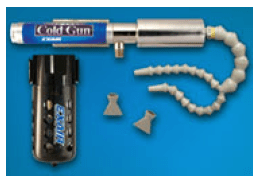
2.  Model 5330 High Power Cold Gun with dual point hose to place on the saw blade. This will extend the life of the blade and help keep the chips cool. Eliminating the melting into the face.

5330 High Power Cold Air Gun
High Power Cold Gun System

3.  Model: 110248 Super Air Knife Kit to blow the chips from the table after it is lifted.

Super Air Knife
Super Air Knife

As you can see, with a simple initial question, it became complicated rather quickly. Instead of looking at one area of the application, I was able to improve their entire process. In any manufacturing plant, scrap and downtime are the two biggest culprits in reducing profits. The scrap occurred when the faces were scratched and damaged. The downtime happened during the cleanup between book change-overs and when the saw blades were being replaced. Overall, their process improved in efficiency and speed.

Whenever you need to look at the overall process for improvement, EXAIR may have multiple solutions to offer. You can speak to an Application Engineer to see how EXAIR can increase your efficiency and reduce your scrap. You can either call 800-903-9247 or send an email to techhelp@exair.com.

John Ball
Application Engineer
Email: johnball@exair.com
Twitter: twitter.com/exair_jb

Big Or Small, We’ve Got ‘Em All! Vortex Tubes, That Is

A couple of weeks ago, I wrote about using large Vortex Tubes for freeze sealing/plugging of pipes. Even though they’re our LARGE Vortex Tubes, they’re still WAY smaller than the liquid nitrogen rigs that are also prevalent for this application. Smaller, in this case, means easier to handle and quicker to set up (and break down.)

So, that’s a case where a smaller device is used to do the same job. Today, I wanted to examine the different sizes of Vortex Tubes that we offer, when the job itself is what’s changing in size.

The Large Vortex Tubes are specified when a high flow of cold air is needed. Like the aforementioned freeze seals. Or this one, published in our catalog:

This is a typical application for a Large Vortex Tube.

Our Medium Vortex Tubes are the most popular – there are ten to choose from, depending on the cold air flow rate and temperature you’re looking for. These can produce temperatures as cold as -40°F (-40°C) when set to a 20% Cold Fraction (which is the percentage of total supply air that’s directed to the cold end) and cold air flows as high as 32 SCFM when set to an 80% Cold Fraction, which will produce a cold air temperature of about 20°F (-7°C). Some common uses are cooling ultrasonic welds and brazed joints.

The Medium Vortex Tubes are so popular, in fact, that they’re incorporated into our Adjustable Spot Cooler and Cold Gun Systems. They come ready-to-go with mufflers, cold air hose kits, and magnetic bases, so they couldn’t be easier to use.

The Small Vortex Tubes are great when very low flows are needed, or if compressed air supply is limited. These are specified for much smaller applications, like cooling the needle of a sewing machine, small drill bits, etc. You can also get one with a cold air hose & magnetic base…that’s the Mini Cooler System.

Another advantage that makes the Vortex Tubes a great choice for cold air production is their consistency and dependability. If you supply one with clean, dry air, it’ll operate just about indefinitely, maintenance free. And if you need a constant supply of air as a certain temperature, say, for testing a thermostat or temperature switch, a Vortex Tube is exactly what you’re looking for: the only things that’ll change the cold air temperature are the compressed air supply temperature & pressure…assuming you don’t change the Cold Fraction yourself, as shown here:

If you’ve got an application requiring cold air flow, give us a call. We’re eager to help!

Russ Bowman
Application Engineer
Find us on the Web
Follow me on Twitter
Like us on Facebook

Cold Gun Aircoolant System Improves Welding Operation

I received a call from a manufacturer that has a spiral welding operation. They create tubes and pipes from metal strips that are welded together in a continuous operation. The material is placed into the machine and twisted in a way to create a butt seam along the edge for welding. The edge has to be shaved to create a welding seam. Because of the speed of operation, the mechanical trimmer that prepares the edge was getting dull. The operation had to be stop for replacement. Understanding the costs associated with down time, they wanted to improve the length of time before replacement.

He called EXAIR to see if we can offer a solution. With this process, he could not use liquid coolant, as it would affect the welding operation. I suggested that we should use the Cold Gun Aircoolant System. It is designed to improve the life of tools by removing heat that causes premature failure. The Cold Gun produces a cold air stream at 50 deg. F (28 deg. C) below supply air temperature. I recommended the model 5230 High Power Cold Gun for his operation. Because it has the highest cooling capacity and force, it will keep the trimmer cool and clean. The down time was reduced by half, making the manufacturer happy that they called EXAIR.

Cold Gun Lineup

When liquid coolant cannot be used in an application or the tools are dulling quickly on a dry machining process, you can contact an Application Engineer at EXAIR to get the correct Cold Gun Aircoolant System.


John Ball
Application Engineer
Email: johnball@exair.com
Twitter: @EXAIR_jb