Efficient Compressed Air System Design with EasyCAS – Powered by Direktin

When it comes to designing an efficient compressed air system, we all know the details matter. From nozzle selection and pipe sizing to pressure drops and force calculation, it’s easy for small oversights to add up to big inefficiencies. That’s why I’m excited to share some news that will help make designing with EXAIR products easier than ever.

EXAIR has officially partnered with DirektIn, the company behind EasyCAS, a powerful design and simulation tool built specifically for industrial compressed air systems. What does that mean for you? It means that many of your favorite EXAIR products: Super Air Knives, Safety Air Guns, Air Nozzles, Air Amplifiers, and more, are now available directly in the software’s component library.

EasyCAS is a comprehensive tool designed to empower engineers, facilities, and suppliers to design, size, simulate, and validate the design and efficiency of a compressed air system with data-driven guidance. Not only can it help you create and maintain a compressed air system from scratch, but uses data and monitoring to pinpoint areas of inefficiency and highlight solutions or products to address the problems. 

EasyCAS offers a great deal of other advantages as well, including:

  • Simulating pressure drops
  • Highlighting helpful components
  • Prevent downtime by identifying problems
  • Calculating air savings and carbon credits
  • Validate performance of your current system

and much more!

You can define line routing, pressure settings, and consumption points, then drop in components like EXAIR Super Air Knives or Nozzles and see how they affect overall system performance in real time.

One of the things I love most about EasyCAS is how intuitive it is. You don’t need to be a CAD expert or software engineer to use it! Just drag, drop, and adjust. Want to compare how much air a homemade drilled pipe uses versus a properly sized Super Air Knife? You can do that. Curious about how much pressure drop you’ll see if multiple Air Nozzles are fed from a single line? EasyCAS has you covered. It’s a great way to visualize pressure loss, flow distribution, and performance impact before anything ever gets installed.

EXAIR is proud to be the only supplier of engineered point-of-use compressed air products currently integrated into the EasyCAS library. That means if you’re designing with EXAIR, you’re designing with confidence.

Visit direktin.com to learn more and for a limited time, you can use code “EXAIR2025to get 10% off a yearly subscription! EasyCAS could be the answer to revolutionizing your processes.

Tyler Daniel, CCASS

Application Engineer/Intl Trade

E-mail: TylerDaniel@EXAIR.com

X: @EXAIR_TD

Using EXAIR Products for “The Old One-Two Punch”

In boxing, there are five basic punches, and they’re commonly called out by numbers so that trainers can instruct boxers rapidly during the development of fundamentals. It’s also useful for them in real live bouts, where overly complicated plans can lead to defeat….former heavyweight champion Mike Tyson famously said, “everyone has a plan until they get punched in the mouth.” Those five basic punches are:

  • #1: The jab. Just like it sounds, this is a punch thrown directly forward with the lead hand. In many combinations, it’s the first punch thrown (that’s why it’s #1).
  • #2: The cross. This is a more powerful punch thrown with the back, or dominant, hand, and gets its power from the torque & rotation of the boxer’s body, when thrown correctly.
  • #3: The lead hook. This is an even more powerful punch than the cross. Its power comes not only from rotating the torso (like the cross) but also by pivoting on the lead foot to get the hip & shoulder involved. Because of the unbalanced and relatively unguarded position it leaves the boxer in, it’s riskier than a jab or cross, and oftentimes reserved for situations where the boxer sees an opportunity to score a knockout blow. If that plan doesn’t work, Mike Tyson’s famous quote above may very well come to fruition.
  • #4: The right uppercut. This is another devastating punch, thrown by the boxer’s dominant hand (assuming they’re right-handed) in an upward motion to contact the opponent’s head or body. If it connects to the chin or solar plexus, there’s a good chance the opponent will end up on the mat. It has to be thrown while the boxer is in close with the opponent, which gives the opponent the option to deal a devastating blow as well.
  • #5: The left uppercut. Same as above, but thrown with the boxer’s lead, or less dominant hand (again, assuming they’re right-handed.)

Because it generally leaves the boxer in a better defense position, the “one-two” combination is by far one of the most used moves in the ring. The term has even found its way into the popular vernacular, meaning two things that happen in rapid succession that lead to the desired outcome.

For the purposes of today’s blog (as the title suggests), I’m going to use it to describe an application where a customer uses two EXAIR products: a Model 1006SS Back Blow Air Nozzle, and a Model 6082 1″ Aluminum Line Vac in conjunction with each other.

This particular customer uses the Back Blow Air Nozzle to blow out the injector bore of an engine cylinder head assembly.

EXAIR manufactures three sizes of Back Blow Nozzles: our Model 1008SS Atto Back Blow Air Nozzle (left) is 0.2″ in diameter and can be used in 1/4″ to 1″ inside diameter holes, channels, etc. Model 11006SS 1/4 NPT Back Blow Air Nozzle (center) is good for 7/8″ to 4″ inside diameters, and Model 1008SS 1 NPT Back Blow Air Nozzle (right) is used for 2″ to 16″ inside diameters.

Thing is, they don’t want the debris flying all over the place. We considered a Chip Shield on the 1/4″ pipe extension that the Back Blow Air Nozzle was threaded onto, but since they insert it vertically from above, that could allow for debris to fall back down onto the assembly, and possibly right back into the injector bore, or one of the other openings on top. Instead, they opted for a Line Vac to vacuum the debris away as the Back Blow Air Nozzle blew it out of the hole.

While Line Vacs are primarily used to convey bulk material from one place to another (left), or to remove scrap trim (center), they’re also well suited for this application. Compressed air (1) enters the annular plenum (2) and is ejected at a high velocity through a ring of jets (3). This draws a vacuum on the inlet (4), creating a conveyance flow of air to carry whatever’s entrained in that flow through the outlet (5).

Engineered compressed air products have a multitude of advantages in applications like this. They’re durable & reliable. They have no moving parts to wear, or electrical components to burn out. They can operate continuously if needed, or they can be cycled on & off rapidly with no ill effects. If you’d like to find out how EXAIR Intelligent Compressed Air Products can help your operation, give me a call.

Russ Bowman, CCASS

Application Engineer
Visit us on the Web
Follow me on Twitter
Like us on Facebook

Just Needs A Little More To The Left

I’ve come across many applications where customers run multiple different parts or products along the same line, and each requires some form of blowoff before moving to the next stage. Too often, a system designed for just one specific part can’t keep up with the variations. Sometimes the “solution” ends up being to crank up the compressed air, which is wasteful and inefficient.

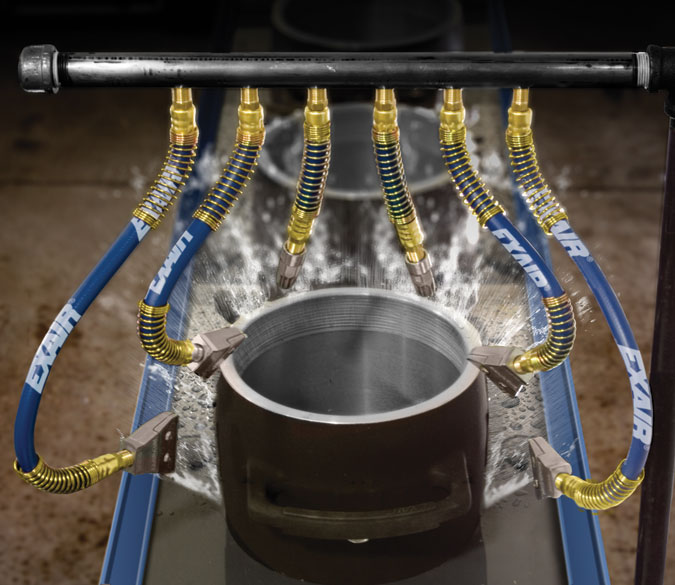
Instead of increasing air pressure or fabricating new mounts every time there’s a changeover, consider installing EXAIR’s Stay Set Hoses or Swivel Fittings.

            Stay Set Hoses are flexible and hold their shape once positioned, making them ideal for quickly adapting to different parts on the line. Available in 1/8″ and 1/4″ MNPT fittings (or a mix of both) and various lengths, these hoses can support anything from a Nano Super Air Nozzle to a Super Air Amplifier—or even a Super Air Knife. Repositioning them is easy: just bend the hose by hand to aim the airflow exactly where it’s needed for the new part.

                Swivel Fittings may be a better fit if your application doesn’t require much flexibility but still needs occasional fine-tuning. These allow up to 25 degrees of movement off axis, are made of durable 303 stainless steel, and help you easily refocus nozzles without a full tear down.

If your blowoff system isn’t keeping up with your line changes, it might be time to explore how Stay Set Hoses and Swivel Fittings can bring efficiency and adaptability to your process.       

Brian Farno, MBA – CCASS Application Engineer

BrianFarno@EXAIR.com
@EXAIR_BF

Save Money With Engineered Products, Then Save More Money With Rebates

One morning last summer, I turned on the water in the shower and waited for it to warm up. And waited…and waited. It was clear something was wrong, so I checked the water heater to find it emptying its contents into the floor drain, through the bottom of the tank, which I found later had rusted away. Between my better-than-average plumbing skills, having a son home from college, and finding out I could keep about $800 in my pocket if I bought a new one and replaced it myself, I woke the boy up (which turned out to be one of the more difficult tasks in the process), drove to my friendly neighborhood home improvement center, and bought myself a new water heater, and we had hot water by the time my wife got home from work that afternoon. Considering the way it started, it turned out to be a pretty good day. Not only was it more efficient (and therefore cheaper to run) than the one I replaced, the water heater I bought also qualified for a rebate, which increased my savings on the project to almost $900. That was some FANTASTIC icing on an already pretty decent cake.

Rewards like this for being energy conscious have been routinely offered by utility companies for years now. One time, I got a box of LED light bulbs, enough weather stripping for TWO houses the size of mine, and water-conserving shower heads, for free, from my electric company as part of a home energy audit. That was a pretty good day too.

Many utility companies across the country have similar programs for residential customers, and commercial ones too. Duke Energy (my free light bulb folks), for example, has a program they call Smart$aver that offers rebates and other incentives to companies for making energy-efficient improvements. Equipment that qualifies for these incentives includes process pumping systems, insulation for injection molding machinery & pellet dryer ducts, low friction v-belts for rotating machinery, and compressed air equipment.

That last one is what I wanted to write about today. It includes improvements to the supply side:

  • Receiver tanks
  • Cycling air dryers
  • Zero-loss condensate drains
  • Compressed air system audits

And the demand side:

EXAIR can help you out with the ones on the demand side. Consider:

Ultrasonic Leak Detector: this handheld device allows you to quickly & easily find leaks in your compressed air system.

EXAIR Model 9207 Ultrasonic Leak Detector filters out audible sound waves and focuses on the ultrasonic sound generated when compressed air finds its way out of a loose fitting, crack, etc. The parabolic disc (left) lets you find the area of the leak(s) and the tube extension (right) directs you to the precise location.
The copper tube used to have a crimped end that was aimed at the part in the chuck. They simply cut it off and used a compression fitting to install the Super Air Nozzle.

Super Air Nozzles: not only will these products get you a rebate, they’ll cost less to operate and will ensure OSHA compliance with regard to your use of compressed air. And they’ll do it quieter, to boot.

Replacing open-ended blow offs with Super Air Nozzles is oftentimes quick and easy. Compression fittings can be used to install them directly onto the ends of existing copper tubing. Stay Set Hoses can replace modular hose, which is great for machine tool coolant delivery but often misapplied for air blowing.

And frankly, I think the engineered products just look better too.

The Duke Energy Smart$aver program is for their customers in North Carolina, South Carolina, Indiana, Ohio, and Kentucky. If that’s not you, though, North Carolina State University’s NC Clean Energy Technology Center has a comprehensive Database of State Incentives for Renewables & Efficiency – DSIRE – that’ll help you find what’s available in your area.

Compressed air isn’t free. Heck, it isn’t even cheap. If you want to find out how much you can save by optimizing your compressed air system in Six Steps, give me a call. And if you want to sweeten the deal with rebates and incentives, contact your local utility company.

Russ Bowman, CCASS

Application Engineer
Visit us on the Web
Follow me on Twitter
Like us on Facebook