“Advice Is Temporary; Knowledge Is Forever”

I stumbled across this recently, and it’s become one of my new favorite adages. In the context of the writing I found this in, it was meant to call out the difference between telling someone WHAT to do (e.g., giving advice) and telling them HOW or WHY to do it (e.g., imparting knowledge, or possibly, wisdom.) It made me think about how I can do my job as an Application Engineer better.

For example, this time of year, we get a lot of inquiries from folks who need to protect their sensitive electric/electronic devices from heat – both from inside and outside the enclosure. With just a few key pieces of data, we can accurately specify the proper Cabinet Cooler System for their needs. Sometimes, the caller doesn’t understand why we need to know the temperatures inside & outside the enclosure, but a simple explanation – the difference in those two temperatures is directly proportional to the heat being generated inside the enclosure – serves to gain their understanding, and their trust.

It’s also been said that a picture is worth a thousand words. We’re no strangers to this concept either. It’s not uncommon for us to ask for a photo of an application, or to email a photo (or series of photos) to, for instance, show how a Cold Muffler is installed on a Medium Vortex Tube:

Med VT-muffler1 Med VT-muffler2 Med VT-muffler3

.

.

.

.

.

If a picture is worth a thousand words, how many pictures is a video worth?  Regular readers of our blogs are treated, once a month or so, to a Video Blog that highlights a particular product, product line, “how-to,” etc.  You can search for a specific one at blogs.exair.com, or here is a list of links for your convenience:

Proper Supply Plumbing for Compressed Air Products
EXAIR Vac-u-Gun
Digital Flow Meter Software Installation
How To Change a Shim in a Super Air Knife
Silencing Mufflers
How To Rebuild an EXAIR Safety Air Gun
How To Replace an EXAIR Filter Element
Flow Meter Data Logger Installation
EXAIR Vortex Tubes, Some History, Some Products
Digital Flowmeter Installation
How To Reset the Thermostat in a Cabinet Cooler System
Introducing the EXAIR Mobile Website
Line Vac Abrasion Resistance
How to Convert a Super Air Knife to Add Static Elimination
Ultrasonic Leak Detector Explained
Taking Care of Your Ion Air Gun
How to Assemble Mounting Brackets to EXAIR Filters & Regulators
Ionizing Bar Maintenance
Air Knife Plumbing Kits
Electronic Flow Control Time Delay Operation
Receiver Tanks: When to Use One, and How to Set One Up
Care and Feeding Of Your Vortex Tube
How To Use an EXAIR Static Meter
How To Rebuild Your Reversible Drum Vac
Universal Air Knife Mounting System
Vortex Tube Demonstration

Like I said, we’re making a new video every month, and we’re always on the lookout for ideas. If you have any questions about an application or a product, whether it’s “what” “how” or “why,” we’ll be happy to help in any way that we can. Who knows…your question could lead to next month’s video!

Russ Bowman
Application Engineer
EXAIR Corporation
(513)671-3322 local
(800)923-9247 toll free
(513)671-3363 fax
Web: www.exair.com
Blog: http://blog.exair.com/
Twitter: twitter.com/exair_rb
Facebook: http://www.facebook.com/exair

Super Air Knife Eliminates Alumina Dust Carryover on Conveyor

EXAIR Super Air Knives are quite often used on belt-style conveyors to blow off and clean the conveyor of any residual product that may try to stick to the belt and fall off at points along the travel where the product can pile up and create a real mess.

Our most recent version of this application was for a conveyor moving alumina dust in a foundry. Our Australian distributor, Compressed Air Australia, worked with the end user to apply this solution.

Mounting an Aluminum Super Air Knife across the width of the conveyor on the underside, just down-stream of the head pulley, the customer was able to completely eliminate the dust accumulation under the belt.

Before Super Air Knife Installation:                          After Super Air Knife Installation:

Alumina dust 1Alumina dust 2

The Super Air Knife with Plumbing Kit, installed below the conveyor belt:

Alumina dust 3

By installing the Super Air Knife, the customer was able to keep production running on the conveyor. Before, they had to stop periodically so the operators could clean up the dust. Dealing with the dust is a safety hazard for the operators for a variety of reasons including inhalation and personal safety risk working around moving parts. The solution allowed production to remain up and moving for longer periods. It also allowed workers to be safer in the environment and also concentrate their manpower and time on other activities as they no longer had to worry about cleaning up this material.

The compact nature of the Super Air Knife with the Plumbing Kit allowed the customer to tuck the unit right up where it was needed most. Notice how the Super Air Knife is blowing almost parallel to the belt. This is key in any Air Knife installation to allow for the longest contact time possible between the airflow and the target. This counter-flow arrangement is how the best performance is achieved with the Super Air Knife.

Neal Raker, Application Engineer
nealraker@exair.com

Positive Crankcase Ventilation

This week I am going to share with you a recent application I did for a customer with a stationary gas compressor. Transporting natural gas through pipe lines across the nation requires substations along route to overcome pressure loss. Some of the gas is used to power up engines that turn large compressors to push the gas further down the line.

With all combustion engines some of the combustion gasses along with carbon soot gets past the piston rings and into the crankcase. Common practice is to vent this back into the intake manifold using the vacuum in the manifold to draw it in.

In this case, the customer wanted to filter the “blow by” before returning it into engine. The pressure drop across the filter impeded the flow too much to be effective.

100_3555 (2)

They installed an EXAIR Line Vac  model HT6063 High Temperature line Vac to generate a vacuum to pull the gasses through the filter. Problem solved. It was a simple solution to a major problem.

Do you have an overwhelming problem? Give one of our application engineers a call and the will do their best to find you a simple solution.

Joe Panfalone
Application Engineer
Phone (513) 671-3322
Fax (513) 671-3363
Web: http://www.exair.com
Twitter: http://www.twitter.com/exair_jp
Facebook: http://www.facebook.com/exair

Spills & The Not So Easy Way To Clean Them Up

Before I worked for EXAIR, I worked for a CNC manufacturer/ distributor here in Cincinnati.  We would constantly have machines in our showroom filled with cutting fluid and running demonstrations, training or test cuts for our customers.  The bad part was that these never happened in the same week, sometimes not even in the same month.  So to keep the machines clean we would have to empty the coolant after we were done.   The way we would always do this was with the EXAIR Reversible Drum Vac.

RDVFamily_300px

Our unit was not exactly treated with the utmost respect.  It would get thrown on a shelf or in a drawer of a tool box for weeks on end, taken to shows, on customer visits, and even left on a drum full of coolant.  The best part is that it always worked.  The unit we had, was over ten years old when I worked there and I had been with them for 5 years, it had never needed any service.   No matter what we did, the unit always pulled through and took up less room than a regular electric vacuum.

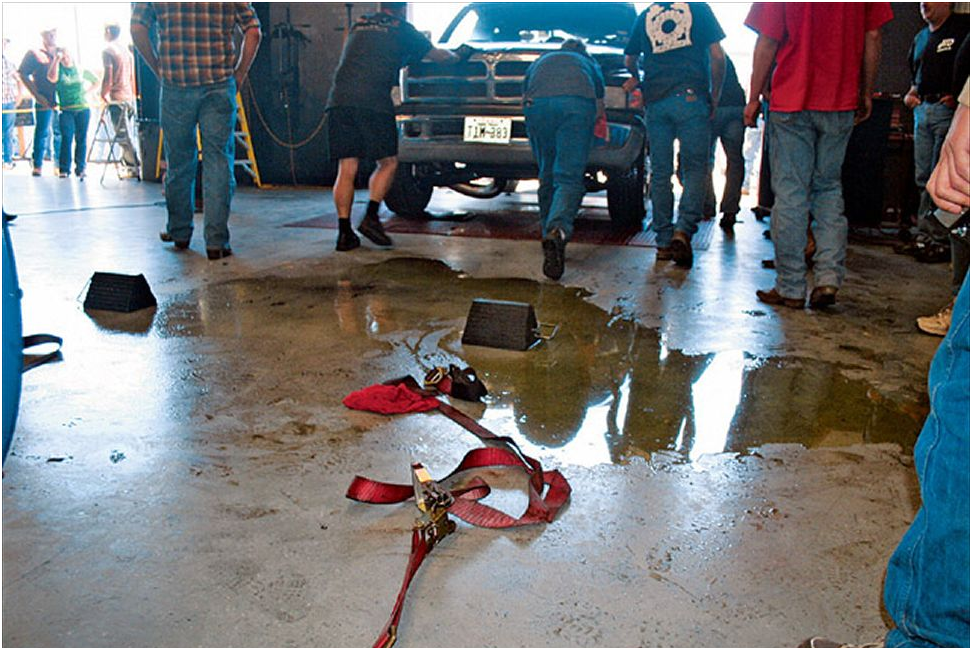
The event that sparked this chain of thoughts was a small (1 entire quart) spill of fork oil in my garage earlier this week.  As I was working on my race bike I accidentally knocked over a freshly opened quart of fork oil and didn’t notice until it was all drained right underneath of my motorcycle.   Unfortunately, I don’t have a Reversible drum Vac at home to quickly suck up the spill before it sets into the concrete so I started cleaning it with paper towels and kitty litter.   Now I have this giant pile of dusty oil soaked stuff in the middle of the garage that has been sitting for 3 days to make sure it is all absorbed.   If I had even had a Mini Reversible Drum Vac I would have been able to utilize my air compressor and suck up the spill, instead I now have an entire trash bag of mess to clean up and dispose of.

spill

This happens more often than one would think in car garages, and performance shops.   Rather than running for the kitty litter, give the EXAIR Reversible Drum Vac a test and find out how much easier it is to suck up that coolant or oil spill straight into a 5, 30, 55 or 110 gallon drum.

Brian Farno
Application Engineer
BrianFarno@EXAIR.com
@EXAIR_BF