
This is a brief video showing the effects of adjusting the needle valve on an EXAIR Atomizing Spray Nozzle.
Brian Farno
Application Engineer Manager
BrianFarno@EXAIR.com
@EXAIR_BF
This is a brief video showing the effects of adjusting the needle valve on an EXAIR Atomizing Spray Nozzle.
Brian Farno
Application Engineer Manager
BrianFarno@EXAIR.com
@EXAIR_BF
About a month ago I was in the field with one of our distributors in India visiting one of their customers. We were there to make an audit of their applications which were suspected of being high volume compressed air users within the plant. The very first application we were taken to was the point where large, steel castings begin their journey through the plant. It is at this point that the castings must be cleaned of all chips and residue prior to being run through a large parts washer.
The application involves multiple personnel blowing onto large, steel castings to remove machining chips, oil and other debris to prepare them for washing. The existing air gun might have been in good condition at some point, but during our visit, we found the air gun’s trigger was secured in an open position with zip ties so it was “on” all the time. Also, there was no nozzle at the tip of the gun. It appeared to have been cut off with a grinding wheel. The fact that there was no engineered nozzle at the end made the unit quite un-safe, loud and a large consumer of compressed air. The fact that the handle was clamped in the open position also negated the effectiveness of being able to use the air only when needed. Finally, when these operators would blow into blind holes debris would exit with significant velocity, so that represented a danger to the personnel that we could also remedy with our recommendation.

After initial review of what was happening in the application and seeing first-hand what the issues were, we recommended EXAIR Model 1410SS-CS (Precision Safety Air Gun with Chip Shield).

Following is our estimate of compressed air usage for the existing air guns and calculated air savings with projected cost savings figured for 4 people operating constantly over three daily shifts. Estimated current air use per each gun = 33 SCFM. Air consumption of model 1410SS-CS = 8.3 SCFM. Net air reduction = 33 – 8.3 = 24.7 SCFM. 75% air savings. Rough estimate for per shift air savings = 47,424 Standard Cubic Feet. At $ .25 USD / 1000 SCF, the “per shift” savings could be $11.86 USD. Total daily savings = $35.57 USD.
As many who follow compressed air savings know, compressed air is one of, if not the most expensive utility in just about any manufacturing operation. And this case demonstrates just how expensive four innocuous air guns blowing in a single application can really be and how it adds to the bottom line costs that every manufacturing decision-maker is usually concerned about.
Point being, if you want to add to your bottom line, give consideration to your air blowing applications. There is usually big savings to be had which can improve the application, help the bottom line, increase safety and conserve on that ever precious resource, energy.
Neal Raker, International Sales Manager
nealraker@exair.com
@EXAIR_NR
I had a call the other day about a Cabinet Cooler System that was not working properly. In talking over the problem, the customer decided a picture might help me understand what he was trying to explain, so he sent one for to me to look at it. When opened, the picture did not show what I expected. Instead of the EXAIR Cabinet Cooler System, I was looking at an EXAIR Vortex Tube mounted to the top of a cabinet. Further discussion revealed that I was talking to the maintenance manager and he had no idea who had installed this and for what reason. He only knew it was reported that 2 cabinets were having issues – one was continuously leaking (the initial call and picture) and one was not as cool as it should be. Now there were two problems!
Starting with the initial, the vortex tube was actually working as it should. It is supposed to “leak” air. Vortex tubes will push cool air out on one side and hot air out the other. Per the picture, this vortex tube was installed to allow the hot air to exhaust from the cabinet, thus it would “leak” air. In this case, the cabinet was cool, but to what standard? No one knew what temperature was to be maintained. The maintenance manager, and for that matter the workers who reported the defect, did not know what the device was or how it worked. After describing how a vortex tube functioned, I directed him to look at the EXAIR website for more information and adjustment instructions if needed. The manager was surprised, and happy, that it was actually working as it “should be” so he could take it off his To-Do list.
PLEASE NOTE: A Vortex Tube is typically recommended for cooling a small area (spot cooling) or small volumes of gas. We do not usually recommend them for cooling electronic enclosures, EXAIR’s Cabinet Cooler systems are the best choice for an enclosure. Cabinet Coolers will provide quick and easy installation while maintaining the NEMA integrity of the cabinet. They are preset to provide maximum cooling and efficiency, and they are available with a thermostat and solenoid to turn themselves on and off as needed to maintain a specific internal temperature.
Now to the second unit. Again, it was determined to be a vortex tube, not a cabinet cooler system as originally thought. This unit was deemed to be working since it was not “leaking” but the cabinet was not cool. To my thinking, this unit was NOT working and explained why. I informed the customer that they may need to check their supply pressure and/or look to see if the unit had been adjusted to the point that the hot end airflow had been closed which would produce cold air. He replied he would look into it and then mentioned that he would have a word with the workers reporting the defects and investigate who and why the installations were done in the first place.
Throughout the conversation, one question kept coming up . . . were these the correct tools for the application? I was unable to answer this directly. I passed on that EXAIR would normally recommend actual cabinet cooler systems. These would provide more control for what they were apparently trying to do (cool the cabinets) and also keep them dirt and moisture-free. However, without more knowledge of what the customer was truly trying to accomplish and insufficient data available, I suggested the manager seek more information and call us back. He agreed. Although the vortex tubes in this application are usually not the choice, we know not all applications are the same. If the environment was extremely hot or space exceptionally tight, a vortex tube may be the best answer.
In my eyes, and to a degree the customer’s, the conversation was satisfactory but may not have provided the most effective and efficient solution. More data was needed, more understanding of the applications, and a better plan of action instead of putting a bandage on the problem. Based off how we left at hang-up, I believe the maintenance manager will be doing a little digging into what is going on in his plant and I foresee a call back to discuss his the best option to cool the cabinets.
John Pinchek
Application Engineer
johnpinchek@exair.com
@EXAIR_JP
A manufacturer that produces laminated signs contacted EXAIR for a blow off application. Being that we are experts in this area, I thought this would be a simple solution. The conversation started out about the signs that they manufacture. They are laminated sheets that have a thin aluminum film with a coating on the front and back sides. Their process was to cut stacks of these signs that he called books to specific dimensions. Here is how the conversation went in a shortened version:
Problem –
Solution –

2. Model 5330 High Power Cold Gun with dual point hose to place on the saw blade. This will extend the life of the blade and help keep the chips cool. Eliminating the melting into the face.
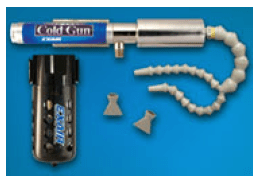
3. Model: 110248 Super Air Knife Kit to blow the chips from the table after it is lifted.

As you can see, with a simple initial question, it became complicated rather quickly. Instead of looking at one area of the application, I was able to improve their entire process. In any manufacturing plant, scrap and downtime are the two biggest culprits in reducing profits. The scrap occurred when the faces were scratched and damaged. The downtime happened during the cleanup between book change-overs and when the saw blades were being replaced. Overall, their process improved in efficiency and speed.
Whenever you need to look at the overall process for improvement, EXAIR may have multiple solutions to offer. You can speak to an Application Engineer to see how EXAIR can increase your efficiency and reduce your scrap. You can either call 800-903-9247 or send an email to techhelp@exair.com.
John Ball
Application Engineer
Email: johnball@exair.com
Twitter: twitter.com/exair_jb