Where Can’t I Use An EXAIR Super Air Knife?

Considering the material options available, there are very few places you CAN’T use a Super Air Knife. Most often, we find those to be due to extreme elevated temperature, like this one:

A caller from a glass manufacturing company wanted to replace a drilled pipe in a cooling application. Thing is, glass makers deal with their product in molten form, which is HOT…the ambient temperature that this drilled pipe is exposed to reaches 800°C, or 1,472°F.  Because of the temperature, and corrosive atmospheric elements (SO2 is also present, as if the heat wasn’t bad enough,) they have to replace the drilled pipe every so often, and wanted to explore other solutions.

Now, this was a rare case where a Super Air Knife would not have necessarily offered an improvement over a drilled pipe:

  • The air flow from the drilled pipe is primarily straight from their compressed air system.  Since the Super Air Knife entrains air from the surrounding environment at a rate of 40:1, the resultant flow would be very close to the 800°C ambient temperature…and not as effective at cooling as the much cooler compressed air supply temperature.  It wouldn’t have helped to reduce consumption if it simply didn’t work.
The Super Air Knife takes a supply of compressed air (1), discharges it through a gap that runs the length of the Air Knife (2,) and entrains an enormous amount of “free” air from the surrounding environment (3.)
  • Another great thing about the Super Air Knife is that it’s dramatically quieter than any other method of compressed air blowing.  Of course, if you find yourself in a 800°C sulfur dioxide environment, hearing protection is the least of your concerns.

    When supplied at 80psig, the EXAIR Super Air Knife produces a hard hitting, powerful curtain of air, with a sound level of only 69dBA.
  • EXAIR Super Air Knives (and all of our Intelligent Compressed Air Products) are compliant with OSHA Standard 1910.242(b) which limits the outlet pressure of a compressed air blowing device used for cleaning to 30psi…this protects personnel from high velocity debris and air embolisms.  Again, not a concern in an unoccupied (and uninhabitable) space.

Again, that’s a rare case…a very specific exception to a broadly inclusive rule, in light of the options EXAIR offers.  Consider:

  • Aluminum Super Air Knives are durable, lightweight, and suitable for most any installation in a typical industrial/commercial environment.  They’re good to 180°F (82°C) and are fitted with stainless steel fasteners to eliminate corrosion in damp environments.  The polyester shim can be replaced with a custom stainless steel shim, increasing the temperature rating to 400°F (204°C) if needed.
  • Type 303 Stainless Steel Super Air Knives offer higher tensile strength, and are good to 800°F (427°C.)  They are popular in applications with factors like high heat, corrosive environments, frequent spray down cleaning, outdoor installations, etc.
  • Type 316 Stainless Steel Super Air Knives are often specified in food and pharmaceutical applications, due to their even higher resistance to chemical attack and pitting.  They’re also rated to 800°F (427°C) and have the same high tensile strength as the Type 303 Stainless Steel models.
  • Some situations call for better corrosion resistance than these high grades of austenitic stainless steels – and that’s where EXAIR’s PVDF Super Air Knife comes in.  Fitted with PTFE shims and Hastelloy© C-276 hardware, they are especially well suited for processes involving the harshest of corrosive agents, such as electroplating, solar cell manufacturing, and lithium ion battery production, just to mention a few.  They would, in fact, be ideal for the SO2 environment at the glass factory, if it weren’t for the temperature…they’re rated to 275°F (135°C.)

Performance is identical, regardless of construction materials, and all EXAIR Super Air Knives come in lengths from 3″ to 108″ (except PVDF…those go up to 54″ lengths) and ship quickly from our well maintained inventory.  Aluminum and Stainless Steel models can be coupled together for even longer flow lengths.  Plumbing Kits and Universal Air Knife Mounting Systems make for easy and quick installation, and all Super Air Knife Kits come with an Automatic Drain Filter Separator, a Pressure Regulator, and a Shim Set for reliability, clean air flow, and total performance control.

If you need a reliable, cost effective, safe, quiet, and efficient curtain of air, EXAIR’s Super Air Knives are what you’re looking for.  If you’d like to discuss a particular application and/or product selection, give me a call.

Russ Bowman
Application Engineer
EXAIR Corporation
Visit us on the Web
Follow me on Twitter
Like us on Facebook

What’s In My Air, And Why Is It Important?

Everyone knows there’s oxygen in our air – if there wasn’t oxygen in the air you’re breathing right now, reading this blog would be the least of your concerns. Most people know that oxygen, in fact, makes up about 20% of the earth’s atmosphere at sea level, and that almost all the rest is nitrogen. There’s an impressive list of other gases in the air we breathe, but what’s more impressive (to me, anyway) is the technology behind the instrumentation needed to measure some of these values:

Reference: CRC Handbook of Chemistry and Physics, edited by David R. Lide, 1997.

We can consider, for practical purposes, that air is made up of five gases: nitrogen, oxygen, argon, carbon dioxide, and water vapor (more on that in a minute.)  The other gases are so low in concentration that there is over 10 times as much carbon dioxide as all the others below it, combined.

About the water vapor: because it’s a variable, this table omits it, water vapor generally makes up 1-3% of atmospheric air, by volume, and can be as high as 5%.  Which means that, even on a ‘dry’ day, it pushes argon out of the #3 slot.

There are numerous reasons why the volumetric concentrations of these gases are important.  If oxygen level drops in the air we’re breathing, human activity is impaired.  Exhaustion without physical exertion will occur at 12-15%.  Your lips turn blue at 10%.  Exposure to oxygen levels of 8% or below are fatal within minutes.

Likewise, too much of other gases can be bad.  Carbon monoxide, for example, is a lethal poison.  It’ll kill you at concentrations as low as 0.04%…about the normal amount of carbon dioxide in the atmosphere.

For the purposes of this blog, and how the makeup of our air is important to the function of EXAIR Intelligent Compressed Air Products, we’re going to stick with the top three: nitrogen, oxygen, and water vapor.

Any of our products are capable of discharging a fluid, but they’re specifically designed for use with compressed air – in basic grade school science terms, they convert the potential energy of air under compression into kinetic energy in such a way as to entrain a large amount of air from the surrounding environment.  This is important to consider for a couple of reasons:

  • Anything that’s in your compressed air supply is going to get on the part you’re blowing off with that Super Air Nozzle, the material you’re conveying with that Line Vac, or the electronics you’re cooling with that Cabinet Cooler System.  That includes water…which can condense from the water vapor at several points along the way from your compressor’s intake, through its filtration and drying systems, to the discharge from the product itself.
  • Sometimes, a user is interested in blowing a purge gas (commonly nitrogen or argon) –  but unless it’s in a isolated environment (like a closed chamber) purged with the same gas, most of the developed flow will simply be room air.

Another consideration of air make up involves EXAIR Gen4 Static Eliminators.  They work on the Corona discharge principle: a high voltage is applied to a sharp point, and any gas in the vicinity of that point is subject to ionization – loss or gain of electrons in their molecules’ outer valences, resulting in a charged particle.  The charge is positive if they lose an electron, and negative if they gain one.  Of the two gases that make up almost all of our air, oxygen has the lowest ionization energy in its outer valence, making it the easier of the two to ionize.  You can certainly supply a Gen4 Static Eliminator with pure nitrogen if you wish, but the static dissipation rate may be hampered to a finite (although probably very small) degree.

At EXAIR Corporation, we want to be the ones you think of when you think of compressed air.  If you’ve got questions about it, give us a call.

Russ Bowman
Application Engineer
EXAIR Corporation
Visit us on the Web
Follow me on Twitter
Like us on Facebook


Air photo courtesy of Bruno Creative Commons License

Accessories and the Value Added

The word “accessory” can come with some baggage… it’s become synonymous with “add-on” and “up-sell,” and cost-mindful consumers may see them as just another way for a slick salesperson to make an extra buck. And frankly, they wouldn’t have that reputation if there wasn’t some truth to it.  The server at your favorite restaurant will offer appetizers, or recommend side dishes to go with your entree. If you go to buy a new car, you’ll get a pitch for a variety of aftermarket add-ons.  The paint counter folks at the hardware store always tell me what specific brush and/or rollers I should use with the paint I’m buying…and it’s never the 10-pack of economy brushes that costs less than the single, premium quality brush they recommend.  In all of these cases, these employees are trained, constantly encouraged, and hopefully rewarded on the success of these “up-sell” strategies.

Of course, my boys and I can devour even the largest plate of chili cheese nachos long before the rest of meal comes out.  My wife absolutely loves the remote starter function that the dealership installed on the new car she bought last year.  And, if you’ve ever painted a well-lit room, you know the difference between a $1 paint brush and a $10 paint brush.  So if my server gets a little bigger tip, my car dealer salesperson gets a little more commission, or the paint counter folks get a bonus, then it’s a win-win, as far as I’m concerned.

EXAIR carries a variety of accessories for our Intelligent Compressed Air Products.  Some aid in mounting & installation:

Clockwise from top: Universal Air Knife Mounting System, Stay Set Hoses, Cabinet Cooler Side Mount Kit, Mounting Brackets for Line Vac, Filter Separator, and Pressure Regulator, Swivel Fitting for Super Air Nozzle, Tool Holder for Industrial Vacuum Drums, Spray Nozzle Mounting Clip.

Others make it easy to ensure adequate supply conditions:

The performance of many EXAIR Intelligent Compressed Air Products can be altered by replacing the shim:

From left to right: Super Air Amplifier, Super Air Knife, 1″ Flat Super Air Nozzle, High Velocity Air Jets, and Air Wipe all feature replaceable shims to modify performance.

In addition to these product-specific accessories, EXAIR carries a complete line of:

Filter Separators are rated for air flow up to 400 SCFM; Oil Removal Filters, up to 310 SCFM.

*Filter Separators to remove water, dirt, and rust from your compressed air system.  Our Automatic Drain Filter Separators have a 5 micron particulate element, and a centrifugal vane to remove moisture.

*Oil Removal Filters with coalescing elements that remove any trace of oil, and also provide additional particulate filtration to 0.03 microns.


*Pressure Regulators, so you can “dial in” the performance you need, so you don’t overpower the application, or waste compressed air.  They come in sizes from 1/4 NPT to 1-1/4 NPT, and are rated for flows up to 700 SCFM.  A pressure gauge provides accurate indication of outlet pressure, and the adjustment cap can be removed to prevent tampering.

*Mounting Brackets and Modular Coupling Kits for our Filters and Regulators.  The latter are especially handy for easy, compact, and leak free installation.

*Silencing Mufflers to reduce work area noise from compressed air exhausting from pneumatic cylinders, valves, etc.  There are several styles to choose from, depending on your needs:

  • Sintered Bronze Mufflers are simple in design, with minimal back pressure restriction, and come in sizes from #10-32 thread to 1-1/2 NPT.
  • Straight-Through Mufflers offer noise reduction up to 20 dB, and come in sizes from 1/4 NPT (up to 22 SCFM) to 3/4 NPT (up to 73 SCFM.)
  • Heavy Duty Mufflers have an internal stainless steel screen that not only protects the exhausting components from environmental contamination, but also keeps air system contaminants from being ejected at high speed into the work area.
  • Reclassifying Mufflers are an upgrade to the Sintered Bronze Mufflers and provide the highest level of noise reduction – up to 35 dB.  They also trap oil mist, eliminating breathing hazards to personnel.

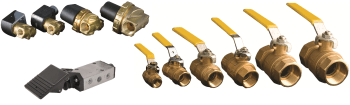
*We have manual ball valves (1/4 NPT to 1-1/4 NPT) and Solenoid Valves (120VAC, 240VAC or 24VDC) from 1/4 NPT to 1 NPT, and a Foot Valve, for hands-free operation.

*Swivel Fittings to securely install & aim many of our nozzles, from the Atto to the High Force 1 NPT Super Air Nozzles.  For a little more flexibility, Stay Set Hoses and Magnetic Bases can be used for Air Amplifiers, Super Air Nozzles, and even short Air Knives.

*12 ft Coiled Hoses (1/4″ or 3/8″ ID) and Compressed Air Hose (3/8″ or 1/2″ ID; up to 50ft lengths) can be provided with any Intelligent Compressed Air Product.  We also have a full supply of fittings (tees, elbows, nipples, couplers, reducers, etc.) and adapters to fit our Super Air Nozzles to your existing air guns or blow off devices.

*Receiver Tanks are used to store a ready supply of compressed air.  If you have an intermittent demand of sufficient size, it can cause a pressure transient in your system, which can drag down the ability to supply other points of use.  Installed near the point of intermittent demand, they prevent pressure & volume fluctuations, keeping the operators at all points of use happy.  Model 9500-60 Receiver Tank has a capacity of 60 gallons, is rated to 200psig, and meets ASME pressure vessel code.

In closing, let me offer the following advice that’s served me well over the years:

*Be mindful of the valued added by the accessories & add-ons you’re presented during a purchase of capital equipment…or anything else, really.  Don’t buy something you don’t need, but if you need it…well…it’s OK to buy it.

*Don’t skimp on quality.  Odds are, if an accessory is offered by the manufacturer of the product, it’s going to work well for you.  They should be able to tell you if it will or won’t if you discuss your needs with them.  I know I will if you call me to discuss a compressed air product application.

*Get the big plate of nachos, especially if you’re dining with teenagers.

Russ Bowman
Application Engineer
EXAIR Corporation
Visit us on the Web
Follow me on Twitter
Like us on Facebook

Let’s Size A Cabinet Cooler System!

I can’t remember the last time I put an exclamation point in the title of my blog, but it was probably the last time I got to talk about doing math. Or write about heat transfer.  Insert your favorite engineer joke here…I’m sure I have it coming.

We’re in the dog days of summer (in the Northern Hemisphere) for sure…or, as we call it, “Cabinet Cooler Season.”  If you’re having heat related problems with a control panel, give us a call; we can help.  If you’d like to know what we’re going to talk about, read on.

Heat can cause real problems for electrical and electronic components, in a hurry…we all know that.  Fortunately, we can also specify the right Cabinet Cooler System for you in a hurry too.  And since we keep them all in stock, we can get it to you in a hurry as well.

You can access our Cabinet Cooler Sizing Guide online, here.  You can fill in the blanks and submit it, or you can call in your data.  We do it over the phone all the time, and it only takes a minute.  Here’s what we’re going to ask for, and why:

Enclosure dimensions.  We need the length, width, and height of your enclosure to calculate the heat transfer surface, and the volume of the enclosure.

Current Internal Air Temperature.  How hot is it inside your enclosure?  This is the starting point for figuring out the internal heat load…how much heat the components inside the box is generating.  This needs to be the air temperature – don’t use a heat gun, or you’re going to give me the surface temperature of something that may or may not be close to what I need.  Just put a thermometer in there for a few minutes.

Current External Air Temperature.  How hot is it in the area where the enclosure is located?  We’re going to compare this to the internal air temperature…the difference between the two is actually proportional to the heat load.  Also, if there’s anything cooling the enclosure right now (like circulating fans; more on those in a minute,) this reading is key to figuring out how much heat they’re removing.

Maximum External Air Temperature.  How hot does it get in the area on, say, the hottest day of summer?  We’ll need this to calculate the external heat load…how much heat the enclosure picks up from its surroundings.

Maximum Internal Temperature Desired.  Most electrical and electronic component manufacturers publish a maximum operating temperature of 104F (40C) – it’s kind of an “industry standard.”  Based on this, a lot of us in the enclosure cooling business set our products’ thermostats to 95F (35C) – if we’re maintaining the air temperature a decent amount cooler than the components are allowed to get, history and practice has shown that we’re going to provide more than adequate protection.  If your enclosure houses something with more sensitive temperature limitations, though, we can work with that too…that’s the only time you’re going to want to put something other than 95F (35C) in this field.

Cabinet Rating.  This is all about the environment…we offer three levels of protection, per NEMA standards:

NEMA 12 – oil tight, dust tight, indoor duty.

NEMA 4 – oil tight, dust tight, splash resistant, indoor/outdoor duty.

NEMA 4X – oil tight, dust tight, splash resistant, corrosion resistant, indoor outdoor duty.

The NEMA rating does not affect the cooling capacity at all.

Other:  If the enclosure is mounted to the side of a machine, or a wall in the plant, you really don’t need to put anything here.  If it’s outside and exposed to direct sunlight, tell us what the surface finish (i.e., polished metal, painted grey, etc.) is so that we can account for solar loading too.  If anything else is unusual or peculiar about the application, let us know that too.

My Cabinet Is…Not Vented, Vented, Wall Mounted, Free Standing, Fan(s).  We’ll use what you tell us here to verify heat transfer surface (a wall mounted cabinet’s back surface isn’t a radiative surface, for example.)  Also, I mentioned fan cooling before, so without further ado…

Fan diameter or SCFM.  If there are fans circulating air into (and/or out of) the enclosure, they’re providing a finite amount of cooling right now.  Proper installation of a Cabinet Cooler System is going to require their removal.  Running a Cabinet Cooler System on a vented enclosure is just like running your air conditioner with the windows open.  So, if we know the size (or the SCFM…sometimes there’s a label on those fans, and we LOVE those folks who do that) then we can use that, and the temperatures you gave us above, to take the fan cooling into account.

Once we have all this information, it’s down to the math. Like I said, we do this all the time (especially during “Cabinet Cooler Season”) – give me a call.  Your heat problem isn’t waiting; why should you?

Before I go…here’s a nice little video, walking you through the Cabinet Cooler Sizing Guide.  Yes, I just made you read the book before watching the movie…feel free to tell me which one you liked better.

Russ Bowman
Application Engineer
EXAIR Corporation
Visit us on the Web
Follow me on Twitter
Like us on Facebook