360° Hollow Circular Atomizing Nozzle Ideal For Treating Ductwork

There are many times we field calls from customers that fall directly in line with the intended use of one of our products. Such would be the case last week when a customer called looking for  a more reliable way to spray a light coating of rust inhibitor on the inside of a small section of ductwork roughly 9″ in diameter.  They were currently using a liquid only spray nozzle but were having trouble controlling the output flow, as well as the actual spray pattern. They were wasting a lot of the inhibitor as it was starting to “pool” in the bottom of the ductwork which would ultimately leak out onto the production floor and operator’s work area when the parts were prepared for shipment, also creating an unsafe work environment.

Model # AT1010SS Internal Mix 360° Hollow Circular Pattern Atomizing Nozzle


After discussing the application with the customer, I recommended our Model # AT1010SS Internal Mix 360° Hollow Circular Pattern Atomizing Nozzle. The circular spray pattern is the ideal solution when trying to coat the inside of a duct with rust preventative. The nozzle produces an even spray pattern up to 53″ in diameter with flows as much as 14.7 gallons per hour of liquid, depending on air and liquid supply pressures. Our Atomizing Nozzles also feature an adjustment valve to provide control of the flow rate as well. The 303ss construction is able to withstand corrosive environments and temperatures up to 400°F (204°C).

EXAIR offers a wide variety of Atomizing Nozzles that can be used to coat, rinse or cool a surface. They are also commonly used for dust suppression due to the wide coverage area they produce. For help selecting the correct Model # for your application, give us a call.

Justin Nicholl
Application Engineer
justinnicholl@exair.com
@EXAIR_JN

What Is A Btu?

A Btu, or British Thermal Unit, is a traditional unit of energy and is a measure of the heat content of fuels.

Originally, the Btu was the amount of energy needed to increase the temperature of 1 pound of liquid water by 1 degree Fahrenheit.  The term became common among engineers in the late 1800’s.

A single Btu is insignificant in terms of the amount of energy used by a single household or by an entire country. In 2013, the United States used about 98 quadrillion (written out, 1 quadrillion is a 1 followed by 15 zeros) Btu of energy.

One Btu is approximately equal to the energy released by burning a match.

Match

Interesting Energy Conversion Factors

Energy source Physical units and Btu (averages,¹ 2012)
Electricity 1 kilowatt hour = 3,412 Btu
Natural gas 1 cubic foot = 1,025 Btu
Motor gasoline (10% ethanol) 1 gallon = 120,524 Btu
Diesel fuel 1 gallon = 138,690 Btu
Heating oil 1 gallon = 138,690 Btu
Propane 1 gallon = 91,333 Btu
Wood 1 cord = 20,000,000 Btu (Estimated)

1Weighted averages across different contexts of each fuel such as imports, exports, production, and consumption. Source:  www.eia.gov/EnergyExplained by the U.S . Energy Information Administration

EXAIR manufactures the Cabinet Cooler System.  The Cabinet Cooler System is a low cost, reliable way to cool and purge electronic control panels.  They incorporate a vortex tube to produce cold air from compressed air – with no moving parts! EXAIR Cabinet Cooler Systems are available for NEMA 12, 4, and 4X type enclosures.  For the most efficient way to operate Cabinet cooler, a thermostat control system would be utilized. The standard thermostat control systems include an adjustable thermostat factory set at 95F.  Also, available is the ETC Electronic Temperature Control, providing precise control with easy adjustability and a digital readout.

Cabinet Cooler Family
EXAIR Cabinet Cooler Systems

In the United States, the power of HVAC (Heating Ventilating and Air Conditioning) systems is often expressed in BTU/hr.

The EXAIR Cabinet Cooler Systems are available with cooling capacities ranging from 275 to 5,600 Btu/hr.  To cool the down the equivalent of 98 quadrillion Btu’s of energy used by the US in 2013, it would take 17.5 trillion of our largest Cabinet Cooler Systems!

If you would like to find out how many Btu’s of cooling your electrical cabinet needs, please fill out and send in the Cabinet Cooler Sizing Guide and we can let you know.

Brian Bergmann
Application Engineer
Find us on the Web
Like us on Facebook


Match Photo courtesy of Samuel M. Livingston via Creative Commons License

EXAIR Reversible Drum Vac Solved a Big Issue that Electric Vacuums Have

Reversible Drum Vac Family

An industrial contractor used a walk-behind cement saw to cut out and revamp cement floors in commercial buildings. In their operation, they used a lot of water to keep the diamond blades cool and the cement dust down.  A wet/dry vacuum was used for cleanup during and after the sawing operation.   But because of the dust and large amount of use, the electric motors in the wet/dry vac would fail.  The dust would migrate into the bearings of the motor, and you would start to hear a high pitch noise (a mark of the bearings starting to fail).  It wasn’t long, and the vacuum would stop working.

As with many people, they typically start with a lower priced vacuum model from their local hardware store. It was no different with this contractor.  He found out shortly that he was replacing the vacuum units every 4 to 6 weeks.  With the excessive down time and continuously running to the local hardware store, it was becoming too much.  He decided to spend the extra money and get an industrial type vacuum unit.  It had a 30 gallon tank, a drum dolly, and a 2 HP electric industrial motor.  He spent nearly $800.00 on this rugged vacuum, hoping that he would not have to purchase another unit for a while.  Even though the electric motor was heavy duty, it was no match for the cement dust.  This unit stopped working like the others after only six months of use.  After this failure, he decided to search for a better alternative.

When he contacted me about his issues with the short-lived operations of his electric vacuums, I knew EXAIR had a solution. I suggested our model 6396-30, a 30 gallon Premium Reversible Drum Vac System.  The 30 gallon size made it very easy to fit into his work truck and to setup at different locations.  With the Spill Recovery Kit included in this system, it made cleaning up the water/cement mixture quick and efficient.  The EXAIR vacuum generator has no moving parts or bearings to wear.  It is made from stainless steel construction which is very resistant to corrosion, and it is very quiet as it only has a decibel rating of 86 dBA.  For the commercial buildings that did not have compressed air yet, he used a portable compressor to operate his new Reversible Drum Vac.  With clean compressed air, this vacuum will last for many years; not months.

If you find that you are going through your electric vacuums or just would like to reduce the noise levels, EXAIR has a large line of Industrial Housekeeping Products. You can contact an Application Engineer to see if we have the right vacuum product for you.

John Ball
Application Engineer
Email: johnball@exair.com
Twitter: @EXAIR_jb

Stop Trying To Squeeze More Out Of That Air Gun!

At EXAIR, we LOVE to talk about efficient use of compressed air. That’s why I was thrilled to get a call from an engineer that works for a non-profit firm that promotes energy efficiency to enable businesses in their area improve sustainability, improve the environment, and save money.

They were working with a local company to, among other things, optimize their use of compressed air and wanted to take advantage of our free Efficiency Lab service to get the “before” data on the current blow off devices.

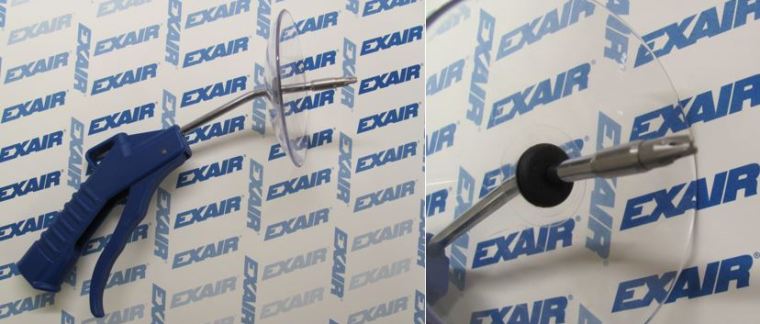
Don't let this happen to your air gun...use an EXAIR Precision Safety Air Gun with a quiet, efficient Super Air Nozzle instead.
Don’t let this happen to your air gun…
Squeeze the trigger on a Model 1410SS Precision Safety Air Gun with Nano Super Air Nozzle instead!

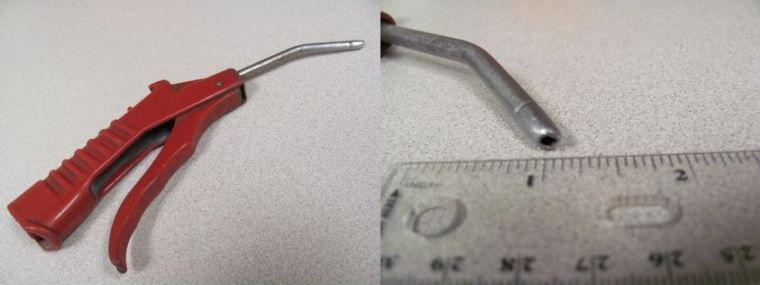
As you can see, they were trying to “squeeze” a little more performance out by, literally, squeezing the tip down.  Thing is, it’s STILL loud and non-compliant with OSHA’s regulations about dead end pressure.  And as far as performance goes, this results in only a slight change in the air flow pattern, with a minimal reduction in compressed air consumption…they’ve changed the geometry of the discharge opening, but not the cross sectional area.  Our Efficiency Lab Test results provide the final answer:

cry for help lab

Efficiency. Saving money. Safety. Sustainability. “Going Green.”   If you’d like to talk about how EXAIR can help you with any…or all…of these things, give me a call.

Russ Bowman
Application Engineer
EXAIR Corporation
Visit us on the Web
Follow me on Twitter
Like us on Facebook