Measuring and Adding Sound Levels

Noise-induced hearing loss, or NIHL, is one of the most common occupational diseases. This doesn’t occur overnight, but the effects are noticed gradually over many years of unprotected exposure to high sound levels. This is 100% preventable! Through proper engineering controls and personal protective equipment (PPE), NIHL can be prevented. It is irreversible, so once the damage is done there’s no going back. OSHA standard 19 CFR 1910.95(a) states that protection against the effects of noise exposure shall be provided when the sound levels and exposure time exceed those shown in the table below.

OSHA Chart

Intensity of the sound pressure level is expressed in decibels (dB). The scale is logarithmic, a 3 dB reduction cuts the sound level in half. A 10 dB reduction decreases it by a factor of 10, and a 20 dB reduction decreases the sound level by a factor of 100. To calculate the dB level, we use the following formula:

Sound SPL

Where:

L – Sound Pressure Level, dB

P – Sound Pressure, Pa

Pref – reference sound pressure, 0.00002 Pa

For example, normal conversation has a Sound Pressure of .01Pa. To calculate the dB level:

dB = 20 log10 (.01Pa/.00002Pa)

 = 54 dB

When designing a new blowoff process, it’s important to consider the sound levels produced before implementation. EXAIR publishes the sound level for all of our products for this very reason. If you’re implementing multiple nozzles, you’ll need to add the sound levels together. To do so, we use the following formula:

Sound Addition

Where:

L1, L2… represent the sound pressure level in dB for each source

A customer was using ¼” open ended copper tubes for a blowoff application removing trim after a stamping operation. They had a total of (4) tubes operating at 80 PSIG. Not only were they VERY inefficient, but the sound level produced at this pressure was 94 dBA. To calculate the sound level of all (4) together we use the above formula:

L = 10 x log10(109.4+ 109.4 + 109.4 + 109.4)

L = 100 dB

At this sound level, permanent hearing loss begins to occur in just two hours of unprotected exposure. We recommended replacing the loud and inefficient copper pipe with our 1” Flat Super Air Nozzle, Model 1126. At 80 PSIG, the 1126 produces a sound level of just 75 dBA.

L = 10 x log10 (107.5 + 107.5 + 107.5 + 107.5)

L = 81 dB

At almost a 20 dB reduction, that’s nearly 100x quieter! Don’t rely on just PPE to keep your operators safe from NIHL. Replacing loud inefficient blowoff methods with EXAIR’s Intelligent Compressed Air Products will take it one step further in ensuring your creating a safe working environment for your employees.

Tyler Daniel
Application Engineer
E-mail: TylerDaniel@EXAIR.com
Twitter: @EXAIR_TD

EXAIR Intelligent Compressed Air Products: Leading the Way in Standards Compliance

EXAIR prides itself in offering products with high-performance and peak efficiency. All EXAIR products are manufactured to meet the strict requirements of a variety of different standards, ensuring that you receive a reliable, high quality product that WILL perform to the specifications we publish.

Safety is a top priority for most companies, EXAIR’s line of Intelligent Compressed Air Products meet or exceed the strict safety standards set forth by both OSHA and the European Union. EXAIR products comply with OSHA 29 CFR 1910.242(b), the standard implemented to ensure safe operation of compressed air blowoff devices, and the EU General Product Safety Directive (2001/95/EC).

sag-osha-compliant
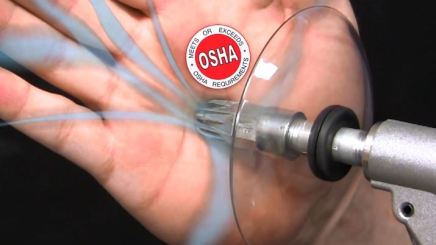
The engineered design of our Super Air Nozzles prevents compressed air from penetrating the skin by eliminating the potential of dead-ending when pressed against the skin.

OSHA Chart

Additionally, they comply with the noise limitation requirements set forth under 29 CFR 1910.95(a) and the EU Machinery Directive (2006/42/EC). From the Optimization product line, EXAIR’s Electronic Flow Control and the Electronic Temperature Control meet the low voltage standards of EU Low Voltage Directive (2006/95/EC). A CE label is placed on all products that comply with applicable directives.

UL

UL, or Underwriters Laboratories, is a third-party safety and consulting organization that certifies products after thorough testing and evaluation. EXAIR’s Cabinet Coolers are UL Listed to US and Canadian safety standards. Static Eliminators are also UL Component Recognized. Within our line of Cabinet Coolers is the Hazardous Location Cabinet Cooler, bearing the Classified UL mark for use in classified areas.

ROHS_Vector

In the assembly of electrical products there can be hazardous materials used during production. The Restriction of Hazardous Substances, also known as RoHS or (2002/95/EC), restricts the use of materials such as: lead (Pb), mercury (Hg), cadmium (Cd), hexavalent chromium (CrVI), polybrominated biphenyls (PBB), polybrominated diphenyl ethers (PBDE), and four different phthalates. The electrical portions of EXAIR’s Static Eliminators, Electronic Flow Control, Electronic Temperature Control, Digital Flowmeter, solenoid valves, and thermostats all comply with the amendment outlined in the European Commission decision L 214/65.

In addition to RoHS, EXAIR is also committed to providing products that are conflict mineral free. In support ofconflictfree_v2 Section 1502 of the Dodd-Frank Wall Street Reform and Consumer protection Act, EXAIR complies with the conflict minerals rule to curb illicit trade of tin, tantalum, tungsten and gold in the DRC region. Using the CMRT 4.20 template, we’re able to document our supply chain to ensure our materials are not being sourced from places that could finance conflict in the DRC and surrounding countries.

reachFinally, per Regulation (EC) No 1907/2006 Title I, Article 3, paragraph 3, the European Union enacted legislation requiring substances and chemicals imported into the EU to be registered to ensure a high level of protection for human health and the environment. Per Title II, Article 7, paragraph 1, articles must be registered when a substance is intended to be released during normal conditions of use that would exceed 1 metric ton per producer per year. Since EXAIR products do not contain substances that are intentionally released, registration is not required.

If you’re looking to maintain compliance in your industry, EXAIR products have you covered. If you have any questions about these standards of compliance feel free to reach out to us. Our team of Application Engineers have years of experience in industry are waiting to take your call.

Tyler Daniel
Application Engineer
E-mail: TylerDaniel@EXAIR.com
Twitter: @EXAIR_TD

Airguns, OSHA, And You

Depending on the context, those may be three words you DON’T want to hear in the same sentence. Case in point…a caller I spoke with recently, who works at a large steel forging plant. During a recent inspection, management was surprised (and disappointed) to find out that, unbeknownst to them, some of their operators had modified some of their compressed air blow off devices.

These modifications left them in violation of both OSHA Standard 1910.242(b) (limit on outlet, or dead end pressure) and 1910.95(a) (limits noise level exposure.)  The OSHA inspector left them with an $8,000.00 fine, and a promise to return with an even higher one if the situation wasn’t corrected.

We discussed the ways their current devices were supplied, the conditions they were operating in, what they were used for…and why the operators had modified them.  Sadly, we found the devices were underperforming due to air supply issues – hoses that were too small in diameter and/or too long, with restrictive quick connect fittings.  And some of their modifications (drilling out the discharge) just exacerbated those problems.

Most of their applications were pretty typical – blowing flash, chips, oil, coolant, etc. from processed metal parts.  Typical enough that a couple of EXAIR Safety Air Guns would allow them to determine what they would need, by taking them around to various stations in the plant and trying them out.

My caller ordered a Model 1210 Soft Grip Safety Air Gun with a Zinc Aluminum Super Air Nozzle (our most popular for typical blow off applications,) and a Model 1260 Soft Grip Safety Air Gun with a High Force 1/2 NPT Zinc Aluminum Super Air Nozzle (the most powerful one available on the Soft Grip Safety Air Gun.)

Here’s Model 1210-6-CS, fitted with a Zinc Aluminum Super Air Nozzle on a 6″ Rigid Extension & Chip Shield.  All EXAIR Safety Air Guns are compliant with OSHA Standard 1910.242(b).

I feel pretty good about the chances of publishing a future blog about the success of this application.  If you want to keep up, I encourage to follow the EXAIR blog – there’s a link to the right to provide your email address – for more on this one, other applications, and a wealth of expert writings on how to get the most out of your compressed air system.

As always, if you’d like to discuss a particular compressed air application and/or product selection, give me a call.

Russ Bowman
Application Engineer
EXAIR Corporation
Visit us on the Web
Follow me on Twitter
Like us on Facebook

Know What to Look For – Are Your Compressed Air Guns OSHA Safe?

One of the easiest ways to find out if your compressed air guns are safe for operation is by looking at the nozzle.  First, take your current compressed air gun and disconnect it from the compressed air line.  Second, look directly into the end of the nozzle where the air comes out.  If you can see the inside of the nozzle, then your air gun or blow-off device is unsafe.  Nine out of ten compressed air guns are considered to be dangerous.  In this blog, I will go through the dangers and violations of compressed air guns and nozzles that are very common in the market place.

Occupational Safety and Health Administration, OSHA, is an organization that enforces standards for safe and healthy working environments.  They have training, outreach programs, and educational assistance for manufacturing plant.  But, they will also enforce these standards with heavy fines for violations.  The two most common violations with compressed air guns and nozzles are 29CFR 1910.242(b) for dead-end pressure/chip shielding and 29CFR 1910.65(a) for maximum allowable noise exposure.  If you are unfortunate in receiving an audit, the OSHA agent will target your compressed air guns and blow-off devices.

Unsafe Nozzle

Here is the first example of a nozzle that I would like to discuss.  As you can see, there is only one opening where the air can come out from the nozzle.  Other types of nozzles that would fall into this category will include copper pipes, extensions, or worn nozzles.  They are dangerous as the compressed air cannot escape if it is blocked by your skin.  An air embolism could occur within the body which can cause bodily harm or death.  If operated above 30 PSIG (2 bar), these nozzles would violate the OSHA 29CFR 1910.242(b) for dead-end pressure.  This is a hazard which can be avoided by using EXAIR Super Air Nozzles and Safety Air Guns.  The nozzles are designed to utilize fins to allow air to escape and not penetrate your skin.  With EXAIR products, you will not violate this standard even if you go above the 30 PSIG (2 bar).

Safety Air Gun

To counteract the dead-end pressure violation, some nozzle manufacturers created a hole through the side of the nozzle (Reference photo below).  This will allow for the compressed air to escape, but, now the issue is noise level.  With an “open” section in the nozzle, the compressed air is very turbulent and very loud.  They state that 70% to 80% of all hearing loss within a manufacturing plant is caused by compressed air.  For this, OSHA 29CFR 1910.65(a) was created to show the maximum allowable noise exposure.  This chart shows the time and noise limits before requiring hearing protection.  The EXAIR Super Air Nozzles are designed to have laminar flow which is very quiet.  With our typical Safety Air Gun, model 1210, the sound level is only 74 dBA; well under the noise exposure limit for 8 hours.

Unsafe Air Gun
Hearing loss is the best known, but not the only, ill effect of harmful noise exposure. It can also cause physical and psychological stress, impair concentration, and contribute to workplace accidents or injuries.

Why do I bring these points up?  Because safety is everyone’s responsibility.  The National Institute for Occupational Safety and Health, NIOSH, has an overview of how to handle hazards in the workplace.  They call it the Hierarchy of Controls (click).  This is a means to best protect workers from dangers.  The most effective way is by eliminating the hazard or substituting the hazard.  The least effective way is with Personal Protective Equipment, or PPE.  For your unsafe compressed air nozzles and guns, EXAIR can help by substituting the hazardous air gun and nozzle with an engineered solution designed with safety in mind.

In my opening statement, I explained a quick and easy method to determine if your compressed air guns are dangerous.  To keep your company compliant and safe, EXAIR offers a variety of different types of nozzles and Safety Air Guns to best fit your requirement.  If you find that you are using hazardous blowing equipment, you can contact an Application Engineer to find a safe and effective alternative.

John Ball
Application Engineer
Email: johnball@exair.com
Twitter: @EXAIR_jb