
EXAIR VariBlast Safety Air Gun

Air guns can be found in nearly any industrial facility that has a compressed air system within it.  From the maintenance department to the production floor, operators potentially use these for anything from, cleaning up work areas,  to blowing product out of a troubled spot in a process. Handheld blowoffs are often overlooked as a means to increase efficiency yet they are often observed as a means to increase safety.

Generic commercial air gun w/ cross cut hole in the nozzle

When evaluating efficiency the length of use for a handheld blowoff is often variable from operator to operator as well as changes even from each use.  Often, operators have several different uses throughout their day that require different levels of force needed to complete the job.  Most safety air guns don’t offer a variable force.  This means operators are full-force for all applications. This means full air consumption whenever that gun is used. EXAIR’s VariBlast Compact Safety Air Gun can help to give operators the adjustability they need.
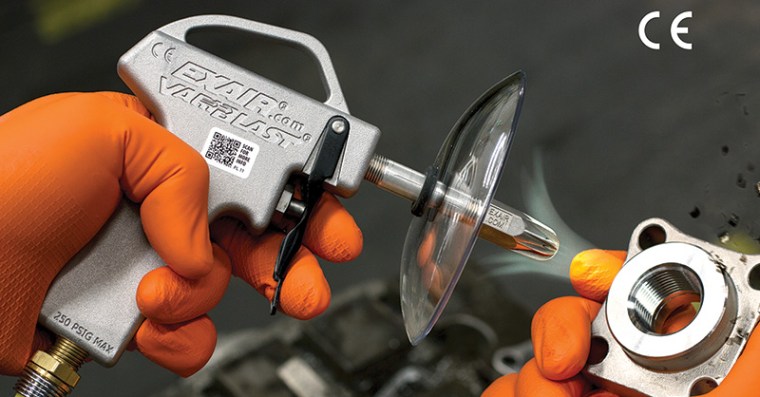
CE compliant, VariBlast Compact Safety Air Gun saves air and increases safety.

The VariBlast Compact Safet Air Gun is available from stock with over a dozen options of different Super Air Nozzles as the end defector of the Safety Air Gun.  These are any nozzle up to a 1/8″ NPT thread size.  To couple with these engineered nozzles, we offer stock length extensions up to 72″ (1829 mm)  in length. This makes many applications that are hard to reach easily managed by the operators.

Different Length Extensions To Suit Nearly Every Application

To couple with the extensions and make sure the VariBlast Compact Safety Air Guns all meet or exceed OSHA standards for operator safety, we offer a Chip Shield accessory as well.
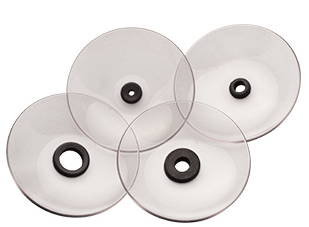
Chip Shields

If you would like to discuss how to lower the demand placed on your air compressor from blowoffs and want to better experience what true variability as well as what an engineered blowoff is capable of, contact us.

Brian Farno
Application Engineer
BrianFarno@EXAIR.com
@EXAIR_BF

Back To The Basics: Process Improvement Basics

We understand that it is more important than ever to realize savings within manufacturing processes. EXAIR can reduce compressed air consumption and provide simple ROI in a matter of weeks in MANY cases.

In the hustle and bustle of the daily grind wherever you are, there are certain processes that become muscle memory for you and certain processes that just work and don’t need any attention. Whether it be a login process for your computer network, the number of steps it takes to fill your coffee cup, or the compressed air applications in your facility.

You know what I am talking about, these items begin to get glanced over and often become overlooked. When going through process improvements or troubleshooting, it is easy to overlook processes which are not causing trouble or that have become “acceptable” because they are producing. EXAIR firmly believes compressed air applications are ripe for improvement, and our product lines are built to replace inefficient compressed air products with engineered and efficient solutions.

When evaluating a process for improvement creating a baseline is the necessary start. With this, we can then start to draw a realistic target of where the process needs to be in order to be optimized and document the changes from our starting baseline.

Much like the 6 Steps to Compressed Air Optimization, which starts with measuring compressed air consumption to provide a baseline.  Sometimes, this may require the installation of a Digital Flowmeter, others it may include taking advantage of our Efficiency Lab service for us to get a baseline of what air consumption and other key performance indicators are for your application.

Looking to “go green?” We can help.

Once we have the baseline and a target, we can then begin to design an improvement process. Whether this is implementing better controls for the air, such as pressure regulators, or implementing controllers such as the Electronic Flow Control, it may even be simply installing an engineered solution.  Once an improvement has been implemented we can then go on to the next testing phase to again gather data to see how much air was saved from the baseline.

EXAIR’s Free Efficiency Lab

Once the performance of the new process is determined then we can take the new cost of ownership numbers and give a simple return on investment back to determine what the actual savings by implementing these process improvements have amounted to.

The below example is from a customer who had already improved their static elimination application by using our Super Ion Air Knife instead of a homemade pipe with drilled holes. They further optimized the application with our Electronic Flow Control.

If you would like to talk through methods for process improvement or how we can help you determine these costs, please reach out.

Brian Farno
Application Engineer
BrianFarno@EXAIR.com
@EXAIR_BF


Protecting Employees With PPE vs. Engineered Controls and Substitution

PPE has been a hot topic and new buzzword for a lot of people and throughout many industries over the past 6 months, and rightfully so. When you look at manufacturing though, PPE has been a buzzword for decades. We continue to evolve processes, equipment, and wearables to ensure the safety of operators.  It all boils down to the fact that PPE and the equipment have to be used, and used appropriately in order to be effective.

When reviewing the CDC’s guides for Hierarchy of Controls the least effective method to protect workers is PPE that they must implement and wear/use properly. The fact is, PPE is one of the cheaper entry levels to get to safe working conditions upfront. However, the cost of ownership can quickly surpass more effective methods of providing safe conditions for operators, such as installation of engineered controls or even substituting the hazard w/ engineered solutions.

CDC’s Hierarchy of Controls


So what exactly does that mean to the people on the shop floor? Rather than having to grab a set of pinch and roll earplugs every day on the way through the breezeway to get to the production line, permanently installing quiet products like Super Air Nozzles or Super Air Knives in place of open-ended pipes and drilled pipe blowoffs could eliminate the need for these uncomfortable nuisances. And reliance on personnel to use them correctly, or use them at all is a gamble.

How else can EXAIR help in this pursuit of operator safety and happiness? We offer a free service, the EXAIR Efficiency Lab, which will test your current blow-off products for force, flow, air consumption and noise level. We then recommend an engineered solution if we can improve upon those parameters (spoiler alert, we can) that will meet or exceed OSHA standards for dead-end pressure and allowable noise level exposure.

EXAIR’s Free Efficiency Lab

For this example, installing a quiet product to aid in lowering noise levels can create an environment that no longer needs PPE for protecting personnel. The fix is permanent and eliminates forgotten, lost or broken PPE and the expensive associated with them.

If you would like to discuss any of these options further, please let me know.

Brian Farno
Application Engineer
BrianFarno@EXAIR.com
@EXAIR_BF


Sound: What Is It … More Importantly, Weighted Scales of Frequencies

We’ve blogged about sound and what exactly it is before, see the link. Understanding that sound is vibration traveling through the air which it is utilizing as an elastic medium.  Well, rather than me continue to write this out, I found a great video to share that is written in song to better recap how sound is created.

Now that we have that recap and understand better what sound is let’s dig a little deeper to better understand why some sounds may appear louder to a person when they may not appear different on a sound scale that is shown by something like a Digital Sound Level Meter.

Loudness is how a person perceives sound and this is correlated to the sound pressure of the frequency of the sound in question.  The loudness is broken into three different weighing scales that are internationally standardized. Each of these scales, A, C, and Z apply a weight to different frequency levels.

  1. The most commonly observed scale here in the USA is the A scale. A is the OSHA selected scale for industrial environments and discriminates against low frequencies greatly.
  2. Z is the zero weighting scale to keep all frequencies equal, this scale was introduced in 2003 as the international standard.
  3. C scale does not attenuate these lower frequencies as they are carrying the ability to cause vibrations within structures or buildings and carry their own set of risks.

To further the explanation on the A-weighted scale, the range of frequencies correlates to the common human hearing spectrum which is 20 Hz to 20kHz. This is the range of frequencies that are most harmful to a person’s hearing and thus were adopted by OSHA. The OSHA standard, 29 CFR 191.95(a), that corresponds to noise level exposure permissible can be read about here on our blog as well.

When using a handy tool such as the Digital Sound Level Meter to measure sound levels you will select whether to use the dBA or dBC scale.  This is the decibel reading according to the scale selected. Again, for here in the USA you would want to focus your measurements on the dBA scale. It is suggested to use this tool at a 3′ distance or at the known distance an operator’s ears would be from the noise generation point.

Many of EXAIR’s engineered compressed air products have the ability to decrease sound levels in your plant. If you would like to discuss how to best reduce sound levels being produced within your facility, please contact us.

Brian Farno
Application Engineer
BrianFarno@EXAIR.com
@EXAIR_BF


1 – Fun Science: Sound – @charlieissocoollike – https://youtu.be/xH8mT2IQz7Y