Using EXAIR Products for “The Old One-Two Punch”

In boxing, there are five basic punches, and they’re commonly called out by numbers so that trainers can instruct boxers rapidly during the development of fundamentals. It’s also useful for them in real live bouts, where overly complicated plans can lead to defeat….former heavyweight champion Mike Tyson famously said, “everyone has a plan until they get punched in the mouth.” Those five basic punches are:

  • #1: The jab. Just like it sounds, this is a punch thrown directly forward with the lead hand. In many combinations, it’s the first punch thrown (that’s why it’s #1).
  • #2: The cross. This is a more powerful punch thrown with the back, or dominant, hand, and gets its power from the torque & rotation of the boxer’s body, when thrown correctly.
  • #3: The lead hook. This is an even more powerful punch than the cross. Its power comes not only from rotating the torso (like the cross) but also by pivoting on the lead foot to get the hip & shoulder involved. Because of the unbalanced and relatively unguarded position it leaves the boxer in, it’s riskier than a jab or cross, and oftentimes reserved for situations where the boxer sees an opportunity to score a knockout blow. If that plan doesn’t work, Mike Tyson’s famous quote above may very well come to fruition.
  • #4: The right uppercut. This is another devastating punch, thrown by the boxer’s dominant hand (assuming they’re right-handed) in an upward motion to contact the opponent’s head or body. If it connects to the chin or solar plexus, there’s a good chance the opponent will end up on the mat. It has to be thrown while the boxer is in close with the opponent, which gives the opponent the option to deal a devastating blow as well.
  • #5: The left uppercut. Same as above, but thrown with the boxer’s lead, or less dominant hand (again, assuming they’re right-handed.)

Because it generally leaves the boxer in a better defense position, the “one-two” combination is by far one of the most used moves in the ring. The term has even found its way into the popular vernacular, meaning two things that happen in rapid succession that lead to the desired outcome.

For the purposes of today’s blog (as the title suggests), I’m going to use it to describe an application where a customer uses two EXAIR products: a Model 1006SS Back Blow Air Nozzle, and a Model 6082 1″ Aluminum Line Vac in conjunction with each other.

This particular customer uses the Back Blow Air Nozzle to blow out the injector bore of an engine cylinder head assembly.

EXAIR manufactures three sizes of Back Blow Nozzles: our Model 1008SS Atto Back Blow Air Nozzle (left) is 0.2″ in diameter and can be used in 1/4″ to 1″ inside diameter holes, channels, etc. Model 11006SS 1/4 NPT Back Blow Air Nozzle (center) is good for 7/8″ to 4″ inside diameters, and Model 1008SS 1 NPT Back Blow Air Nozzle (right) is used for 2″ to 16″ inside diameters.

Thing is, they don’t want the debris flying all over the place. We considered a Chip Shield on the 1/4″ pipe extension that the Back Blow Air Nozzle was threaded onto, but since they insert it vertically from above, that could allow for debris to fall back down onto the assembly, and possibly right back into the injector bore, or one of the other openings on top. Instead, they opted for a Line Vac to vacuum the debris away as the Back Blow Air Nozzle blew it out of the hole.

While Line Vacs are primarily used to convey bulk material from one place to another (left), or to remove scrap trim (center), they’re also well suited for this application. Compressed air (1) enters the annular plenum (2) and is ejected at a high velocity through a ring of jets (3). This draws a vacuum on the inlet (4), creating a conveyance flow of air to carry whatever’s entrained in that flow through the outlet (5).

Engineered compressed air products have a multitude of advantages in applications like this. They’re durable & reliable. They have no moving parts to wear, or electrical components to burn out. They can operate continuously if needed, or they can be cycled on & off rapidly with no ill effects. If you’d like to find out how EXAIR Intelligent Compressed Air Products can help your operation, give me a call.

Russ Bowman, CCASS

Application Engineer
Visit us on the Web
Follow me on Twitter
Like us on Facebook

Just Needs A Little More To The Left

I’ve come across many applications where customers run multiple different parts or products along the same line, and each requires some form of blowoff before moving to the next stage. Too often, a system designed for just one specific part can’t keep up with the variations. Sometimes the “solution” ends up being to crank up the compressed air, which is wasteful and inefficient.

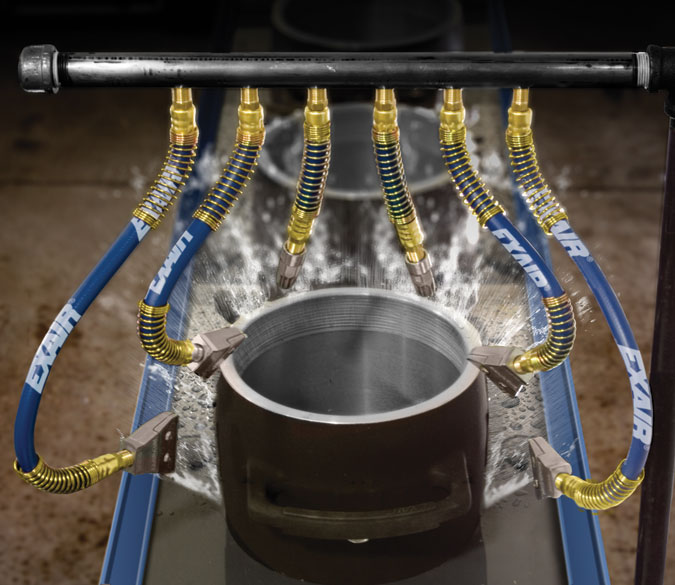
Instead of increasing air pressure or fabricating new mounts every time there’s a changeover, consider installing EXAIR’s Stay Set Hoses or Swivel Fittings.

            Stay Set Hoses are flexible and hold their shape once positioned, making them ideal for quickly adapting to different parts on the line. Available in 1/8″ and 1/4″ MNPT fittings (or a mix of both) and various lengths, these hoses can support anything from a Nano Super Air Nozzle to a Super Air Amplifier—or even a Super Air Knife. Repositioning them is easy: just bend the hose by hand to aim the airflow exactly where it’s needed for the new part.

                Swivel Fittings may be a better fit if your application doesn’t require much flexibility but still needs occasional fine-tuning. These allow up to 25 degrees of movement off axis, are made of durable 303 stainless steel, and help you easily refocus nozzles without a full tear down.

If your blowoff system isn’t keeping up with your line changes, it might be time to explore how Stay Set Hoses and Swivel Fittings can bring efficiency and adaptability to your process.       

Brian Farno, MBA – CCASS Application Engineer

BrianFarno@EXAIR.com
@EXAIR_BF

Sound Level of Cicadas

At the time of writing this blog, Cincinnati is experiencing our usual 17-year brood of cicadas. Millions, if not billions, of 17-year cicadas have emerged in Cincinnati and Southwest Ohio, making spending any amount of time outside unbearable. My four-year-old’s favorite part of the day is swinging on the back porch, and he even wants to go right back inside after just a few minutes.

I stuck the EXAIR 9104 Digital Sound Level Meter inside of one of our bushes here at the office. Within a 3′ radius, I counted 10–15 cicadas crawling around pretty casually. And they were producing a whopping 90 dBA! And if i shook a branch and really got them worked up, it peeked over 101 dBA.

Now while it takes repeated exposures of sufficient duration to cause hearing loss. And in a few weeks these cicadas will be gone; you probably don’t need to worry about the 2025 cicadas affecting your hearing. Noise exposure is, however, a real issue for most manufacturing facilities. Due to this risk, OSHA strictly enforces standard 29 CFR-1910.95(a).

This directive outlines the effects of noise and limits exposure based on the dBA. The table below indicates the maximum allowable exposure time to different noise levels. Sound levels that exceed these levels should first be addressed by proper engineering controls, such as isolating the source of the sound from personnel or replacing the cause of the sound with something like an engineered compressed air nozzle. When such controls aren’t feasible, proper PPE must be worn to protect the operator.

Hearing loss is the best known, but not the only, ill effect of harmful noise exposure. It can also cause physical and psychological stress, impair concentration, and contribute to workplace accidents or injuries.

Hearing loss can occur in as little as 30 minutes when exposed to sound levels of 110 dBA or greater. Operators have a tendency not to use PPE as directed. If an OSHA inspector comes to your facility and notices that the sound levels exceed the maximum allowable level without PPE protection being worn, hefty fines will soon be following. In this example from the United States Department of Labor, a company was fined a total of $143,000 for failing to protect their employees.

EXAIR 9104 Sound Level Meter

In order to identify the places or processes in your facility that are causing the problems, you’ll need a tool to measure the sound level. EXAIR’s easy-to-use Digital Sound Level Meter allows you to measure and monitor the sound level pressure in a wide variety of industrial environments. The source of the loud noise can then be identified and isolated so that corrective action can be taken. For compressed air-related noise, EXAIR manufactures a wide variety of engineered compressed air products that can reduce the sound level dramatically. In many cases, EXAIR products are capable of reducing noise levels by as much as 10 dBA. Since the dBA scale is logarithmic, this equates to cutting the sound level in half!

If there are processes within your facility that are above these limits, and you’d like to eliminate relying on proper PPE, give an Application Engineer a call. We’ll help walk you through the selection process and make sure that when the OSHA inspector comes knocking you’re prepared! Sorry, but we will not be able to help you with your Cicada problems. We just have to let nature do its thing, and they will be gone in a few weeks. Until 2027, that is, when we get hit with the 10-year brood!

Jordan Shouse, CCASS

Application Engineer

Send me an email
Find us on the Web 
Like us on Facebook
Twitter: @EXAIR_JS

Informal Video: Model 7905 Static Meter

With technology today, many materials are changing to non-conductive plastics and coatings, especially in the automotive, medical, and paper industries.  As this happens, the manufacturing of these items becomes susceptible to static electricity.  Static is caused by non-conductive materials having the electrons “rubbed” from one atom to another.  This generates highly charged areas, either negative or positive.  Like magnets, the same charges repel and opposite charges attract.  The electrically charged atoms can cause issues with stacking, alignment, dirt, labeling, and shocking operators.  As the saying goes: “What gets measured, gets done”. If you don’t know the source of the static problem, or the severity, it’s often difficult to implement a proper solution. So how do we measure static? You can use a static meter. Here is a video showing you the features and functions of the EXAIR 7905 Static Meter.

John Ball
Application Engineer
Email: johnball@exair.com
Twitter: @EXAIR_jb