Compressed Air Efficiency Results in Better Business!

Time and time again we write about how compressed air is considered the fourth utility in a manufacturing setting. Compressed air is a great resource to use, however it needs to be used responsibly!

How you use it in your business is important, for a couple of key considerations:

The Cost of Compressed Air

Compressed air isn’t free.  Heck, it isn’t even cheap.  According to a Tip Sheet on the U.S. Department of Energy’s website, some companies estimate the cost of generation at $0.18 – $0.30 per 1,000 cubic feet of air.  A typical industrial air compressor will make 4-5 Standard Cubic Feet per Minute per horsepower.  Let’s be generous and assume that our 100HP compressor puts out 500 SCFM and is fully loaded 85% of the time over two shifts per day, five days a week:

500 SCFM X $0.18/1,000 SCF X 60 min/hr X 16 hr/day X 5 days/week X 52 weeks/year =

$22,464.00 estimated annual compressed air cost

So to minimize the compressed air use and the over all generation costs there are six easy steps to follow!

  1. Measure: the air consumption You must create a baseline to understand your demand requirements. How can you measure your improvements if you do not understand your total demand or baseline? Installing an EXAIR Flow Meter to your main air lines will help identify the amount of compressed air demand you have and help identify areas of concern.
  2. Find and fix leaks in the system: The repair of compressed air leaks is one of easiest ways to gain energy savings. In most cases all you need is a keen sense of hearing to locate a leak. Once a you have confirmed a leak then the make the necessary repairs. Harder to find leaks may require tools such as EXAIR’s Ultrasonic Leak Detector. This is a hand held high quality instrument that can be used to locate costly air leaks.
  3. Upgrade your blow off, cooling and drying operations: Updating your compressed air process tooling can save you energy and help you comply with OSHA noise and safety regulations. An example would be to replace old blow off or open pipe systems with EXAIR Safety Air Nozzles. Replacing open copper tubes or pipes can amount up to 80% air savings. You achieve lower sound levels and significant energy savings.
  4. Turn off the compressed air when it isn’t in use: It sounds obvious but how many times has an operator left for a break or lunch and doesn’t shut off the compressed air for his/her station? The minutes add up to a significant amount of time annually meaning there is opportunity for energy savings. The use of solenoid valves will help but EXAIR’s Electronic Flow Control (EFC) will dramatically reduce compressed air costs with the use of a photoelectric sensor and timing control.
  5. Use intermediate storage of compressed air near the point of use: The use of storage receivers can improve your overall system efficiency in a number of ways. For example, using a main air receiver at the compressor room can make load/unload compressor control more efficient. Localizing receiver tanks such as EXAIR’s 9500-60 sixty gallon receiver tank by the point of use for a high demand process will stabilize the demand fluctuations allowing a more fluid operation.
  6. Control the air pressure at the point of use to minimize air consumption: The use of pressure regulators will resolve this issue. Using regulators you can control the amount of air being processed at each point of use. EXAIR offers different sized pressure regulators depending upon your air line and process requirements. Regulating the compressed air to the minimum amount required and will reduce your overall demand resulting in annual savings and a payback schedule.

Health & Safety

Injuries and illnesses can be big expenses for business as well. Inefficient use of compressed air can be downright unsafe.  Open ended blow offs present serious hazards, if dead-ended…the pressurized (energized) flow can break the skin and cause a deadly air embolism.  Even some air nozzles that can’t be dead ended (see examples of cross-drilled nozzles on right) cause a different safety hazard, hearing loss due to noise exposure.  This is another case where EXAIR can help.  Not only are our Intelligent Compressed Air Products fully OSHA compliant in regard to dead end pressure, their efficient design also makes them much quieter than other devices.

Efficient use of compressed air can make a big difference in the workplace – not only to your financial bottom line, but to everyone’s safety, health, and livelihood.  If you’d like to find out more about how EXAIR can help, give me a call.

Jordan Shouse
Application Engineer

Send me an Email
Find us on the Web 
Like us on Facebook
Twitter: @EXAIR_JS

Clean Room Certification – ISO 14644

The number of clean room certifications are vast and vary tremendously. ISO 14644 is the most used standard when looking at electronics and pharma manufacturing controlled environments. With this popularity, it has also undergone revisions within the past five years.

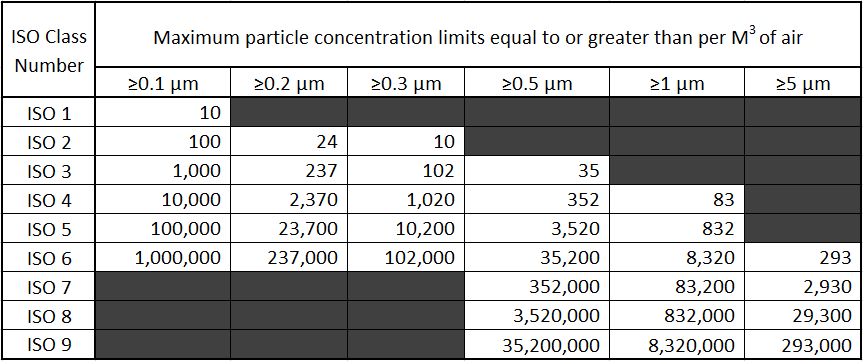
No matter the standard, each is divided into classes. The classes are rated from 1 to 9. The class identifies the maximum limit for particulate size and quantity per cubic meter of air. The chart below showcases the size and the quantity breakdown.

Cleanroom Classification Allowable Maximums.

ISO 9 as you can see is the loosest standard. This standard is equivalent to air quality within a city environment. These environments can fit a multitude of manufacturing and are some of the easiest to achieve and abide by. The opposite end of the spectrum, ISO 1 is the strictest and hardest to maintain. There are three main factors when designing for a clean room. These are surfaces, airflow, and employee access.

When selecting surfaces that will be within the environment it is best to choose a surface that will hold up to the level of use as well as not be damaged by the cleaners or solvents being used to ensure the surface is clean. This should carry over into part fixturing and even machine materials of construction as well. This is not always easy and should be a design element to the process and environment.

Airflow within the room is what helps maintain the concentration levels of particulates. Generally, a clean room is positively pressurized to where the pressure within the room is higher than that outside of the room. This results in a positive air exchange, generally this is provided by the HVAC system. Having a system that does not recirculate the air from inside of the room and a substantial filtration system is key. Another type of airflow that can be found within these environments is a blowoff operation for the part or process. When installing a blowoff within a clean room environment it should be confirmed that the materials of construction are compatible with the environment and cleaning processes and that the airflow will not be introducing particulate into the environment which can result in contamination.

Lastly, employee access should be limited to those employees who are trained and necessary to be within the environment. Sometimes if an employee wears the wrong type of deodorant it can effect an entire environment. Even the wrong type of clothing or soap can alter the state of an environment, let alone using a blowoff incorrectly or bringing the incorrect cleaner inside the cleanroom. Access to these areas should be limited and individuals should be well trained to meet the demands of the clean room.

If you would like to discuss your production environment or blowoff application within a clean room, please contact us.

Brian Farno
Application Engineer
BrianFarno@EXAIR.com
@EXAIR_BF

EXAIR Safety Air Guns – On Promotion Now!

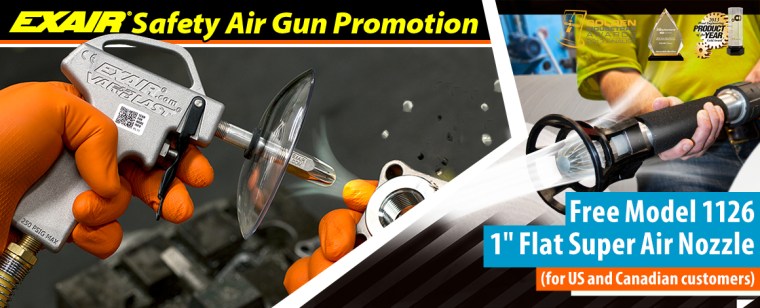
August marks the beginning of our Safety Air Gun Promotion! For a limited time, order any EXAIR Safety Air Gun and receive a FREE Model #1126 Flat Super Air Nozzle with purchase. Head over to EXAIR.com to learn more about our Safety Air Guns and if you have questions or want to learn more, please contact any of our Application Engineers.

EXAIR Safety Air Guns are durable and comfortable to use. Each model uses an engineered Air Nozzle that provides superior performance by entraining large volumes of surrounding air. Safe operation is assured along with low air consumption and noise levels. Airflow that exits the nozzle can not be blocked, as required by OSHA standard 1910.242 (b).

You can see all of our Safety Air Guns and Air Nozzles on our website http://www.EXAIR.com. The following are the different models we carry and a few key points for each:

TurboBlast® Safety Air Gun, are the newest addition to our line and designed for extended use without fatigue during the most demanding applications, which require a huge amount of force to solve. These air guns produce up to 23 pounds of force! The TurboBlast air blow guns can be found removing slag from primary metal manufacturing processes, cleaning pulp from paper manufacturing machines and covering large or distant areas in need of cleanup. The rugged cast aluminum handle is covered with a soft, durable elastomer grip. Low profile trigger button will disengage if release. Our newest Safety gun provides adjustable flow, strong blow off force, 3′ and 6′ extensions and meets OSHA noise and pressure requirements.

Features & benefits of the new TurboBlast Safety Air Gun

EXAIR Safety Air Guns are made to withstand the demands of daily use, meet OSHA standards for noise and safety, CE compliant, designed for extended use and produce high blow off force.

VariBlast Precision Safety Air Gun is extremely lightweight and the most comfortable to operate during long periods of extended use. It features a variable trigger valve which produces varying force levels depending on how much the trigger is activated. The small diameter nozzle and extension will fit into tight spaces while providing strong blowing force.

The VariBlast Precision Safety Air Guns provides the most focused and precision air flow from EXAIR’s smallest engineered air nozzles.

VariBlast Compact Safety Air Gun is a uniquely powerful gun which produces variable force depending on trigger activation. This cast aluminum gun is equipped with any of our 1/8 NPT engineered air nozzles. The VariBlast Compact Safety Air Gun is small, comfortable and powerful while remaining light and ergonomic. It has two inlets for flexible air supply options.

VariBlast Compact Safety Air Gun

Soft Grip Safety Air Gun has a durable cast aluminum body that is suited for rugged industrial use. The ergonomic design has a large trigger for easy operation and a convenient hanger hook for easy storage.

EXAIR Model 1210 Soft Grip Safety Air Gun

Heavy Duty Safety Air Guns are a powerful air gun with a durable cast aluminum body that is best suited for heavy use in rugged industrial environments. The ergonomic composite rubber grip and wide curved trigger can be used for hours without fatigue.

Heavy Duty Safety Air Gun

EXAIR’s selection of Safety Air Guns, with engineered air nozzles, will cover any air gun application in your plant, meet OSHA’s standards for safety and minimize compressed air consumption when compared to similar commercial air nozzles. Take advantage of our promotion to day and receive a free air nozzle.

Eric Kuhnash
Application Engineer
E-mail: EricKuhnash@EXAIR.com
Twitter: @EXAIR_EK

Video Blog: Cabinet Cooler® System Calculator

In may I wrote a Blog Announcing our new Calculator tool on EXAIR.COM! You can read it here!

The Video below will walk you through how to get the information you need to fill the form in, and take you all the way to final where you can add it to your cart!

By providing certain information like size of the enclosure, NEMA rating needed, and environmental conditions, this new calculator will sort through our large selection of ready-to-ship Cabinet Cooler® Systems and provide instant feedback on the best model number for any applicable electrical enclosure.  Taking the guess work out of the equation, EXAIR’s Calculator ensures the customer that they can be confident in selecting the correct product for their unique specifications. You can even Print the form for your records!

If you have any questions or need additional support with the Sizing Calculator please reach out to one of our application Engineers give us a call. Or shoot us an email to techelp@exair.com

Jordan Shouse
Application Engineer

Send me an Email
Find us on the Web 
Like us on Facebook
Twitter: @EXAIR_JS