3 Common Mistakes in Your Compressed Air System

Every day I speak with engineers who are having trouble using compressed air products. A common problem they have is not providing an adequate air supply to their unit. I go through a basic troubleshooting technique to ensure that their pressure and flow rate is adequate. I ask them to install tee on the inlet to the compressed air product in order to install a pressure gauge right at the inlet to the pipe. This allows us to know exactly what pressure we are supplying to the product. Customers are always surprised how the gauge on the compressor or the regulator may read 120 PSIG, but the gage on the inlet to the compressed air product is significantly less.

Last year, my colleague, Russell Bowman, made an excellent video showing how the inlet pressure at the knife will have a significant impact on the performance of the Super Air Knife.  In the video, he changes the length and ID of the compressed air supply to illustrate the difference a proper supply line will have on the performance of a compressed air products.

Not providing adequate air supply is commonly caused by these three mistakes, when plumbing compressed air systems.

1. Incorrectly Sized Piping – This can be the single biggest problem. A lack of planning before installing a compressed air product. Not all compressed air systems are created equal. Though a 1/4″ shop air hose may work for a number our products, some of our products require a larger air line because they require more volume of air to be effective. We often speak with customers an illustrate this problem by stating small air lines are like trying to feed a fire hose with a garden hose – there simply is not enough volume to create the pressure necessary to reach the fire, or solve the application in our scenarios. We publish the flow rates for all of our products and make inlet pipe size recommendation in the installation and maintenance guide furnish with the products so you may avoid this common problem. We also have air data tables in our Knowledge Base or  you may consult an application engineer who will be happy to make the proper recommendation.

2. Quick Disconnects – These handy connectors are great when operating a brad nailer, or a small blow gun, but the small through diameter can severely limit the flow rate into a long air knife, large diameter air operated conveyor, or big vortex tubes.  Due to this fact it is strongly advised to use threaded fittings or over-sized quick disconnects.

3. Adding extra hose or pipe – Extra hose is never a bad thing, right? No, an extra 30 feet of air hose can significantly drop the pressure of a compressed air system. 20 feet of ½ Pipe can flow 70 CFM with a 5 PSI pressure drop.  50 feet of ½” pipe will only flow 42 SCFM with the same 5 PSIG pressure drop. Keep your hose or pipe lengths to a minimum to improve the volume of air you can deliver to a compressed air product.

Dave Woerner
Application Engineer
DaveWoerner@EXAIR.com
@EXAIR_DW

Life Hacking = Better Easier Life. So What Happens When You Hack Compressed Air?

The birth of the internet and personal computer brought to light a new form of hacking.  For many years now hacking has been considered a negative action, even criminal.  However, within the past several years the term lifehacking has come to mean a process of bettering your life through tips and tricks.  There are entire blogs and TED talks about life hacking, so that has gotten me thinking of how can EXAIR hack your compressed air system and turn it into a life hack?

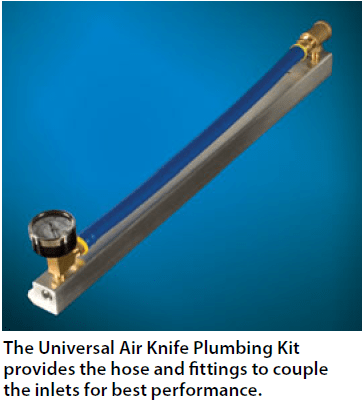
All of our products are designed and engineered to make your life easier and better.  The best product I can think of to demonstrate this is our Super Air Knife With Plumbing Kit Installed.  This is an option for any of our Super Air Knives which are longer than 24″ that makes installation even easier on your end.  The plumbing kit has already connected air to each port on the Super Air Knife so all you have to do is plumb air to a single port at the end of the kit assembly.  See the picture below for a better idea.

Alumina dust 3 PKI

Another item that has helped many customers is our Chip Trapper System.   This is essentially a modified or hacked Reversible Drum Vac System which  adds the benefit of filtering the liquid you are sucking up to a 5 micron level.  (Other filter levels/sizes available.) This means you can make your cutting fluid last longer and cut that rancid coolant smell in your machine shop down because the bacteria in the coolant doesn’t have any solids to live upon.  This also means that you won’t be giving your coolant reclamation company any of your valuable solids so you keep more of your scrap profits.

So if you are looking for a way to make your life easier while you are working with compressed air, let us know, we’ll see how you can hack your compressed air applications.

Brian Farno
Application Engineer
BrianFarno@EXAIR.com
@EXAIR_BF

Troubleshooting 101: Super Air Knife

Yesterday, I was working with a customer on troubleshooting a Super Air Knife. He had brought the knife into EXAIR’s demo room so I was able to verify a few items very easily.  When trouble shooting air knives there are no moving parts, so it is very small list of items to check.

  1. Check the Air Supply

  2. Check the plumbing

  3. Check the inside of the Air Knife for debris

The customer had a 36″ Super Air Knife ,and he was seeing some weak spots in the air flow as well as a gradient in flow from one side of the knife to the other.  The first thing I did was to install a pipe tee with a pressure gauge in both ports on the bottom of the knife.  This would allow me to monitor the pressure we were supplying to the knife to calculate the air consumption and ensure the our piping was not starving the knife for air.

IMG_3735

Feeding the knife with equal pressure from both sides, is necessary for any air knife 24 inches or longer. The customer immediately noticed that the flow from the knife lost any sort of gradient, once it was fed in (2) locations. Still the air knife exhibited a spot in the flow where air velocity significantly decreased.  Since we were getting correct pressure and supplying enough air, we decided to remove the cap from the Super Air Knife.  Under the cap we found a variety of debris and one dreaded piece of PTFE plumbing tape. The plumbing tape was suppose to prevent air leaks throughout the compressed air system, but a piece had become lodged in the air gap of the Super Air Knife preventing air flow through a small portion of the Super Air Knife.  As you can see, once we followed a few simple steps to ensure proper installation of the Super Air Knife, it was quick and easy to narrow down what caused the lack of performance. This is yet another reason to make sure you have clean and dry compressed air, as well as use a point of use filter separator.

Dave Woerner
Application Engineer
Davewoerner@EXAIR.com
@EXAIR_DW

Choices, Choices

This past Sunday was my birthday. I had planned on teaching my 13-year-old son some basics of pitching…but it rained, so instead, he got a lesson in the basics of plumbing, since the toilet in his bathroom needed a new wax ring installed. It actually wasn’t too bad, since I learned something too: I’ve replaced a few toilet seals in my time, but I never knew how easy it was when help was available, especially from a strapping, athletic teenager who’s capable of lifting his half of that awkward, ceramic hulk. When we go to tile that bathroom floor (don’t tell him yet; it’s a surprise…maybe for HIS birthday), this is one task I don’t dread all that much anymore.

You’re probably thinking of a thousand better ways to spend a birthday, and, a thousand times, you would be right. It wasn’t all bad, though: right before we got into the plumbing project, we had lunch with some of our best friends. Since it was my birthday, I got to choose where we went. After making several fast-food suggestions that I KNEW would be unacceptable to my wife, I picked one of her favorite steak joints, and all was well. Medium well, actually…

Speaking of smart decisions, I had the pleasure of helping a new customer with product selection for a cooling application yesterday. There are many, many situations where an EXAIR product can be used for cooling, but it all comes down to two considerations. Is it better to use:

*A small-to-moderate flow of very cold air (like a Vortex Tube), or
*A high volume flow of ambient temperature air?

In this case, they needed to keep a sensitive component in a vision inspection system relatively cool in a very high temperature environment. For that kind of mass heat removal, the obvious answer was an Air Amplifier:  although a Vortex Tube can produce very cold temperatures, when the temperature of the machinery is more than a few hundred degrees, the relative “cool” of room temperature air will do just fine, especially if you can provide a LOT of it.  What (I hope) sells the customer on it is a video we recently became aware of, showing our Adjustable Air Amplifiers being used to cool the exhaust during the testing of the 2014 Corvette’s 450HP V8 engine:

If you have an application requiring a cooling flow of air and aren’t sure which way to go, give me a call. If the Corvette engine video doesn’t convince you, we can even resort to quantitative analysis of your heat load, which is almost as fun. Almost…

Russ Bowman
Application Engineer
EXAIR Corporation
(513)671-3322 local
(800)923-9247 toll free
(513)671-3363 fax
Web: http://www.exair.com
Blog: http://blog.exair.com/
Twitter: twitter.com/exair_rb
Facebook: http://www.facebook.com/exair