The Adjustable Spot Cooler – Cold Air to -30°F (-34°C) From Your Compressed Air Supply

The Adjustable Spot Cooler is a low cost, reliable , maintenance free way to provide spot cooling to a myriad of industrial applications. Simply turn the knob, and the temperature can be changed to suit the needs of the process. The Adjustable Spot Cooler delivers precise temperature settings from -30°F (-34°C) to room temperature.

Adjustable Spot Cooler

The Adjustable Spot Cooler utilizes the Vortex Tube technology that converts compressed air into a cold air stream. To learn more about EXAIR vortex tubes, click here.

  • It can produce temperatures form -30°F to +70°F (-34°C tp +21°C)
  • Parts included for flow rates of 15, 25 and 30 SCFM (425, 708, 850 SLPM.) The unit comes from the factory set at 25 SCFM (708 SLPM)
  • It can produce refrigeration up to 2,000 BTU/hr (504 Kcal/hr.)

A swivel magnetic base allows for easy mounting and portability, you can move it from machine to machine as needed. The flexible cold air outlet tubing holds its position and is easy to aim. Most importantly, there are no moving parts or CFC’s, ensuring maintenance free operation.

asc_onlathecmyk
The Adjustable Spot Cooler maintains critical tolerances on machined plastic parts

How the Adjustable Spot Cooler WorksThe Adjustable Spot Cooler incorporates a vortex tube to convert a supply of compressed air (1) into two low pressure streams, one hot and one cold. With the turn of a knob, the temperature control valve (2) allows some hot air to flow through a muffling sleeve and out the hot air exhaust (3). The opposite end provides a cold air stream (4) that is muffled and discharged through the flexible hose, which directs it to the point of use. The swivel magnetic base (5) provides easy mounting and portability.


The Adjustable Spot Cooler can produce a wide range of air flows and temperatures as determined by the temperature control valve knob setting and the generator installed. The generator controls the total SCFM (SLPM) of compressed air consumption, and is easy to change. From the factory, the 25 SCFM (708 SLPM) generator is installed, producing up to 1,700 BTU/hr (429 Kcal/hr) of cooling. For less cooling, the 15 SCFM (425 SLPM) generator can be installed, providing up to 1,000 BTU/hr (252 Kcal/hr) of cooling. And for more cooling, the 30 SCFM (850 SLPM) generator can be installed, providing up to 2,000 BTU/hr (504 Kcal/hr) of cooling.

Adjustable Spot Cooler Specifications

Two (2) Systems are available as shown below, and include the 15 and 30 SCFM (425 and 850 SLPM) generators, a filter separator, and either a single or dual point hose kit.

Adjustable Spot Cooler Systems3825_3925 adj spot cooler

If you have questions about the Adjustable Spot Cooler or any of the 16 different EXAIR Intelligent Compressed Air® Product lines, feel free to contact EXAIR and myself or any of our Application Engineers can help you determine the best solution.

Brian Bergmann
Application Engineer
Send me an email
Find us on the Web 
Like us on Facebook
Twitter: @EXAIR_BB

Business Benefits Of Compressed Air Efficiency

The primary business benefits of an efficient air compressor system are reduced operational costs, reduced maintenance and increased up-time.  With that being said, is your compressed air system costing you more than you think it should?  Are you having failures, pressure drops, inadequate volume and/or pressure?  You might think from these issues that your system has seen better days and is ready to be replaced.  However, it is possible that your existing tried and true compressor system has more life left in it than you think and with a few simple steps you could have it performing like a champ again!

It is estimated that typically plants can waste up to 30 percent of their generated compressed air and that cost is substantial.  Considering the average cost to generate compressed air is .25 cents per 1000 SCFM, that translates into .075 cents for every .25 cents spent!  Considering that energy costs have doubled in the last five years, it couldn’t be more timely to make your air compressor system more efficient.

So just where is all this waste occurring?  The largest source of compressed air energy waste is from unused or leaked compressed air and that is followed by line pressure drops, over pressurization and inadequate maintenance of the compressor.

So how can you identify this issues in your system?

1). Finding leaks can be accomplished by several methods such as soapy water applied to a suspected joint or connection or the EXAIR Ultrasonic Leak Detector.   It is a high quality instrument that can locate costly leaks in your compressed air system.  When a leak is present and audible tone can be heard in the supplied headphones and the LED display will light.  This testing can be done up to 20′ away so need to get on a ladder!

Leak Detector

2). Pressure drop is caused by is caused by the friction of the compressed air flowing against the inside of the pipe and through valves, tees, elbows and other components that make up a complete compressed air piping system.  If the piping system is to small, the flow (volume) will not be sufficient and the devices will not operate properly.  The volumetric demand would need to be added up to determine if the piping is of sufficient diameter to flow the required volume.  EXAIR’s Digital Flow Meter is an easy way to monitor compressed air consumption and waste.  The digital display shows the exact amount of compressed air being used, making it easy to identify piping that may be undersized.  Installing one on every major leg of your air distribution system to constantly monitor and benchmark compressed air usage is a fast and efficient way to see what your volume through that distribution leg is.

Flow Meter

3). Over pressurization is also an issue, as the pressure is raised to account for high demand periods, system leaks and pressure drops. Unfortunately operating at higher pressures can require as much as 25 percent more compressor capacity than needed, generating wasted air which is called artificial demand.

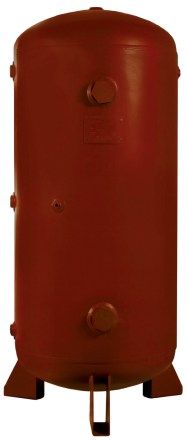
You can reduce the leakage rate by running the compressor at lower pressures. If you’re short on air, don’t turn up the pressure. Run your compressor at no higher pressure than what you process requires. To relieve peak demands on your system consider the EXAIR Receiver Tank.  It store’s compressed air during low usage times and releases it when the demand is increased without working your air compressor system harder.

receiver_tank

4). Finally, a preventative maintenance (PM) program will need to be implemented to keep the air compressor system running properly.  Two items that are often neglected are the drive belts and filters.  Loose belts can reduce compressor efficiency and dirty filters allow dirt to get through the system and cause pressure drops.  EXAIR has replacement elements for our line of filter separators to keep you air clean and line pressure down.

By increasing your awareness of the health of your air compressor system and implementing a PM program you can significantly reduce your costs from wasted energy and avoid costly down time from an out of service air compressor.

If you would like to discuss improving your compressed air efficiency or any of EXAIR’s engineered solutions, I would enjoy hearing from you…give me a call.

Steve Harrison
Application Engineer
Send me an email
Find us on the Web 
Follow me on Twitter
Like us on Facebook


Air Amplifiers – What is an Amplification Ratio?

On Friday my colleague, Russ, blogged about the Super Air Amplifier (see that BLOG here, including a video demo)  In discussing the Air Amplifiers, the topic of amplification was mentioned. Today, I’d like to expand a bit further the amplification aspect of the Air Amplifier performance.

As the name of the device implies, the compressed air used by the Air Amplifier is added to, and thus ‘amplified’, the total output flow of the unit. Depending on the size and type of Air Amplifier, the amplification ratio starts at 12:1 and goes up to 25:1, with the ratio being the output flow to the compressed air usage.

AirAmplifiers.jpg
Super Air Amplifier and Adjustable Air Amplifier

EXAIR offers (2) types- the Super Air Amplifier and the Adjustable Air Amplifier.  The Super Air Amplifier uses a patented shim technology to maintain a precise gap, which controls the compressed air flow and expansion through the unit.  As the expanded air flows along the Coanda profile, a low pressure area is created at the center which induces a high volume flow of surrounding air into the primary air-stream.  The combined flow of primary and surrounding air exhausts from the Air Amplifier in a high volume, high velocity flow.  The larger diameter units have a greater cross sectional area with larger low pressure areas, resulting in greater amplification ratios.

The Below table shows the amplification ratios.

SuperAirAmplifierPerformance

The Adjustable Air Amplifier does not use a shim, but rather has an infinitely adjustable gap, allowing for fine adjustment of performance.  Force and flow is changed by turning the exhaust end to adjust the gap, and is then locked into place. The method of the amplification is the same as for the Super Air Amplifier, and the amplification ratios are similar and shown below.

AdjustableAirAmplifierPerformance

The Super Air Amplifiers and Adjustable Air Amplifiers are ideal for use in applications and processes that require cooling, drying and/or cleaning of parts, or the ventilation of confined areas or weld smoke or the exhausting of tank fumes.

If you have questions regarding the Air Amplifier, or would like to talk about any EXAIR Intelligent Compressed Air® Product, feel free to contact EXAIR and myself or one of our Application Engineers can help you determine the best solution.

Brian Bergmann
Application Engineer

Send me an email
Find us on the Web 
Like us on Facebook
Twitter: @EXAIR_BB

EXAIR Super Air Knives Helps Keep Labels on the Bottles.

Super Air Knife Blower Air Knife

Sometimes you need more power.  I received a phone call from a bottling facility that was currently using a blower style type of air knives.  They increased their production rate from 220 bottles/min to 300 bottles/minute, and they started to see issues in the labeling process.  Their operation consisted of a wash cycle, rinse cycle, drying cycle, then labeling.  They determined that the bottles were not getting dry enough during the drying cycle before the labels were applied.  They had a VFD (Variable Frequency Drive) for the blower system, and they reached the maximum rate.  Still the bottles were not getting dry enough to allow the label to stick to the surface properly.  This meant that they would have to increase the size of their blower system.  With the capital cost of a blower system, they decided to call EXAIR to see if we could help them with the drying application.

Compressed air is the best way for establishing a strong blowing force.  Instead of air pressures in the range of inches of water, the compressed air system can generate over 40 times the amount of pressure than a typical blower system.  EXAIR products uses this power of the compressed air to give you a wide range of blowing forces for drying, cooling, or moving products.  For the above application, I recommended two model 110212 Super Air Knife kits.  The kit includes the Super Air Knife, a filter, a regulator, and a shim set.  They mounted one knife on each side of the bottles to blow off and remove the liquid after the rinse cycle.  Even at the increased bottle speeds, the EXAIR Super Air Knives had no issues in keeping the bottles dry.  With the regulator and the shim, it was easy for them to dial in the correct amount of force without using excess compressed air.  The labels remained glued and the bottling process ran smoothly.  Because the company was impressed by the Super Air Knives, they wanted to comment on the comparisons between the blower knife and the Super Air Knife.

  1. Cost:
    1. Blower System – The reason for contacting EXAIR. Blower-type air knives are an expensive set up.  They require a blower, ducting, and a knife.  To have any flexibility, a control panel with a VFD will be needed.
    2. Super Air Knife – It is a fraction of the cost. With their system, we were roughly 1/10 the cost; even with the kit.  No capital expense report would be needed for the two air knives.
  2. Installation:
    1. Blower System – They stated that it took them a week to install the entire system before they were able to operate. They had to run electrical wires, controls, ducting, and they even had to change the conveying system slightly to accommodate the blower size.
    2. Super Air Knife – They mounted the filter and the regulator on the conveyor, and ran tubing to the Super Air Knives. Even with a fabricator making a bracket to fit into their system, they had the system up and running is less than two hours.
  3. Size:
    1. Blower System – The foot print of the blower is large and it takes up floor space. The 3” ducting had to be ran to an oversized air knife.  With the congestion of the bottle system, it made it difficult to optimize the position and the blowing angle to adequately dry the bottles.
    2. Super Air Knife – With the compact design, the Super Air Knife packs a large force in a small package. It has a footprint of 1 ¾” X 1 ½” X 12” long.  The air knife only required a ¼” NPT compressed air line to supply the compressed air.  It opened up the floor space as well as the bottling area.
  4. Maintenance:
    1. Blower System – The blower filter had to be changed regularly, and system had to be checked. Being that the blower motor is a mechanical device, the bearings will wear and the motor will fail over time.  These items should be checked quarterly as a PM which increase the cost to run the system.
    2. Super Air Knife – No moving parts to wear out. The only maintenance would be to change the filter once a year.
  5. Versatility:
    1. Blower System – They did have a VFD to control the blowing force. But it was still very limited.  With a 36% increase in the bottle speed, they went beyond the maximum capacity of the blower.
    2. Super Air Knife – With a regulator and the shim set, the blowing force can be controlled easily from a breeze to a blast. With their application, the customer only required 40 psig with a standard 0.002” shim to clean and dry the bottles.  They had the option to adjust the regulator or change the shim to get the appropriate amount of blowing force.  So, with any changes in the bottling operations, the Super Air Knife could easily be adjusted.  Also, with the blowing force being optimal from a distance of 3” to 12” from the target, they had more flexibility in angle and distance to hit the moving target.
  6. Quiet:
    1. Blower System – With the blower and turbulent air flow, the units are very loud. It had a sound level near 93 dBA, and with the operators working around the system, they needed PPE to protect them from the high potential of noise induced hearing loss.
    2. Super Air Knife – These units are very quiet. At 40 PSIG, the sound level is only at 61 dBA.  (Even operating at a pressure of 100 PSIG, the sound level is only 72 dBA).  This was very nice for the operators to work around as it wasn’t a constant noise nuisance.

In using the compressed air, the Super Air Knives are engineered to be very efficient.  The design creates a 40:1 amplification ratio which means that for every 1 part of compressed air, 40 parts of the ambient air is entrained.  But, even with the use of compressed air, the customer still wanted to share the ease of installing, the effectiveness of blowing, and the improvements to their process.  With the 6 points noted above, the customer wished that they would have contacted EXAIR at the beginning.

John Ball
Application Engineer
Email: johnball@exair.com
Twitter: @EXAIR_jb